
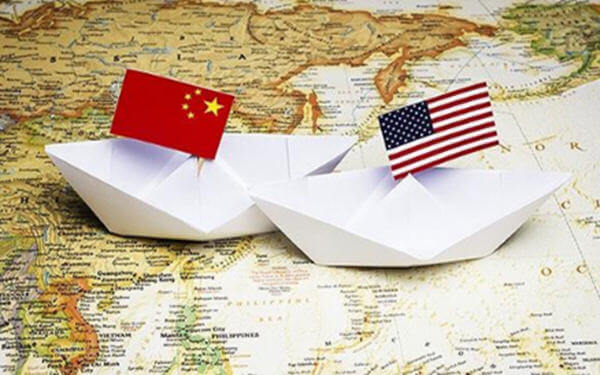
Chinese officials are rushing to finalise new regulations by May that will allow foreign financial groups to take majority stakes in securities companies as they seek to avert a looming trade war with the US.
According to people briefed on the discussions, Beijing has also offered to buy more semiconductors from the US by diverting some purchases from South Korean and Taiwanese manufacturers, in an effort to help reduce annual $375bn merchandise trade surplus with the US.
Last week US president Donald Trump threatened to impose tariffs of up to 25 per cent on $60bn of Chinese industrial exports, in retaliation for allegedly “forcing” foreign companies to transfer technology and other intellectual property in mandated joint ventures.
Beijing subsequently outlined its response to Mr Trump’s earlier threat to impose tariffs on $3bn of Chinese steel exports. The counter-move was intended as a warning that Beijing would respond in kind if Mr Trump proceeded with the much larger action against industrial exports.
The discussions to avert a tit-for-tat trade war are being led by Liu He, China’s vice-premier and President Xi Jinping’s most trusted economic adviser, and US Treasury secretary Steven Mnuchin. On Saturday, China’s official Xinhua news agency said Mr Liu told Mr Mnuchin during a phone call that the US actions were in violation of global trade rules and warned him that Beijing was prepared to defend its interests.
The US Treasury confirmed the call on Sunday, saying that the two men had discussed “mutually agreeable” ways to cut America’s trade deficit with China.
According to the people briefed on the discussions between the leaders of the world’s two largest economies, Mr Liu and Mr Mnuchin have also exchanged letters during the past week about further opening China’s financial services sector and reducing Chinese tariffs on imported cars.
They said Chinese officials had initially been working to allow foreign majority control of securities companies by June 30, but that Mr Liu was aiming for formal State Council approval as early as May.
The liberalisation, which would raise the 49 per cent ceiling to 51 per cent, was first outlined by China’s finance ministry in November. At the time, Zhu Guangyao, vice-finance minister, also said the cap would be lifted within three years.
Chinese officials have told their US counterparts that they would accelerate this three-year timetable — as well as additional plans to ease limits on foreign investment in commercial banks and life insurance joint ventures within three to five years. “But this cannot be done overnight because everything has to go through a process,” said one person close to the negotiations.
Further moves to ease foreign ownership limits in China’s commercial banking and insurance sectors could be revealed next week when Mr Xi addresses the Boao Forum for Asia, an annual meeting modelled on the World Economic Forum and hosted by the Chinese government on the southern island province of Hainan.
It is unclear how Washington will react to Beijing’s proposal that Chinese companies purchase more semiconductors from the US rather than South Korea and Taiwan, because that could drive a wedge between the US and two of its traditional allies in the region. “The US would basically be stealing from their surpluses with China,” one person said.
Over the weekend, senior Chinese officials mingled with global executives at an annual development forum in Beijing, with many of them promising further ambitious — but often vague — market opening moves.
Wang Shouwen, a vice-minister of commerce, said on Sunday that China would also lift or remove restrictions on foreign ownership in the telecom, medical and education sectors.
In his first remarks as the newly confirmed central bank governor, Yi Gang said the People’s Bank of China was committed to opening up the country’s financial sector, adding that Chinese and foreign companies would ultimately receive equal treatment.
But the Chinese government is sensitive to potential criticism at home if it is seen to react too readily to foreign pressure. In a statement on his ministry’s WeChat account on Sunday night, Zhong Shan, commerce minister, said China would alone determine the pace of new opening measures.
Speaking at about the same time in Washington, Mr Mnuchin told Fox News that the US was “not afraid of a trade war” with China and would proceed with its tariff plans if needed.
Source: FT.com