
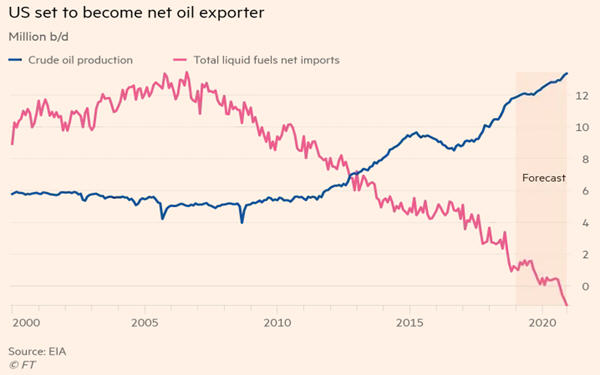
The US will become a consistent net petroleum exporter late next year, the government has forecast, an astonishing shift that reflects surging domestic crude oil production.
The country will ship out more crude oil and liquid fuels than it imports by September 2020 and the net export total will surpass 1m barrels a day by December 2020, the Energy Information Administration said in a monthly energy outlook issued Tuesday.
The prospect raises the stakes for members of the Opec cartel and allied producers struggling to stabilise oil markets in the face of US shale supplies, which can accelerate quickly when prices rise.
West Texas Intermediate crude was trading at $51.73 a barrel in New York on Tuesday, down more than 30 per cent from its peak last year but still a profitable level for leading producers in shale basins.
The EIA forecast, its first short-term projections for 2020, said US crude oil production would rise to average 12m b/d in 2019 and 12.9m b/d in 2020 after breaking historical output records last year, the independent analysis agency said. By December 2020 production would reach 13.4m b/d.
The US will continue to import nearly 5m b/d more crude oil than it exports, EIA said. But growth in simultaneous crude oil exports — helped by the abolition of federal export restrictions in 2015 — and in outbound shipments of refined fuels such as petrol and diesel would cement its status as a net exporter.
The US in late November reported one week in which it was fleetingly a net petroleum exporter for the first time in decades.
The EIA’s new forecast sees that anomaly becoming the norm. The EIA said US gross exports of natural gas will increase by more than half between 2018 and 2020, as exports of liquefied natural gas climb in that period from about 3bn cubic feet per day to 6.8bn cu ft/d thanks to new liquefaction terminals opening along the Gulf of Mexico coast.
Source: Financial Times