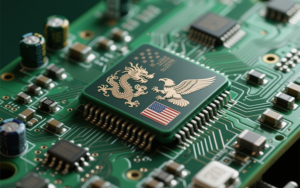
As the curtains rise on the World Artificial Intelligence Conference in Shanghai, Premier Li Qiang has injected a fresh element into the global AI narrative. He announced China’s plan to establish a global AI cooperation organization, with its headquarters nestled in the heart of this bustling metropolis. This move, according to Xinhua, has been packaged as a pioneering step towards fostering international AI collaboration. But in the complex chessboard of global politics and economics, not every move is as it appears.
The initiative, at face value, reveals China’s ambition to position itself as a global leader in the AI arena. But the layers of implications run deeper. This move, as per a Bloomberg analysis, could redirect vital global AI investments towards the Middle Kingdom, potentially reshaping the competitive landscape in the process. For international investors, this proposition carries mixed implications; while it opens exciting investment opportunities, it also raises questions about data privacy and the geopolitical balance of power.
Many Western analysts view this initiative with skepticism, their concerns echoed in a quote from a South China Morning Post article: “If China sets the rules, it controls the game.” This sentiment encapsulates the apprehensions related to international data privacy and China’s increasing stronghold in the AI arena.
Turning inward, Chinese public opinion offers a fascinating study in contrasts. Platforms like Weibo are ablaze with nationalistic pride, as users revel in the possibility of China leading the next wave of technological revolution. At the same time, there’s an undercurrent of suspicion. Concerns about domestic surveillance intensification are voiced, painting a contrasting picture to the triumphant narrative.
Much like the contrasting sentiments within the Chinese populace, international investors face a conundrum. China’s AI initiative could yield significant returns. At the same time, it could also reset the dynamics of the global AI competition, making the investment landscape more volatile. As such, a cautious approach, with close monitoring of the development of this initiative, is recommended.
As we look forward, the AI collaboration organization proposal appears to be a powerful catalyst in the global AI narrative. Investors, policymakers, and AI stakeholders need to closely watch how this initiative unfolds, especially as China gradually rolls out its next Five-Year Plan and navigates the intricacies of State-Owned Enterprise (SOE) reform.
China’s AI ambition is a clear indication of its strategic macro vision. The initiative encapsulates China’s pursuit of technological supremacy while raising critical questions about the future of international cooperation, competitiveness, and privacy. In this unfolding narrative, the key for global stakeholders is to discern the implications and navigate the intricacies astutely.