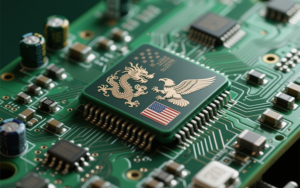

Global markets lurched on tariff headlines, but China’s state lenders quietly dropped a different kind of catalyst in their half-year updates: large language models are moving from pilot to production at scale. While Tesla jumped 6.06 percent and Apple rose 1.55 percent as traders weighed new U.S. tariff threats on India, Europe and pharma, China’s biggest banks detailed hundreds of live AI use cases, hardened risk engines and on-prem compute spines measured in tens of thousands of servers. The takeaway for investors in ICBC 1398.HK, Bank of China 3988.HK, and China Merchants Bank 600036.SS is straightforward: AI is no longer a slide deck. It is a capital program aimed at earnings durability in a choppy macro.
Industrial and Commercial Bank of China says its enterprise LLM stack now powers more than 200 scenarios across 20-plus business lines, with over 100 new AI use cases added this year in personal finance, markets and corporate credit. Postal Savings Bank of China reports 230-plus LLM deployments spanning trading bots and loan decisioning, including robots that run full workflow control on bills and handle bond underwriting inquiries with a reported 95 percent efficiency gain. Bank of Beijing rolled out a consolidated AI architecture linking model ops, compute and more than 300 application scenarios. China Merchants Bank’s consumer assistant now serves over 20 million customers a month while an internal copilot covers all roles bankwide. This is the scale that moves P&L: front-end service, middle-office analytics and back-office workflows stitched together by the same model fabric.
The banks are positioning AI beyond cost takeout. Wealth assistants and research copilots aim to lift fee income per customer, improve cross-sell and compress time-to-quote in capital markets. PSBC’s AI for bond distribution signals real throughput gains in fixed-income origination. Retail assistants at CMB are designed to expand coverage at flat headcount, turning a compliance-heavy channel into a sales funnel with personalization. The pitch to shareholders is that LLMs do not replace bankers; they scale them, nudging higher transaction frequency and wallet share. With net interest margins under pressure and loan growth constrained by property and local government deleveraging, fee-led uplift matters. The faster these copilots become reliable and compliant, the quicker they can contribute to non-interest revenue.
The near-term payback looks clearest in risk. ICBC’s new credit AI agents capture external signals, run real-time risk analysis and speed rule retrieval for credit review. It upgraded credit monitoring and even expanded satellite remote sensing coverage for agriculture exposures, a reminder that China’s collateral and borrower verification problems are not confined to urban real estate. Zheshang Bank added more than 120 risk models this year across retail, supply chain and small business. PSBC processed about 127 million transactions a day through AML engines and deployed knowledge graphs and LLMs to generate suspicious transaction analyses automatically, claiming a 30 percent efficiency lift in human review. It also blocked losses for more than 100,000 potential fraud victims and preserved over 800 million yuan in customer funds. Industrial Bank reported intercepting 5.04 billion yuan in suspected fraud flows. In a year when geopolitics and tariffs can whipsaw cash flows overnight, faster alerting and sharper segmentation can define credit outcomes.
AI at this scale requires iron. Bank of China disclosed roughly 40,000 servers and continued migration to distributed architectures, with hundreds of applications on new platforms. Shanghai Pudong Development Bank highlighted a full-stack domestic compute platform paired with open-source models, kilocard-level accelerators, and a two-city, multi-data-center cloud with more than 35,000 cloud hosts and 275,000 containers. CMB’s cloud availability hit five nines as it pushed an enterprise AI middle platform to lower integration friction. The subtext is strategic: banks are hardening on-prem and China-native stacks to manage regulatory, privacy and sanctions risk. That choice narrows their dependency on restricted foreign chips and software. If Washington expands controls on AI semis or software licenses, these banks want continuity. Trump’s latest tariff barrage and threats on semiconductors only reinforce that calculus.
The spend is real. Compute, storage, model ops and talent will pressure near-term costs, even as efficiency benefits accrue. The ROI math hinges on three variables: reduction in fraud and credit losses, cycle time gains in underwriting and ops, and incremental fee income from better targeting. Early indicators are promising—PSBC’s AML automation and ICBC’s credit review tooling are quantifiable—but reproducibility and model governance matter. Hallucinations in wealth advice or biased credit scoring are not tolerable in a regulated industry. Expect more conservative, retrieval-augmented designs, explainability tooling and human-in-the-loop escalation. Investors should watch cost-to-income trajectories, NPL coverage improvements and model-driven products per active user, not just AI press releases.
This is not a one-quarter sprint. Banks laid out multi-year roadmaps. Industrial and risk platforms are now in all domestic branches at ICBC. SPDB formalized a model evaluation framework and built a knowledge base at reported eight-figure scale in documents. CMB says its AI middle platform is enterprise-wide. PSBC is drafting its next five-year IT plan focused on AI capacity building. Timelines matter because infra-first programs delay P&L. But once platforms stabilize, reuse drives marginal returns. The leading indicators: growth in shared AI capabilities across business units, rising internal API calls per day, and a tilt from bespoke pilots to standardized services.
Trade shocks have refocused banks globally on resilience. In the past eight hours, U.S. policy signals included higher tariffs on India, a 35 percent threat on EU goods, a path to 250 percent on pharmaceuticals, and a coming chip tariff plan. The EU paused retaliation but kept options open. U.S. equities opened higher, crypto rallied, and Palantir hit a record as investors sought analytics and defense themes. For China’s lenders, the message is to fortify balance sheets against exogenous hits. AI-driven early warnings, sector stress testing and supply-chain graphing can compress reaction time when new duties snag exporters or input costs jump. If U.S.-China tech controls tighten further, the banks that already run critical AI on domestic stacks will face less refactoring and downtime, a subtle but real competitive edge.
China’s big banks still trade at depressed price-to-book multiples relative to historical norms. If AI visibly lowers loss ratios and stabilizes fee income, the market may reward the shift with modest re-rating, even without top-line acceleration. The path to that outcome runs through credible disclosures: number of AI-assisted decisions, share of retail interactions handled by copilots, fraud dollars prevented, and time-to-yes in SME lending. Absent proof points, investors will treat AI as expense, not alpha. The banks seem to understand this, with more granular half-year data on model coverage and platform availability. In a year when macro tailwinds are scarce, a defensible, regulated AI stack that pays for itself is the story to underwrite.
China’s banks are building an industrial AI spine under real-world load, not lab demos. ICBC, Bank of China, PSBC, CMB, SPDB and others now talk in hundreds of live scenarios, not pilots, with risk control as the wedge and revenue follow-through in wealth and markets. Compute sovereignty is the design constraint and the advantage. As tariffs and geopolitics inject fresh volatility, the lenders that turn LLMs into faster decisions, lower fraud, and stickier customers will take share and protect returns. The capital is committed. The execution gap will decide who gets paid.