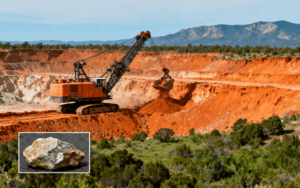
Copper producers and investors love a neighbor. The latest Mining and Markets Podcast puts a spotlight on GSP Resource Corp and its Alwin Project in British Columbia. The pitch is straightforward: a past-producing, high-grade copper system sitting on the fence line of a giant, Teck Resources’ Highland Valley Copper. This is a familiar junior mining playbook—leverage proximity to a major mine to reduce exploration risk, compress timelines, and keep optionality open for a future partnership. It is compelling, but it is not simple. The value hinges on geology, scale, and capital discipline, not just a good postal code.
Alwin sits beside one of Canada’s most important copper districts. Highland Valley Copper is a long-life, low-grade porphyry operation with decades of production, a mature processing complex, and well-understood metallurgy. That matters because brownfields adjacency can de-risk certain pieces of the puzzle. Roads, power, and a trained workforce are not theoretical. The regional geologic model—porphyry copper-molybdenum systems with broad alteration halos, fracture-controlled mineralization, and potential supergene effects—has been mapped and drilled for generations.
For a junior like GSP, proximity can be more than a talking point if the subsurface cooperates. Convergence of structure, intrusive phases, and hydrothermal plumbing at a property boundary can create high-grade zones or feeder structures that are distinct from the low-grade bulk-tonnage ore that keeps a major mill humming. If Alwin can demonstrate continuity, thickness, and a footprint that supports either a small but profitable underground restart or a satellite open pit, the neighbor thesis becomes tangible. Without that, adjacency alone does not pay the bills.
Alwin’s-known history is narrow, high-grade copper veins mined intermittently decades ago—classic underground material, not porphyry-scale volumes. The exploration challenge is clear: can those veins link into thicker zones or a broader, lower-grade shell amenable to bulk mining, or are they isolated shoots that are difficult to model and mine economically at today’s costs? The solution is in the data. Compilation of historic underground mapping and drilling, plus modern core, downhole geophysics, and 3D modeling, can identify whether there is a porphyry-related halo at depth or along strike.
It is encouraging when a junior integrates legacy datasets with current drilling and re-logs old core. That often finds overlooked alteration vectors or late-stage structural controls that can reframe the target concept. But investors should be disciplined about decision-grade evidence. Look for consistent copper intervals over mineable widths, not just narrow spikes. Pay attention to whether mineralization carries molybdenum, gold, or silver credits, which can improve economics. Metallurgy needs to be addressed early in a past-producer scenario; similar mineralogy to the neighbor supports future processing optionality, while deleterious elements or complex mineral associations complicate the story.
Exploration math is as important as geology. In southern British Columbia, all-in diamond drilling costs often land in the 200 to 350 dollars per meter range depending on terrain, depth, and support requirements. A focused 5,000-meter program designed to test extensions, step out on discoveries, and probe deeper porphyry targets can run in the low to mid seven figures. If the target is a porphyry center at depth, the meterage requirement grows fast. Juniors in this position need a defined sequence of holes that can either upgrade the model quickly or cut risk if results do not vector in. Otherwise, equity dilution fills the gap.
The last 24 hours underline this funding reality across the juniors. Dryden Gold raised 7.8 million dollars to push drilling, a reasonable bite for systematic campaigns. Luca Mining is projecting 80 to 100 thousand gold equivalent ounces in 2025 and 30 to 40 million dollars of free cash flow; a reminder that companies with operating cash flow have options in a tight cost environment. If GSP aims to test deeper or expand its drill grid around Alwin, an equivalent financing cadence will matter, and so will spend visibility. Good programs kill bad ideas quickly and concentrate capital on the best targets.
Peer moves give context to the neighbor thesis. Zeus Mining’s push into the Idaho Copper Belt is a geology-first analog strategy, citing similarities to Hercules Metals’ Seven Devils volcanics discovery. Geological parity is not economic parity; the key is proving the local plumbing system delivered metals where they are looking, in thickness and continuity that supports mine design. Super Copper’s acquisition in Chile’s Atacama region buys time-proven copper ground, but Chile’s water constraints and permitting complexity raise the bar for project definition and infrastructure planning. A cheap entry price is not the same as low-cost development.
Aston Bay’s Nunavut Epworth project leans into Kamoa-Kakula-style potential with head-turning chalcocite boulders grading up to 61 percent copper. Spectacular boulders create headlines, but they are float until proven otherwise. The technical bar is mapping transport distance, finding the source horizon, and drilling stratigraphic and structural controls for a sediment-hosted system. Exploits Discovery’s Hawkins property consolidation in Ontario highlights another route: build scale by acreage in a productive camp to ensure you control the system if discovery hits. Each strategy has merit; each requires disciplined testing. For GSP, the neighbor path is narrower—your upside is real if the geology attaches to a major mine trend, and your downside accelerates if it does not.
Brownfields areas often benefit from existing infrastructure and social familiarity with mining, but that does not negate the permitting process. Canagold’s decade-long partnership with First Nations for New Polaris is a sober benchmark. Early, durable engagement pays off in permitting certainty and project longevity. In British Columbia, clarity around disturbance footprint, water management, and closure planning is increasingly front-and-center. GSP would do well to foreground its engagement plan and environmental baseline work as part of its catalyst stack. It signals risk management and can accelerate options if drilling succeeds.
A note of caution: past producers sometimes carry legacy environmental issues. Even if Alwin’s historical footprint is small, baseline studies should verify acid rock drainage potential and metal leaching risks before scale decisions are made. These are not academic exercises; they determine capital needs for water treatment and tailings, and they influence a potential tolling or partnership conversation with a neighbor that must protect its own permits.
Gold’s current price strength is reshaping company focus. Luca Mining’s increased emphasis on gold production is rational in a high-price tape. Copper’s thesis—a multi-year structural deficit driven by electrification and supply inertia—remains intact but requires patience. Highland Copper in Michigan, with feasibility and full permitting, shows how long copper projects take to mature in North America, even with supportive policy around critical minerals. That timescale argues for two things in juniors: a clear runway to catalysts and a project concept that does not need billion-dollar capex to be relevant.
Scandium Canada’s Crater Lake update is a useful contrast. Specialty metals can create outsized value from relatively small tonnages, but market depth and offtake shape outcomes. Copper enjoys market depth and liquidity. The trade-off is competition for capital and a high bar for resource quality. For a neighbor play like Alwin, the most credible value path is demonstrating a resource that is either accretive as a satellite to an existing mill or stands alone with modest capital and robust margins. Low-grade bulk tonnage without scale, or high grade without continuity, will struggle to clear that bar.
For GSP, the next set of de-risking signals is straightforward. First, consistent drill intercepts that move beyond narrow veins into mineable widths, ideally with supportive byproduct credits and clean metallurgy. Second, a credible plan for resource definition—investors should look for steps toward a compliant resource estimate. Without one, valuation stays narrative-driven and sensitive to market mood. Third, clarity on capital needs and program design. If deeper porphyry targets are in play, the company should be explicit about meterage, hole design, and decision points. Fourth, engagement and permitting steps that align with Canadian expectations for social license.
Across the sector, recent moves show money is flowing to programs with defined targets and credible teams. Dryden’s financing, Exploits’ land consolidation, and Canagold’s partnership approach all speak to execution under scrutiny. Copper-focused newcomers like Zeus and Super Copper will need to show that analogs and addresses convert to core that carries. For GSP, being a neighbor to one of Canada’s biggest copper mines is an advantage—but only if the geology and the drill plan press that advantage into data that a major, a lender, or the market can underwrite.