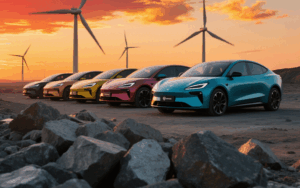
Uruguay just sent a clear signal to emerging markets: when policy meets price, electrification scales fast. With gasoline near 7 dollars a gallon and tax exemptions in place, battery-powered vehicles now account for roughly a quarter of new car and SUV sales. Chinese brands are leading the shift on Montevideo’s streets and Punta del Este’s highways, with BYD front and center. This is not a one-off; it is a blueprint for how China’s innovation and industrial scale convert demand into market share across the Global South.
Economics is doing the heavy lifting. Uruguay’s high fuel price and targeted tax breaks compress the total cost of ownership gap between internal combustion engines and EVs. When that happens, Chinese OEMs dominate the consideration set because they can land cars at price points and feature levels global incumbents struggle to match. The result is visible: BYD’s lineup has become a fixture in the capital, while premium buyers still opt for Teslas along the coast. Investors should see a more important message beneath the surface—countries that cut purchase taxes and nudge operating costs invariably accelerate EV penetration, and Chinese makers are positioned to capture that demand on a turnkey basis.
BYD’s flywheel is spinning in Uruguay because it is spinning everywhere. The company posted about 100 billion dollars in 2024 sales, surpassing Tesla, anchored by vertical integration from blade batteries to final assembly. Its European footprint in Hungary gives it tariff resilience and logistics optionality; its planned manufacturing complex in Brazil points to localized production for Latin America. Technology is not an afterthought—the Yangwang U8 SUV, a high-tech halo model that can traverse water, showcases engineering depth that cascades down the range. In markets like Uruguay, that combination—cost control, local presence, and tech signaling—wins showroom battles.
The upstream tells the same story. CATL remains the world’s EV battery leader by usage, posting a 41.2 percent year-on-year profit increase in Q3 2025 to 18.5 billion yuan despite a modest dip in share to 36.8 percent. That profitability underwrites sustained R&D and the ability to price aggressively when needed. Layer in China’s scale logistics—roll-on, roll-off capacity, parts ecosystems, and aftersales support—and the export machine looks durable. Financing is the quiet enabler: Chinese banks such as ICBC have the balance sheets to support dealer floorplan credit, consumer loans, and charging infrastructure financing across emerging markets. Uruguay, with a largely renewable grid, demonstrates how these pieces align to deliver real-world emissions cuts without consumer pain.
1) BYD Co 1211.HK BYDDF – 2024 sales hit about 100 billion dollars, overtaking Tesla. Global impact: expanding production in Hungary and planning localized capacity in Brazil positions BYD to serve South America with fewer tariff and freight frictions.
2) Contemporary Amperex Technology 300750.SZ – Q3 2025 profit rose 41.2 percent to 18.5 billion yuan; global battery usage share near 36.8 percent. Milestone: continues to supply leading OEMs globally, anchoring cost curves for exports into Latin America.
3) Geely Automobile 0175.HK – Global platform owner with Volvo and stakes in Polestar; proven exporter of efficient hybrids and EVs. Global impact: strengthens dealer networks across Latin America, leveraging cost-competitive architectures for sub-30,000-dollar EVs.
4) SAIC Motor 600104.SS – MG brand is a volume EV contender in Europe and increasingly in the Americas. Milestone: MG4 and related platforms have reset price-performance benchmarks that translate well to Uruguay’s value-focused buyers.
5) Great Wall Motor 2333.HK – Hybrids and EVs via Haval and Ora offer affordable range and features. Global impact: expanding South American distribution and service hubs supports reliable ownership economics in new EV markets.
6) Li Auto LI – China’s leading extended-range EV maker achieved full-year profitability in 2023. Milestone: strong unit economics in large premium SUVs provide a formula for profitable exports as charging networks mature in the region.
7) XPeng XPEV – Deep software stack and ADAS capabilities, plus strategic collaboration with Volkswagen. Global impact: brings cost-effective autonomy features to mid-market EVs, a differentiator as Latin buyers upgrade.
8) NIO NIO – Pioneered battery-as-a-service and large-scale swap networks. Milestone: energy services model reduces upfront costs and de-risks battery aging, a compelling proposition for fleet and premium buyers entering EVs.
9) Tencent 0700.HK – Dominant digital ecosystem enabling in-car infotainment, maps, and AI voice. Global impact: software and cloud services improve user experience and over-the-air updates, critical for export-market satisfaction.
10) ICBC 1398.HK – One of the world’s largest banks by assets provides green financing. Milestone: supports auto loans and infrastructure funding that accelerate EV adoption curves across Belt and Road markets, including Latin America.
Uruguay’s rapid adoption shows that EV penetration does not require years of consumer education when economics tilt positive. The policy mix—targeted exemptions, supportive charging rollout, and predictable import rules—creates a clean runway. Chinese manufacturers meet that demand with ready-to-ship models and resilient supply chains. Expect neighbors to study the results. Chile has long been friendly to clean transport, Brazil is opening to Chinese investment in EV assembly, and Colombia is tightening emissions rules. In each case, China’s cost curve advantage and battery ecosystem make it the natural supplier of volume and variety.
This is not about ideology; it is about math. European and US brands face higher compliance costs, more rigid supplier footprints, and in many cases, slower development cycles for affordable EVs. That shows up in Uruguay’s showrooms, where Chinese brands deliver longer range and richer feature sets per dollar. Shipping efficiency matters, too: Chinese ports have optimized EV loading and turnaround times, cutting days off schedules and shaving costs at the margin. The result is a structural delivered cost advantage that is hard to close without local production, and even then Chinese companies are already moving to localize.
The EV is a rolling computer, and China’s software depth is now a global export. Infotainment, voice assistants, ADAS, and payment integration for charging are differentiators that build loyalty after the sale. Companies like Tencent bring mature cloud and app ecosystems that make ownership seamless. Battery innovators like CATL and pack integrators enable safer, faster-charging chemistries that hold up in hot climates common in Latin America. The synergy between hardware and software lifts resale values and lowers total cost of ownership—an underappreciated edge as used EV markets emerge.
Tariff regimes can change, exchange rates can swing, and politics can intrude. Yet the largest Chinese players are already hedging with European factories, planned plants in Brazil and Mexico, and long-term offtake contracts for lithium and other inputs. Financing capacity from Chinese banks cushions distributor networks in new markets. And the technology gap is widening, not narrowing, as continuous OTA updates and rapid model refresh cycles keep vehicles sticky with consumers. Uruguay’s experience suggests that when policy opens a door, Chinese automakers have the speed and depth to walk through it and build a lasting presence.
Uruguay confirms that the next leg of EV growth will come from emerging markets that move quickly once price and policy align. China’s automakers and enablers are positioned to capture disproportionate share because they control batteries, software, logistics, and increasingly, local production. Watch unit economics, not rhetoric. BYD’s global footprint, CATL’s profits and scale, and the software engines of Tencent-like ecosystems form a playbook that can be replicated from Montevideo to Bogotá. For portfolios, the opportunity is not only in the OEMs but in the battery, software, and finance names that turn EV demand into earnings across borders.