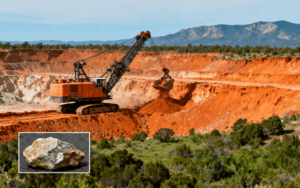
Anfield Energy’s order for eight underground haul trucks from Young’s Machine is a straightforward signal: Velvet-Wood is moving from planning to execution. For a junior, committing to long-lead, specialized gear is one of the few hard tells on schedule and intent. Delivery slated to begin in Q2 2026 puts a rough outer bound on the development cadence and offers a way to track progress against what remains a complex hub-and-spoke uranium restart strategy centered on the Shootaring Canyon Mill.
Equipment procurement drives the critical path for underground start-ups because trucks, loaders, jumbos, ventilation, and electrical gear all have multi-quarter lead times and must be sequenced. The decision to standardize on Young’s 960-series trucks from a local Utah vendor brings two advantages: lower logistics friction and better parts support. A uniform haulage fleet tends to raise availability, simplify training, and shrink spares inventory. None of that guarantees on-time startup, but it pulls one major risk lever in the right direction. A scheduled first delivery in Q2 2026 implies mine development and rehab should be well underway through 2025 and early 2026. Investors can now benchmark claims against a vendor delivery schedule rather than generic timelines.
The trucking headline is a piece of a bigger bet: feed sourced from Velvet-Wood and other spokes will need a central mill. Anfield’s strategy relies on restarting the Shootaring Canyon Mill to avoid toll milling and to capture processing margins. That is logical on paper, given the scarcity of U.S. licensed uranium mills and the fixed cost leverage a mill brings as throughput grows. The gating item is not trucks. It is permitting, refurbishment, and capital to re-commission a mill that has been idle for decades. Recent federal and Utah approvals noted by the company help, but a construction green light is not the same as a fully funded, permitted restart. Until Shootaring’s license status, refurbishment scope, and cost-to-first-feed are disclosed in bankable detail, the mill remains the key risk to any 2026-2027 production target.
Colorado Plateau uranium-vanadium deposits have historically been mined by room-and-pillar in tabular sandstones, which favors low-profile, agile equipment over large, high-speed trucks designed for big headings. In that context, a fleet of small, narrow-width units reduces development dimensions, lowers ground support requirements, and keeps ventilation demand manageable. Equipment standardization can lift mechanical availability five to ten points in small mines, enough to materially impact tonnage delivered to the ore pass. Pairing local build support with simplified maintenance protocols matters because downtime in a small fleet scales directly into missed tonnes and higher unit costs. The business logic here is sound: match the fleet to the geology and geometry, then reduce complexity wherever possible.
Velvet-Wood’s roots in past production are a plus. Historic output of roughly 4 million pounds U3O8 and 5 million pounds V2O5 in the 1970s-1980s shows the ground can produce, and uranium-vanadium co-product credits can help offset costs when vanadium prices are supportive. A 2023 PEA pointing to positive production potential is a start, but investors should remember that PEA-level work is preliminary and sensitive to price assumptions and operating rates. Recent confirmation drilling at JD-7 and planned underground drilling at other Paradox Mine Complex sites indicates ongoing resource definition work, which is critical. Tight drill spacing improves mine design, reduces dilution, and supports a credible production plan. The best signal to watch is not only headline grades but how those grades reconcile with modeled widths and tonnages once development advances into ore.
The first trucks arriving in mid-2026 do not equate to immediate production. Ahead of that, Anfield must complete mine rehab, install ventilation and power, commission dewatering, secure explosives and ground support supply, and staff up underground operations. On the processing side, Shootaring will need a defined refurbishment scope, contractor bids, a construction schedule, and a commissioning plan. Each step adds capital and timeline risk. The company’s reference to a hub-and-spoke ramp to as much as 3 million pounds per year of uranium sets a high bar. To get there, Anfield will likely need phased capital deployment, staged spokes, and firm offtake to support financing. Expect working capital to rise with inventories and development metres. Watch for whether the truck order includes staged payments or vendor financing—useful tells on balance sheet flexibility.
Sourcing trucks from Young’s Machine in Monticello is good operational hygiene. Proximity should allow faster warranty support and better alignment of specs to actual ground conditions. It also ties the company to Utah-based manufacturing, which is politically and practically helpful as domestic nuclear fuel supply gains attention. Still, none of this replaces the need for substantial capital to restart a mill, develop multiple underground spokes, and carry a workforce to cash flow. Juniors often sequence procurement to catalyze investor interest and demonstrate momentum. In this market, where investor sentiment on small-cap miners remains mixed, tangible progress can open doors to equity, debt, or strategic partnerships. The trade-off is dilution if equity fills the gap before cash flow. Clarity on capex, funding sources, and offtake will matter more than fleet branding.
Uranium prices have recovered meaningfully from the pre-2020 trough, and U.S. policy has tilted in favor of domestic supply resilience. That backdrop supports the concept of restarting conventional mines in the Four Corners region, particularly those with existing infrastructure and a path to processing. Even so, the economics will hinge on realized pricing and contract coverage rather than spot optimism. Producers with signed term contracts, clear conversion and enrichment paths, and firm delivery schedules are best positioned to finance restarts. ISR operators in Wyoming and Texas can move faster with lower upfront capex, while Energy Fuels’ White Mesa Mill gives that firm optionality. Anfield’s differentiator is a potential second U.S. uranium mill at Shootaring—but that is also the single largest execution risk on its plan.
This truck order is a real milestone, but it is one of many. Near-term, look for detailed Shootaring refurbishment plans, permit and license updates, a definitive schedule, and capex breakdowns. Underground, track development metres advanced, ventilation raise completion, water inflow management, and any first-pass reconciliation of grade versus model in test stopes. On the commercial side, watch for offtake agreements, project financing terms, and the delivery schedule for the Young’s fleet. Red flags would include slippage of equipment deliveries, cost inflation outpacing guidance, limited contract coverage, or reliance on repeated small equity raises to bridge capex. If Anfield hits its engineering and financing marks while the uranium contract market stays constructive, the hub-and-spoke model can work. The trucks are a necessary step, not a sufficient one.