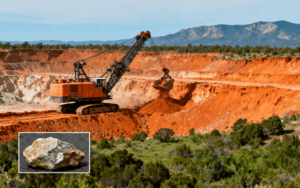
Mining Weekly put eyes on ore at surface from West Wits Mining’s project, 15 km west of central Johannesburg. That visual matters in a sector full of slides and promises. Moving gold-bearing rock from underground to surface is the first hard proof of access to ore horizons. It does not equal steady-state mining, but it moves the project from concept to early execution. With gold prices firm and majors buying ounces, the timing is favorable. The execution test now begins.
A stockpile of ore indicates the decline or access infrastructure is cutting into mineralized reef and that basic logistics are functioning. The next questions are the ones that drive value: what is the sustainable hoisting rate, how consistent are grades against the resource model, and where will the material be processed. Early development ore is often lower grade due to dilution from opening up access drives. Grade control must tighten as stopes are established. Investors should look for reconciliation updates between channel samples, development faces, and the block model. Without consistent reconciliation and a processing route, a pile of ore is a milestone, not a margin.
West Wits sits in the Witwatersrand Basin, a mature gold camp where tabular conglomerate reefs host the metal. These paleo-placer systems often deliver lateral continuity over long distances, which helps mine planning and reserve conversion when the geology is well constrained. The reefs are narrow, which can enable selective mining and lower dilution if stopes are managed tightly. The tradeoff is geotechnical complexity. Faulting can offset reef elevations, old stopes can break continuity, and ground stress at depth increases seismic risk. The operating recipe that works here is consistent geology, close-spaced sampling, and disciplined narrow-reef mining to protect head grade.
Proximity to Johannesburg brings roads, power lines, a skilled labor pool, and equipment suppliers. That is a real cost and schedule advantage over frontier greenfields. It also brings legacy issues from over a century of mining. Old workings can act as water conduits and create unexpected voids. Dewatering is not optional in this basin; it is central to safety and productivity. Acid mine drainage in the region adds regulatory scrutiny to water management. Security is another practical factor. Illegal mining around historic shafts is a known risk on the West Rand. Robust access control, ventilation integrity, and community engagement are not soft issues here—they are core to uninterrupted production.
Power reliability remains a primary operating risk. Underground mining depends on ventilation, pumping, and hoisting. Any load curtailment or outage has immediate safety and productivity impacts. A firm plan for backup generation or guaranteed supply agreements can mitigate this. On the positive side, a weak rand versus the US dollar tends to support margins for South African producers because revenue is dollar-linked while most costs are in local currency. That tailwind is strongest when gold rises faster than domestic inflation in wages, consumables, and security. Watch for updates on Eskom supply arrangements, on-site power contingencies, and cost guidance in rand terms to judge the true margin profile.
Ore on surface raises the question: where will it be treated. Building a new plant adds capital and permitting complexity. Toll-milling through an existing plant limits capex and speeds cash flow but often comes with recovery tradeoffs and fees. The right answer depends on ore characteristics—grind, liberation, and whether any refractory behavior emerges—as well as nearby plant availability. From a financing perspective, lenders focus on reserve-backed life of mine plans, proven metallurgy, and offtake certainty. Investors should look for a definitive processing solution, detailed reserve conversion from the current resource base, and a binding funding package. Those steps convert a visible stockpile into bankable ounces.
The broader tape is accommodating. Majors continue to buy de-risked ounces. Fresnillo’s move to acquire Probe Gold for $556 million and its 10 million ounces in Canada underscores a preference for scale and jurisdictions with predictable rules. Equity markets are leaning into the gold trade. Canada’s S&P/TSX composite was lifted by a stronger materials group as gold moved back above 4,000 dollars an ounce, improving sentiment and access to capital across the sector. But the capital is selective. It is flowing to projects that shrink execution risk: permits in hand, clear processing, credible mine plans, and near-term cash flow. West Wits is positioned to benefit if it can show that sequence.
China’s end of a gold tax break effective November 1 introduces a demand-side variable. China is a top consumer of physical gold. Any policy that changes retail demand or import dynamics can alter premia and, in the short term, price volatility. For project economics, that argues for stress testing at lower gold prices even in a bullish tape. Narrow-reef underground mines are sensitive to grade variability and unit costs; a 5 to 10 percent price swing can be the difference between free cash flow and breakeven early in a ramp-up. Management discipline on dilution control and cost containment is the best hedge against policy-driven price chop.
Elsewhere in the juniors, de-risking is the common thread. Denarius Metals completed 7,225 meters of surface infill drilling at Zancudo in Colombia, targeting upgrades from Inferred to Indicated resources. Reported intercepts at Los Albertos included multiple high gold and silver grades and confirmed continuity along the main structure. That is the sort of work that lowers resource uncertainty and supports mine design. Results from Las Brisas are pending. For West Wits, the parallel is clear: convert ounces into mineable reserves and show repeatable production steps. The market is rewarding juniors that replace talk with measured, verified progress.
Key catalysts are practical. First, a processing path—toll treatment terms or a plant decision with capital, schedule, and metallurgical detail. Second, reserve conversion and grade reconciliation between model and mined ore as stoping begins, not just development faces. Third, evidence of power reliability and water management plans sized to historic workings. Fourth, safety and security metrics that reflect operating control underground. Fifth, funding on terms that do not erase equity value before cash flow arrives. Each update will tell you whether the visible ore marks a controlled ramp-up or a one-off photo op.
West Wits is trying to restart gold mining in one of the world’s most prolific basins, within sight of a major city. The geology is well understood, the workforce is local, and infrastructure is close. Those are real advantages. The red flags are not abstract: power reliability, legacy water and voids, security, and the need for a clear processing and financing plan. With gold firm, majors acquisitive, and investors rewarding de-risking, the window is open. Converting ore on the pad into consistent ounces with clean reconciliation is the step that will decide where this project sits on the risk curve.