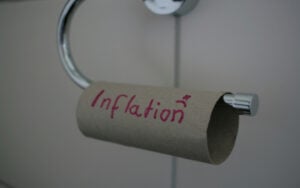
The market is not afraid of Kevin Warsh. It is afraid of discovering how much of its prosperity was borrowed from the future. Stocks and Treasuries fell together on the prospect of a Warsh-led Federal Reserve, a reminder that one assumption has underwritten nearly every asset for a decade: that the price of time would keep falling. When that premise wobbles, portfolios built on it wobble too. The moves in the dollar and gold were not stray signals; they were a stress test of a system that has taken cheap money as a constant.
The headline move was simple. US equity futures dipped while Treasuries sold off as traders adjusted to a chair candidate perceived as less supportive of deep rate cuts. Under the surface, something more important showed up. Equities and bonds dropped in tandem. That correlation shift is the tell. The modern 60-40 portfolio depends on bonds rallying when stocks fall. It has mostly worked since the late 1990s as inflation trended down and central banks suppressed volatility. But when the policy regime is uncertain and inflation risk is not dead, both legs can slip at once. We saw it in 1994’s bond rout. We saw it in the 2013 taper tantrum. We saw it again in 2022. A chair perceived as hawkish is just the spark; the tinder is the accumulated bet that duration hedges always show up. That is not a law of markets. It is a conditional relationship that fails precisely when you most need it. In engineering terms, resonance is the enemy. If a bridge sways to the frequency of the wind, one more gust does not stabilize it.
Markets have put a premium on chair personality for 35 years. Call it the Fed Put by face. Greenspan to Bernanke to Powell, the assumption has been that drawdowns elicit easing. That pattern trained investors to overweight liquidity over productivity. Warsh, a former Fed governor from 2006 to 2011, built a reputation as a skeptic of post-crisis asset purchases. Whether or not he would be a relentless inflation hawk is beside the point. The market hears fewer cuts and reprices everything that leaned on falling discount rates. That means long-duration equities in technology, venture, and real estate, where cash flows sit far in the future and are sensitive to the price of capital. It also means business models that rely on cheap rollover risk. Corporate treasurers who extended maturities are safer; those who didn’t face refinancing into a headwind. Investors often mistake a regime for a trend. They extrapolate the last decade’s easing reflex and forget that rates are not a monorail; they are a pendulum in a political economy. In game theory terms, anchoring to a dovish player changes your best response. Change the player, the equilibrium moves.
Prediction markets had the odds of a Warsh nomination jump from about 15 percent to more than 40 percent within hours of political chatter. That is a rational repricing of a binary event. It is not certainty. The problem is that portfolios often behave as if precision in odds equals precision in outcomes. A shift in the expected chair changes the distribution of future policy paths more than it changes any single point forecast. Investors tend to build point-estimate portfolios because that is how spreadsheets work. Real risk is distributional. There are scenarios where fewer and slower cuts make the system sturdier by reducing the chance of unanchored inflation. There are others where slower cuts expose duration fragilities in banks and balance sheets before nominal growth has a chance to heal them. Think of 2023’s regional bank stress, when unrealized losses on held-to-maturity securities suddenly mattered. Policy is a sequence, not a one-off. A higher path for rates extends the life of those unrealized losses. It also forces capital allocation to refocus on return on invested capital over momentum. In probability terms, the variance went up. The mean matters less than the tails.
A stronger dollar and weaker gold on the Warsh chatter suggest the market is pricing a Fed that prioritizes inflation control over aggressive easing. There is an irony here. Near-term tighter financial conditions often lower longer-term macro risk. That tradeoff is unpleasant for portfolio marks but good for credibility. Still, the global plumbing reacts. A firmer dollar tightens conditions for anyone who borrowed in dollars without natural hedges. Emerging markets have seen this movie. So have US firms with overseas revenues. Domestic rate-sensitive sectors will not be spared. Real estate lives on cap rates and the weighted average cost of capital; technology with long-dated cash flows lives on the discount rate. If cuts are fewer or later, cap rates need to reflect a higher real hurdle. Some analysts call Warsh a safe choice for investors relative to alternative candidates. The market’s reaction says the safety many investors have priced is a belief in the central bank’s willingness to cushion every fall. That is not safety. It is moral hazard. A robust system does not care who the chair is. A fragile one does.
When bonds and stocks drop together, you learn who added leverage to boost returns in a low-vol world. The last 15 years rewarded duration and financial engineering. Buybacks at low yields looked smart. Private markets priced assets off compressed spreads and cheap debt. The arithmetic changes when the marginal cost of capital does not fall on schedule. Companies with variable cost structures, flexible inventories, and genuine pricing power can adapt. Those with fixed costs and maturity walls cannot. Banks with longer-duration securities books can withstand a patient rate-cut path only if deposit betas do not spike again. In 2022, the illusion was that accumulated paper losses did not matter. In 2023, we learned the hard way that liquidity and confidence can make paper losses real. A Warsh-led Fed, if it means less eagerness to cut into every drawdown, resurrects an old corporate discipline: earn your return, do not borrow it.
The negative correlation between stocks and bonds since the dot-com bust gave asset allocators a free hedge. It was an era defined by disinflation, global supply integration, and central bank dominance in the volatility market. That world broke in 2022 when inflation surged and policy chased it. Today’s wobble on a chair headline is a reminder that correlation is a regime variable, not a constant. In classical terms, we confused an equilibrium outcome for a law. Goodhart’s Law lurks here: when a measure becomes a target, it ceases to be a good measure. Target a stable stock-bond hedge, and the very policies that delivered it (suppressing rates, buying duration) create new fragilities. The next regime, whether run by Warsh or anyone else, will not restore the old correlation on command. If inflation risk is two-sided and fiscal impulses remain noisy, both stocks and bonds can be risk assets at the same time. That is uncomfortable. It is also honest.
The nomination fight reopens the question of Fed independence. Markets like the idea of an apolitical central bank that maximizes credibility. They also like easy money. You cannot always have both. A chair that leans more toward inflation control sends a signal to fiscal authorities: the central bank will not as readily monetize policy mistakes. In game theory, firming one player’s strategy changes the other’s incentives. The Burns to Volcker history lesson stands. It took pain to re-anchor expectations. No one is arguing for a re-run of 1980. But the belief that easing will be deployed on a market timetable is a habit that needs breaking if you want an antifragile economy. The immediate mark-to-market pain from such a signal is the cost of buying real options on future stability. Long dated assets will dislike it. Savers and productive capital will not.
The lesson is not to bet on or against Warsh. The lesson is to stop making portfolios that only work if the chair behaves a certain way. In nature, systems survive by having redundancy and slack, not by optimizing for last season’s weather. In finance, that means balance sheets that can absorb a higher cost of money, operating models that produce cash without subsidy, and capital allocation that prices risk honestly. It means acknowledging that precise probabilities in prediction markets are not plans. They are inputs to scenarios. The market did not sell off because the wrong person might take the job. It sold off because it remembered, briefly, that the price of time matters. If your strategy breaks on a headline about who sets that price, the problem is not the headline. It is the strategy.