
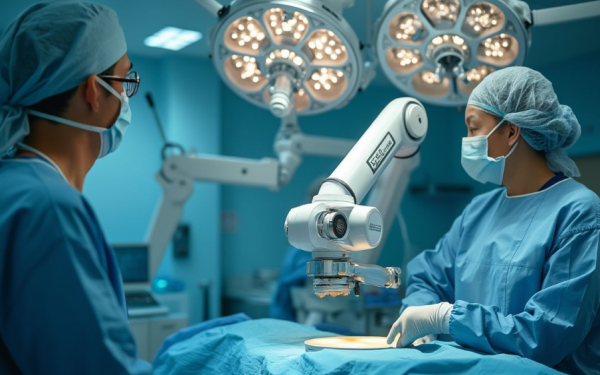
Despite pandemic disruptions and macroeconomic headwinds, Intuitive Surgical (ISRG) has outperformed both operationally and in stock returns over the past five years. However, with Medtronic’s Hugo system gaining FDA clearance and Johnson & Johnson’s Ottava advancing toward approval, the longtime robotics leader now faces an increasingly competitive field.
Can Intuitive Surgical maintain its dominance through the next half-decade? And does the bullish investment thesis still hold?
At the heart of Intuitive’s strength is its da Vinci robotic-assisted surgery platform. In 2024, the fifth-generation da Vinci 5 received regulatory clearance—a milestone that represents not just a technological upgrade but a key growth engine for the coming years.
Over the next five years, the system is expected to evolve through software updates and expanded surgical indications, incorporating real-world data and surgeon feedback. This should drive further adoption, increasing both the installed base and procedural volume.
Intuitive’s business model thrives on this dynamic: the majority of revenue comes from instruments, accessories, services, and training tied to its systems. More placements lead to more procedures, which in turn fuel recurring revenue from consumables and support. The rollout of da Vinci 5, alongside the continued use of earlier generations, forms the dual pillar of the company’s near- to mid-term growth.
The competitive landscape is indeed shifting rapidly:
Yet the robotic-assisted surgery market remains underpenetrated. New entrants could help accelerate overall adoption, expanding the market rather than merely dividing it. In this expanding arena, Intuitive benefits from more than two decades of clinical experience, a large installed base, and an established training ecosystem—factors that create significant switching costs for hospitals.
For healthcare providers, replacing a robotic system involves not only capital investment but also retraining staff and adapting clinical workflows. This inertia gives Intuitive considerable customer retention power, while new competitors face an uphill battle against its entrenched ecosystem.
Two key factors support Intuitive’s sustained leadership:
While competition will undoubtedly intensify over the next five years, Intuitive Surgical’s multi-layered advantages—continuous innovation, deep clinical data, a loyal provider network, and high switching costs—position it to remain the formidable leader in robotic surgery.
For investors, the story is not about absence of challenges, but about a company equipped to defend and extend its moat in a high-growth, dynamic market. The golden age of surgical robotics is just unfolding, and Intuitive Surgical remains the map-holder in the race ahead.