
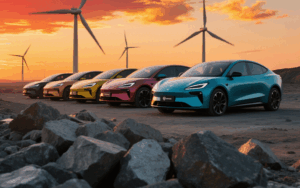
Tesla’s China shipments rose 9 percent year over year in January, the third straight monthly gain and a clear tell on where EV demand is resilient. Even as several local makers saw a soft start to 2026, including a nearly one-third drop at BYD, the bigger takeaway is unchanged: China’s electrification engine is still setting the global cost curve and exporting vehicles, components, and software at scale. For investors, the signal is not about one company’s print. It is about a system advantage built on manufacturing intensity, policy alignment, and AI-driven platforms that compound with every product cycle.
A third consecutive month of shipment gains from Shanghai cuts through the noise on pricing headlines. The world’s largest EV production base is again proving that throughput and logistics consistency matter more than monthly discounts. China’s EV complex turns capacity into cash flow by filling both domestic and export pipelines. Shanghai’s plant is an export hub to Europe, the Middle East, and Asia, reinforcing that the marginal EV delivered globally still originates in China. The January beat confirms that order books tied to affordable power electronics, LFP battery ubiquity, and reliable ports stay intact. When a global brand’s China factory outperforms in a choppy month, it validates the country’s role as the anchor of EV supply and a bellwether for downstream suppliers and platforms.
Short-term volume swings at individual brands do not change the industry’s structural math. China’s vertical integration from cathode to inverter produces sustained unit cost advantages that competitors struggle to match. BYD’s January dip follows a year where it sold roughly 3 million new energy vehicles and cemented its status as the world’s largest NEV maker by volume. That kind of scale takes the edge off promotional cycles and preserves R and D cadence. Meanwhile, battery and power electronics makers clustered around the Yangtze River Delta and Pearl River Delta keep lowering costs per kilowatt hour, which feeds back into pricing, export competitiveness, and faster technology diffusion to emerging markets. The ecosystem wins because every link in the value chain learns and iterates at global volumes.
China’s EV and tech manufacturers are leaning into the export channel to smooth domestic seasonality and extend brands. The playbook is well known: build at scale in China, ship complete vehicles and kits to Europe, Southeast Asia, the Gulf, and Latin America, and localize where volume proves durable. The fact pattern is supportive. Shanghai, Shenzhen, and Ningbo ports are moving a rising mix of finished vehicles and energy electronics, while Chinese platforms are exporting not only products but also software, payments, and logistics standards. For investors, this is about diffusion. Every unit shipped abroad anchors aftermarket demand for charging, software, content, and fintech services. That multiplier effect is why a single positive China delivery datapoint should sharpen focus on the wider basket of China-exposed names across EVs, AI, cloud, and logistics.
Beijing’s innovation policy has been consistent: scale the infrastructure, let competition push costs down, and back AI to drive utilization. The buildout of charging networks, autonomy testing zones, and 5G backbones lowers the friction for new products and services. That matters because the next leg of margin in EVs will come from software attach, ads inside mobility ecosystems, and payments. The same applies to internet platforms that run manufacturer-to-consumer logistics, cross-border marketplaces, and cloud workloads for automakers. AI is the connective tissue across these domains, accelerating ad yield, route planning, energy management, and customer service. In capital markets terms, China’s policy architecture creates operating leverage for companies at the intersection of electrification and software.
1) BYD Company (1211.HK) – Worlds largest NEV maker by volume, with about 3 million NEV sales in 2023; vertical integration in batteries and semiconductors stabilizes margins through cycles; global impact note: accelerating NEV adoption in emerging markets via accessible price points.
2) Baidu (BIDU) – Robotaxi services have expanded from Wuhan to Hong Kong and Dubai, a milestone that puts commercial autonomy in sight; AI stack is exportable across mobility and cloud; global impact note: advancing autonomous mobility standards beyond China.
3) Alibaba (BABA) – Rated the fifth-largest AI company in 2020; Alibaba Cloud underpins regional enterprises and smart mobility workloads; milestone: entrenched in China’s digital infrastructure with a growing AI services mix.
4) Tencent (0700.HK) – Unmatched consumer network effects across social, gaming, payments, and media drive mid-teens revenue growth and double-digit net profit growth; AI is lifting ad yields; global impact note: content and fintech rails that travel with Chinese brands overseas.
5) PDD Holdings (PDD) – Temu’s rapid expansion across Europe, the Americas, and the Middle East is reshaping retail price expectations; manufacturer-to-consumer logistics compresses costs; milestone: cross-border GMV momentum tied to China’s factory network.
6) JD.com (JD) – A nationwide logistics backbone that lowers fulfillment cost per order and delivers same or next-day to major cities; global impact note: bonded warehousing and cross-border shipping link Chinese manufacturers to world consumers with fewer intermediaries.
7) NIO (NIO) – Premium smart EV maker known for innovation in service models; battery-as-a-service and swap stations increase customer stickiness and utilization; global impact note: pushing a software-first ownership model in EVs.
8) iQIYI (IQ) – Online video platform with a deep slate of originals; monetization and licensing travel with China’s growing diaspora and global streaming partnerships; milestone: building recurring subscription revenue tied to domestic and overseas audiences.
9) TAL Education (TAL) – K-12 edtech provider with a tech-centric operating model; global impact note: digital learning tools developed at scale in China can be adapted to other high-population markets.
10) Huawei (private) – 5G and energy electronics deployments are foundational infrastructure that lower unit data and power costs across multiple continents; milestone: integrated power and telecom gear that supports EV charging, cloud, and industrial IoT.
In a market recalibrating for earnings quality, operators that compound free cash flow through cost leadership and platform effects should command a premium. January’s CPCA-style delivery snapshots can be volatile, but the market tends to reward companies that demonstrate pricing power through unit economics, not just promotion. Export mix, backlog visibility, and software monetization metrics are the tells. With global investors still underweight China’s on-the-ground operating assets in EVs and AI, positive datapoints from production hubs like Shanghai often precede flows into the broader China basket, not just the headline name.
Focus on cost per kilowatt hour, inverter and drivetrain gross margin, charging network density, and software attach rate per vehicle. For the platforms, AI-driven ad yield, cross-border GMV, logistics cost per order, and cloud utilization are the handles. Watch autonomy milestones such as new city approvals and paid ride volumes for robotaxi players. In e-commerce, time-in-transit and return rate trends reveal the durability of price-led expansion. These are the numbers that convert headlines into sustained rerating.
Tesla’s third straight month of shipment growth out of China confirms that the country remains the world’s scale-up factory for next-gen mobility. It also validates the strategy of stacking manufacturing advantages with AI-native platforms and policy-built infrastructure. Investors do not need to pick a single winner. The stronger play is to build exposure across the electrification flywheel: the OEMs that set the price, the platforms that move the goods, the clouds that run the models, and the networks that power the data. The 10-stock slate above spans those nodes. With exports broadening and unit costs falling, China’s innovation machine is not just competing globally; it is defining the standard for how the next trillion dollars of value will be created in EVs, AI, and digital infrastructure.


