
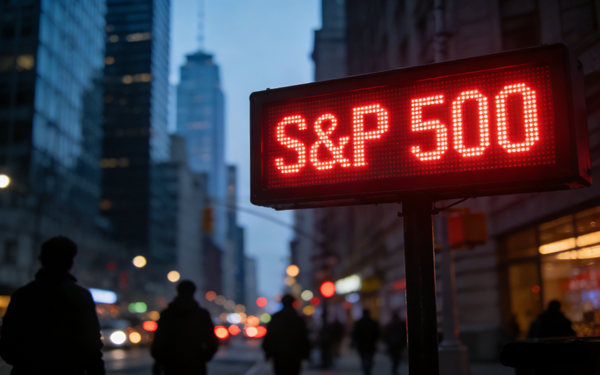
U.S. stocks briefly rose in early trading Wednesday following robust jobs data but ultimately gave back gains, with the three major indexes closing mostly lower. Concerns that artificial intelligence technology could disrupt multiple industries weighed on market sentiment.
The S&P 500 ended slightly lower after approaching its record closing high during the session, subsequently erasing all gains. The Nasdaq 100, which has a higher weighting in technology stocks, rose 0.3% after climbing as much as 1% earlier. The Cboe Volatility Index (VIX) hovered around 18.
Mark Hackett, Chief Strategist at Nationwide, noted that the post-jobs report rally itself was surprising, as recent market focus has been more on the Federal Reserve than economic fundamentals. He pointed out that the recent sell-off has been concentrated in the tech sector, continuing a rotation trend seen in recent months where international stocks and value stocks have led gains.
An index tracking the “Magnificent Seven” megacap tech stocks fell 0.6%, while software-related ETFs dropped sharply by 2.6%. Over the past week, the sector has been under pressure due to concerns about AI technology disrupting traditional software business models, prompting capital to rotate toward companies perceived as less vulnerable to AI substitution.
Real estate services stocks also weakened Wednesday, becoming the latest sector swept into the “AI panic trade.” Jade Rahmani, analyst at Keefe, Bruyette & Woods, noted that within the past two weeks, investors had successively reduced holdings in software, private credit, wealth management, and insurance brokerage stocks. CBRE Group (CBRE.US) tumbled 12%, while Jones Lang LaSalle (JLL.US) and Cushman & Wakefield (CWK.US) also declined.
Louis Navellier, Chief Investment Officer at Navellier & Associates, believes growth and momentum stocks are currently under the most pressure, mainly due to market expectations that interest rates will remain higher for longer. He pointed out that the stronger the job market, the harder it is for yields to fall, creating a classic “good news is bad news” situation.
Data released by the Bureau of Labor Statistics, delayed due to a government shutdown, showed nonfarm payrolls increased by 130,000 in January, the largest gain in over a year, while the unemployment rate unexpectedly fell to 4.3%. Following the jobs report, traders generally priced in the first rate cut of the year for July, compared to previous expectations for June or earlier.
Market attention has now shifted to the Consumer Price Index (CPI) due Friday. JPMorgan’s trading desk anticipates that if core CPI comes in near or below expectations, the S&P 500 would have a 70% probability of rising.
Lindsay James, analyst at Quilter Investors, stated that the Fed is likely to maintain current interest rates, while Fed Chair nominee Kevin Warsh may face pressure from the Trump administration to cut rates in the future. She described the current U.S. market as a “kaleidoscope of contradictions and collisions”: on one hand, growth expectations have been revised upward; on the other, household finances are under strain, with lower-income consumer groups showing signs of cutting back on spending. She added that with relevant 2025 data significantly revised downward, investors may not rush to place bets based solely on a single month’s jobs figures.