
Southern Silver Exploration Corp. (TSXV: SSV, SSEV: SSVCL, OTCQX: SSVFF)
Southern Silver, a low-risk junior development company with substantial upside potential that is emerging as one of the premier Ag-Pb-Zn companies in Mexico

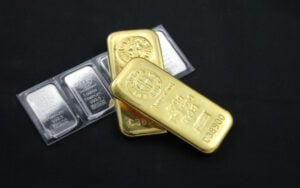
Shares of Barrick Mining Corporation (B), a globally renowned gold mining company, extended their decline on Thursday, dropping 6.7% as of 2:00 PM Eastern Time, marking their third consecutive session of losses. The immediate catalyst for this decline was clear: gold prices plunged 5.6% on the day to $4,614 per ounce, while silver prices fared even worse, tumbling 7.8% to settle at $71.41 per ounce.
Gold prices have now fallen for nine straight trading days. Concerns that rising oil prices could fuel inflationary pressures are prompting investors to shift towards interest-bearing bonds rather than gold, which yields no interest. Since hitting a recent high of $5,242 per ounce on March 10, gold prices have accumulated a decline of approximately 11.5%. However, over the same period, Barrick Mining’s stock price has dropped by 18.3%, a discrepancy that has drawn attention.
A deeper analysis reveals that the decline in silver prices has been far steeper than Barrick’s stock price. Since peaking at $89.59 per ounce on March 10, silver prices have fallen by 20.3%. Given that Barrick mines both gold and silver, its stock price shows a higher correlation with silver, suggesting the market is currently valuing it as a silver stock rather than a pure-play gold stock.
As one of the world’s largest gold mining companies, Barrick Mining operates in 17 countries and is also a significant copper producer. A key characteristic of the company is its focus on “Tier One” mine assets. Barrick defines a Tier One mine based on three criteria: annual production exceeding 500,000 ounces; a remaining mine life of at least 10 years; and total cash costs positioned in the lower half of the industry cost curve. These mines are expected to provide a relatively stable supply of low-cost gold and copper, ensuring the company can remain profitable even during periods of low prices.
The substantial cash flow generated by its Tier One mines enables Barrick to implement an attractive dividend policy. In 2026, the company announced a new dividend strategy targeting the distribution of 50% of its annual free cash flow. The implementation consists of two parts: a base dividend, which was increased by 40% for 2026, and a supplemental dividend paid based on annual performance. The final total dividend payout may be higher or lower than the 50% target, depending on factors such as cash flow, capital requirements, and balance sheet strength.
Regarding production expansion, Barrick continues to invest in the exploration and development of new mines and the expansion of existing ones. These projects are helping the company steadily increase its output: gold production is projected to grow from nearly 3.3 million ounces in 2025 to between 3.4 million and 3.75 million ounces by 2029; copper production is planned to increase from 220,000 tonnes in 2025 to between 255,000 and 285,000 tonnes by 2028.
The ongoing decline in the stock price has pushed Barrick’s valuation into an attractive range. Based on Thursday’s closing price, its price-to-earnings (P/E) ratio stands at just 13.8 times, while offering a compelling dividend yield of 4.2%. More notably, analysts generally anticipate that the current weakness in gold and silver prices will not persist. Based on forecasts for a rebound in precious metal prices next year, Barrick’s forward P/E ratio has already fallen to around 10 times.
For investors bullish on the long-term prospects of precious metals, the current price correction in Barrick Mining’s stock may present a noteworthy entry opportunity.