
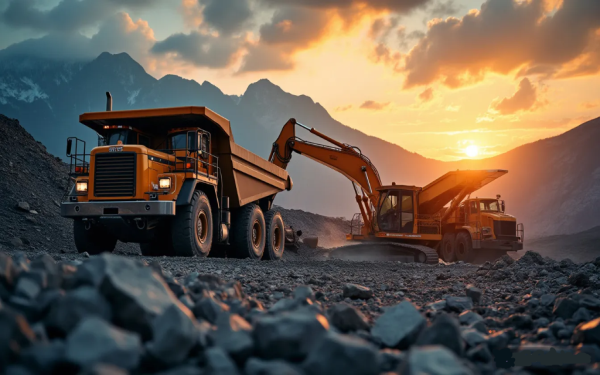
When most people think of Caterpillar (CAT), the image that comes to mind is unmistakable: bright yellow excavators, bulldozers, and massive mining trucks rumbling across construction sites. As an iconic giant in the heavy machinery industry, Caterpillar’s portfolio has long been synonymous with earth-moving. But in 2025, as the artificial intelligence revolution reshapes the global economy, this 100-year-old industrial powerhouse is quietly playing a role you might never expect—it has become the “shovel seller” for the AI age.
The company’s latest earnings tell the story of a business firing on all cylinders. In 2025, Caterpillar generated $67.6 billion in sales and delivered adjusted earnings per share of $19.06. Even more telling for the future: its backlog surged to a record $51 billion by year-end. That mountain of unfilled orders suggests 2026 will be another banner year. So what’s driving the yellow giant? The answer lies not just in traditional housing starts or road repairs, but in a wave of new demand born from the AI era.
First, Caterpillar’s core business isn’t slowing down—it’s actually getting a tailwind from the global push to “reshore” manufacturing. As companies move production closer to home markets, they need new factories and supporting infrastructure. Since 2020, spending on manufacturing construction in the United States has jumped more than 40%. While the pace has cooled slightly from its peak, absolute spending remains historically high. That translates directly into orders for Caterpillar’s earth-moving equipment. In the fourth quarter of 2025 alone, global sales to construction industries rose 11% year over year.
If reshoring is the bread and butter, AI data centers are the new growth avenue. As tech giants race to build out the computing power required for artificial intelligence, they’re pouring billions into new facilities. Since 2020, spending on data center construction in the U.S. has soared by nearly 350%. While the total dollar volume still lags behind manufacturing, the growth rate is staggering—and the need for heavy machinery is non-negotiable. Every new data center requires graders to level the ground and dozers to lay the foundation. Caterpillar’s familiar yellow machines are becoming a standard feature on AI’s physical construction sites.
But Caterpillar’s connection to AI goes far beyond building shells. The company has a quieter but critical business line: power generation. Its massive generator sets can supply prime power in remote locations or serve as instant backups when the grid fails. For an AI data center, electricity isn’t just a utility—it’s the lifeline. Power costs account for a huge slice of operating expenses, and reliability is paramount.
Caterpillar’s generators address two core pain points. First, when a data center is built far from existing grid infrastructure—or in an area with insufficient capacity—Caterpillar’s equipment can provide temporary or even permanent prime power, allowing the facility to come online faster. Second, when the grid flickers or fails, its backup systems kick in seamlessly, keeping servers humming and preventing costly downtime or data loss. With global electricity demand projected to rise 43% between 2023 and 2030—and data center power consumption expected to jump 200%—Caterpillar’s power business is stepping out of the shadows. It’s evolving from a backup option into a critical enabler of the AI-driven economy.
Of course, Caterpillar isn’t without its blemishes. Precisely because its AI-adjacent growth story is so compelling, the stock has already run up significantly. Currently, Caterpillar trades at a price-to-earnings ratio of around 37—far above its five-year average of roughly 19. For investors accustomed to valuing Caterpillar as a cyclical industrial, that multiple is tough to swallow. And it’s worth remembering that Caterpillar’s business is inherently cyclical; a downturn in the macroeconomic outlook or a shift in sentiment could trigger a sharp pullback.
The Caterpillar of today is no longer just an excavator company. It’s a backstop for traditional infrastructure, a builder of AI’s physical footprint, and a guardian of the power supply that keeps the digital world running. In the great AI gold rush, Caterpillar is participating in the most time-honored way possible: by selling the shovels—and the generators.