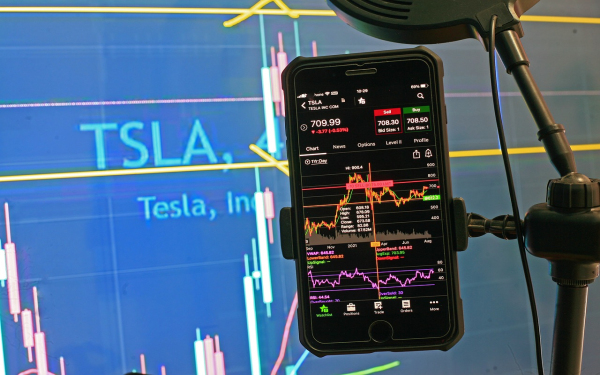
Tesla (TSLA), once the undisputed darling of the capital markets, is now facing a serious test of investor confidence. The company’s stock has pulled back approximately 20% from its 52-week high as of the latest close, extending a sluggish start to the year that has left many latecomers sitting on losses.
Amid the selloff, CEO Elon Musk is once again waving the flag of his “future vision,” pinning the company’s next act on artificial intelligence, humanoid robots, and robotaxis. But with sliding sales and slashed profits as the current reality, can these ambitious promises really pull Tesla out of its nosedive?
Tesla’s fundamentals are flashing warning signs. The latest earnings report shows the company’s sales fell 3% year-over-year last quarter, bringing a decade-long streak of rapid growth to a halt. More alarming is the deterioration in profitability: net income for the fourth quarter of 2025 came in at just $840 million—a staggering 61% drop compared to the same period last year.
As global competition in the EV space intensifies, particularly from the rise of Chinese domestic brands, Tesla’s market share is facing unprecedented pressure.
Facing a slowdown in its core business, Musk has swiftly shifted the narrative. In recent public statements, he has reframed Tesla not as a car company, but as an “AI and robotics company.” The vision Musk paints includes a global fleet of Robotaxi self-driving taxis and mass production of Optimus humanoid robots, targeting an output of one million units per year.
These ventures are being positioned as the next high-margin growth engine for Tesla, and they currently serve as the core story propping up the company’s stock price.
However, a vast commercial chasm separates the ideal from reality. Even under the most optimistic forecasts, large-scale deployment of robotaxis and robots is years away and faces immense technical, regulatory, and cost-related hurdles.
The more immediate issue is that Tesla’s automotive business is hitting a growth bottleneck, and these new ventures are a classic case of “far water cannot quench near thirst.” Investors are confronted with an awkward truth: the company still relies on selling EVs to make money, but the moat around that business is narrowing.
Even after the sharp decline, Tesla’s valuation remains breathtakingly expensive. The stock currently trades at a forward price-to-earnings ratio of over 350, far exceeding the S&P 500’s average of around 25. This suggests the market is still paying a premium for a future that has yet to arrive.
Simple math reveals the challenge. If Tesla’s valuation were to contract to the broader market’s multiple over the next decade, its earnings per share would need to grow at a compound annual rate of 31% just for the stock price to remain flat. This calculation exposes a harsh reality: the current share price has already priced in overly optimistic expectations.
Even Musk himself has acknowledged that there is no definitive timeline for when autonomous driving and robotics will mature. For the average investor, betting on Tesla at this stage is tantamount to a gamble. A decade from now, the company could either be the king of autonomous mobility or a footnote in a crowded, competitive industry. This level of uncertainty makes long-term investment decisions incredibly difficult.
Tesla undoubtedly possesses an innovative culture and the halo of Elon Musk. But investing cannot be built on faith alone. With deteriorating fundamentals, unproven new business lines, and a valuation that still defies gravity, blindly buying the dip looks more like catching a falling knife. For risk-averse investors, there are plenty of growth stocks with clearer near-term visibility and more reasonable valuations to choose from. Whether Tesla can navigate its way out of this slump with its AI and robotics narrative remains to be seen. Until then, caution appears to be the more prudent path.