As the calendar ticks toward January 1, 2027, procurement officials at the Pentagon are staring down an unprecedented supply chain crisis. On that date, any weapons system containing Chinese-sourced rare earths—from the F-35 fighter jet to the Javelin anti-tank missile—will be barred from U.S. military procurement.
The problem? The Western world has spent the past three decades dismantling its ability to convert rare earth ores into military-grade metals. And right now, one NASDAQ-listed company—REalloys (NASDAQ: ALOY)—stands alone in the breach.
REalloys’ story begins with a fact that most observers still miss: the geopolitics of rare earths isn’t about who owns the mines. It’s about who controls the processing. China commands roughly 90% of the world’s rare earth processing capacity. That means even if you dig ore out of the ground in the United States, it still has to travel to China to become usable metal and magnets.
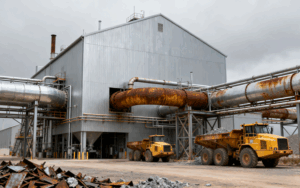
Rather than chasing mining permits, REalloys went straight for the most exposed joint in Western supply chains: metallization and alloy production. The company operates a metallization facility in Euclid, Ohio, where it converts rare earth oxides into defense-grade alloys and magnet-ready inputs. More critically, it holds an exclusive offtake agreement with the Saskatchewan Research Council (SRC), locking in 80% of the output from North America’s only operational rare earth separation plant that touches zero Chinese inputs at any stage.
The strategic logic bears repeating: feedstock from North America, Brazil, Kazakhstan, and Greenland; separation in Canada; metallization in the United States. Every link in the chain—chemical reagents, graphite electrodes, AI control systems—contains no Chinese capital, no Chinese technology, and no Chinese chemicals. In the rare earth industry, that translates to a simple equation: 1% reliance on China is 100% vulnerability.
The loss of rare earth processing capability over the past two decades wasn’t just about equipment. It was about knowledge. China didn’t just build the world’s largest separation capacity; it cultivated an entire generation of process engineers and skilled operators. Every time Western companies tried to rebuild, Beijing’s price weapon intervened. In the early 2000s, again in 2010-2011, and once more in 2015-16—each time Western investment gained momentum, China flooded the market and collapsed the economics.
2020 marked a turning point. That year, China passed its export control law, explicitly prohibiting the sale of rare earth processing technology to countries it didn’t consider friendly. The SRC was forced to design its separation equipment and control systems from scratch. The result was unexpected: an intelligent production line that achieves higher purity with fewer workers. In a typical Chinese separation plant, 200 workers move through a maze of chemical tanks, manually adjusting valves. At the SRC facility, six engineers plus an AI system receive thousands of data points per second and make all optimization adjustments automatically. The system not only bypassed Chinese technology restrictions—it delivers superior output.
REalloys’ Ohio facility draws on nearly a decade of R&D support from the U.S. Department of Energy and Department of Defense. From concept to commissioning, this combined effort took close to ten years. A competitor starting from zero today, even with unlimited capital, would need three to seven years just to reach the starting line. 2027 is less than nine months away.
There’s a deeper logic to REalloys’ positioning: it’s locked into heavy rare earths. Light rare earths (neodymium, praseodymium) go into consumer electronics and commercial EV motors. Heavy rare earths (dysprosium, terbium) define the ceiling for military-grade magnets. Add just a small percentage of dysprosium, and the temperature resistance of an NdFeB magnet jumps from 80°C to over 200°C—precisely what F-35 engines, missile guidance systems, and advanced drones require. Without heavy rare earths, the modern precision-strike complex simply stops working.
Global heavy rare earth resources are far scarcer than light ones, and they are almost entirely controlled by China. Through its SRC agreement, REalloys has secured a stable source of dysprosium and terbium. Phase one production is expected to come online in early 2027, at roughly 400 tonnes of metal per year, scaling to 600 tonnes by late 2028. That may represent only a fraction of total defense demand, but it is currently the only confirmed non-Chinese source. More significantly, the company’s Phase 2 plan targets 20,000 tonnes per year of heavy rare earth permanent magnets—at which point REalloys would become the largest refined dysprosium and terbium producer outside China.
The Pentagon’s ban covers the entire chain: mining, separation, melting, and final product. Any stage with Chinese exposure disqualifies the whole system. Every defense contractor—Lockheed Martin, Raytheon, Northrop Grumman—must now find a qualified, non-Chinese supplier. And rare earth processing capacity takes five to seven years to build.
Japan’s foresight now looks prescient. The Japanese government began building strategic reserves of processed rare earths decades ago, while private companies quietly stockpiled years of consumption. The United States and Europe? Zero stockpiles. Both have been running on just-in-time supply from a country that issues rare earth export licenses on a monthly basis. When China briefly restricted exports in 2023, a Ford plant shut down almost immediately. When Trump threatened 100% tariffs, China’s counter-threat—no more processed rare earths—made the White House back down.
Washington has finally noticed. The U.S. Export-Import Bank has issued a $200 million letter of interest to back REalloys’ supply chain expansion. The company’s board reads less like a corporate roster and more like a national security briefing: the president of GM Defense, a former four-star general and Vice Chief of Staff of the U.S. Army, the former premier of Saskatchewan, the president of Palantir Canada, and executives from Raytheon and Boeing. That lineup reflects both the project’s strategic sensitivity and a clear path to defense contracts.
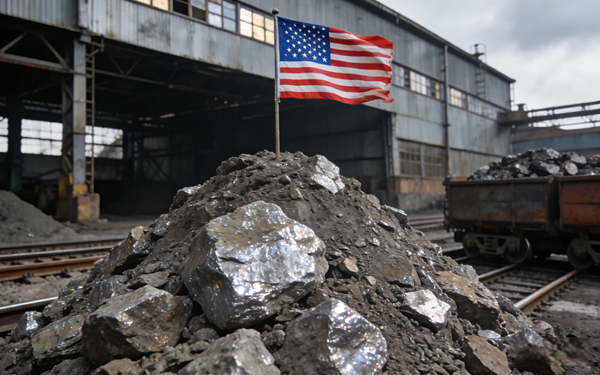
REalloys’ head of R&D, Andy Sherman, has a phrase that captures the company’s positioning: “Concentrates are commodities. Materials are commitments.” The Pentagon doesn’t buy rocks. It buys certified, military-grade materials. Mining rights alone are meaningless—you must possess the capability to turn ore into commitment.
That’s the fundamental distinction between REalloys and every other rare earth story. It doesn’t mine. It doesn’t promote exploration fantasies. It has planted itself in the most difficult-to-replicate, most time-consuming part of the chain: processing. While competitors are still discussing feasibility studies and financing rounds, REalloys has already locked in North America’s only non-Chinese separation capacity, is operating its own metallization facility, and holds confirmed defense industrial base contracts.
As January 1, 2027, draws closer, the eyes fixed on REalloys’ output will only widen. For the U.S. defense supply chain, this company isn’t one option among many. It is currently the only option.