USA Rare Earth (Nasdaq: USAR) has taken a decisive step toward becoming a vertically integrated Western rare earths champion. The Oklahoma-based company announced Thursday a definitive agreement to acquire all outstanding shares of Texas Mineral Resources Corp. (OTCQB: TMRC) in an all-stock transaction valued at approximately $73 million.
The deal gives USAR 100% economic ownership and sole operational control of the Round Top heavy rare earth and critical minerals project in West Texas — widely considered the richest known deposit of its kind in North America. The acquisition simplifies governance of the asset and aligns strategic decision-making under a single operator as USAR accelerates its push to build a non-China supply chain from mining through magnet manufacturing.
Shares rose about 1% in pre-market trading following the announcement. But for investors watching USAR, the question is no longer about control — it’s about valuation. With full ownership of a Tier 1 strategic asset now secured, does the risk-reward calculus favor buying, holding, or waiting on the sidelines?
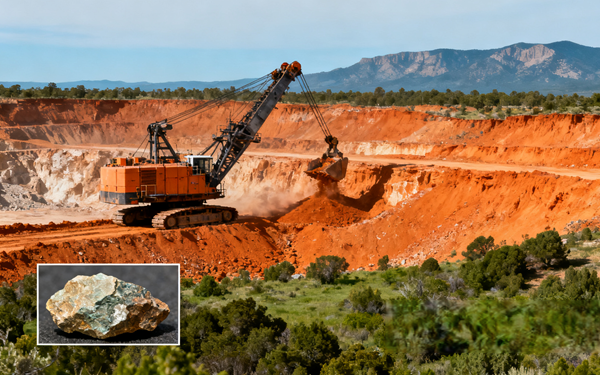
Round Top sits on approximately 950 acres of Texas state land leased from the Texas General Land Office, with prospecting rights to an additional 9,345 acres. The deposit is rich in heavy rare earth elements (including dysprosium and terbium), gallium, germanium, and lithium — minerals critical to defense systems, renewable energy, semiconductors, and advanced manufacturing.
Currently, China dominates global rare earth supply, and the U.S. lacks large-scale domestic mining and processing capacity. That dynamic gives Round Top strategic weight beyond its commercial potential — a point Texas Land Commissioner Dr. Dawn Buckingham emphasized in the deal announcement.
“A well-capitalized, American-owned company now has full control of developing the largest heavy rare earth deposit in the country,” Buckingham said. “That means good-paying jobs for West Texans, critical royalty revenue for our Permanent School Fund, and a major step toward ending America’s dangerous dependence on China.”
USAR’s broader plan is to build an integrated “mine-to-magnets” platform anchored by Round Top. The company has hired Fluor Corp. and WSP Global Inc. as engineering, procurement, and construction management partners to advance feasibility studies and infrastructure development. Under its Accelerated Mining Plan (AMP), commercial production is targeted for 2028, with daily throughput reaching 40,000 tons of rare earth and critical mineral feedstock by 2030. Downstream capabilities will include rare earth oxide separation, metal making, and sintered neodymium-iron-boron (NdFeB) magnet manufacturing.
The strategic narrative is reinforced by Washington’s support. In January 2025, the U.S. Commerce Department agreed to back a $1.6 billion debt-and-equity financing package in exchange for a 10% stake in USAR. Proceeds are earmarked for developing Round Top and the company’s magnet plant in Stillwater, Oklahoma, which is expected to begin production in the first half of 2026 with annual capacity of 5,000 tons of sintered magnets.
That facility would make USAR one of the few U.S.-based producers capable of scaling permanent magnet output — a critical component for electric vehicles, robotics, and defense platforms. The government’s involvement signals bipartisan continuity on critical minerals policy. Former President Donald Trump invoked emergency powers last year to accelerate permitting for domestic projects, and the current administration has maintained similar urgency.
From an investment perspective, full ownership of Round Top eliminates coordination risks with minority stakeholders and streamlines capital allocation. TMRC previously held an 18.6% interest in the project, which, while non-controlling, could have complicated future funding or operational decisions. That overhang is now gone.
The deal structure also avoids cash burn: USAR issued approximately 3.83 million shares (roughly 3% of current outstanding stock) to TMRC shareholders, limiting dilution while consolidating the asset.
The “mine-to-magnets” thesis now rests on three pillars: the largest U.S. heavy rare earth resource, federal funding, and downstream magnet capacity. That closed-loop narrative supports USAR’s current market capitalization north of $4 billion. If Round Top reaches commercial production, revenue potential is substantial. TMRC previously estimated, using 2019 pricing, that the project could generate around $400 million annually over a mine life exceeding 20 years.
Yet risks are significant — and for some investors, they may outweigh the upside.
First, development timelines and capital costs remain uncertain. While USAR has secured initial government funding, full development of Round Top will require billions more for mining infrastructure, water treatment, and environmental systems. The total undisclosed investment likely exceeds current estimates, and any cost overruns or delays could pressure the stock.
Second, technical risk is real. Round Top’s ore body is unconventional, requiring a specialized leaching process that has not been proven at industrial scale. USAR says pilot testing is complete, but commercial-scale extraction introduces new variables — both technical and environmental — that could disrupt timelines or economics.
Third, valuation. USAR is pre-revenue. The Stillwater magnet plant is expected online this year, but production ramp-up will take time. Round Top itself is at least two years from commercial output. A $4 billion market cap for a pre-revenue miner is not inexpensive, especially compared to established producers like Lynas Rare Earths (market cap ~$4 billion, with steady production and cash flow). USAR’s valuation implies aggressive growth expectations, leaving little room for disappointment.
For long-term investors willing to bet that U.S. policy support for domestic critical minerals will endure and that USAR can execute on its 2028 production timeline, the current valuation may offer strategic entry points. The Round Top acquisition removes governance friction and strengthens the core asset narrative.
But for traders or those seeking near-term returns, caution is warranted. Between now and commercial production, numerous milestones — definitive feasibility study results, subsequent financing rounds, and magnet plant performance — will test the thesis. At $4 billion, much of the optimism may already be priced in.
In mining, the gap between owning an asset and monetizing it is often wide and deep. USAR has secured its boat. Whether it can cross the river remains to be seen.