
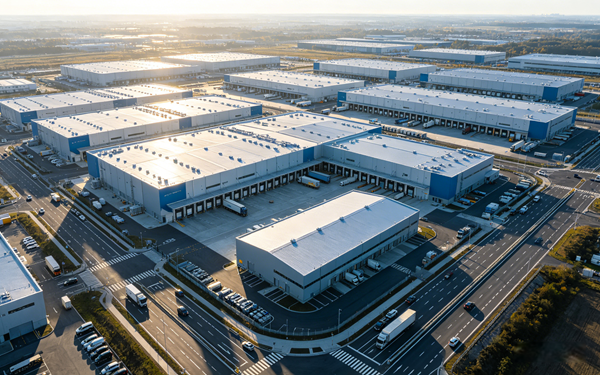
Industrial real estate has quietly become one of the steadiest corners of the market, underpinned by the same forces reshaping retail and logistics. As e-commerce penetration deepens and supply chains move toward just-in-time models, a handful of U.S.-listed REITs are seeing sustained demand for warehouse, distribution, and storage space.
Below are four industrial and self-storage REITs that combine market values above $9 billion, dividend yields of at least 3%, and positive returns so far this year.
Prologis is in a league of its own. The company owns or operates roughly 1.2 billion square feet of logistics and industrial space, making it not only the largest industrial REIT but the largest publicly traded REIT in the U.S. by market capitalization. Its tenant roster includes Amazon and FedEx — names that typically sign longer-term leases for large blocks of space, which helps keep rollover risk low. With land scarce and construction costs elevated in core markets, the barriers to entry remain high, reinforcing Prologis’s scale advantages.
Public Storage dominates the self-storage industry with more than 3,500 facilities across 40 states and roughly 258 million square feet of net rentable space. Unlike REITs tied to B2B logistics, its tenant base is heavily consumer- and small-business-driven. That fragmentation tends to provide a buffer in downturns — when people delay home purchases or downsize, demand for temporary storage often rises, giving the business a counter-cyclical tilt. The company recently added to its footprint by acquiring National Storage Affiliates, further widening its lead in an industry where location density translates directly into pricing power and brand visibility.
CubeSmart offers the highest yield among this group and has differentiated itself by turning storage into a mobile service. Alongside conventional self-storage units, it provides portable storage containers that are dropped off and picked up from customers’ locations, removing the need to visit a facility. On the income front, the quarterly dividend has climbed from $0.16 per share in 2015 to $0.53 today — a more than threefold increase over the past decade. While past growth doesn’t guarantee future payouts, the trajectory highlights significant cash flow generation. Customer stickiness is another structural support; once a tenant stores their belongings, moving them elsewhere involves cost and friction that encourage long-term occupancy.
EastGroup Properties focuses on midsized, flexible distribution spaces — typically 20,000 to 100,000 square feet — primarily across fast-growing Sun Belt markets. Rather than catering to mega-fulfillment centers like Prologis, its tenant base consists largely of regional distributors and businesses that need space closer to urban consumption hubs. In March 2025, the company declared its 185th consecutive quarterly dividend, a streak that, while not a forecast, is often viewed in the REIT sector as a signal of consistent cash flow generation. As Sun Belt population growth continues to outpace the national average, EastGroup’s infill-location strategy keeps its portfolio closely tied to rising local demand.