
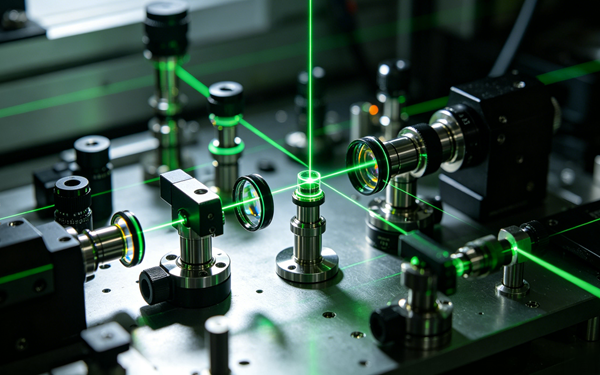
The AI boom is running into a critical data center bottleneck: copper wiring can no longer keep pace with the bandwidth and power demands of massive GPU clusters. Nvidia Corp.’s multibillion-dollar push into photonics — light-based data transmission — has turned once-niche U.S. optoelectronics firms into some of 2026’s top-performing stocks, triggering earnings upgrades and valuation reratings that open the door to multi-bagger long-term returns.
Raw GPU performance continues to improve, but data transfer speeds between chips and servers have become the main drag on AI model efficiency. Copper wiring, still standard inside most AI servers, suffers from worsening signal loss and surging power use as clusters scale to tens of thousands of accelerators, according to Gil Luria, head of technology research at D.A. Davidson. “Shifting to optical connections delivers a step change in model performance,” he said.
Photonics replaces electrical signals with light to move data across GPUs, memory and networking hardware, solving both bandwidth and power constraints. While long-haul fiber optics are already widespread, advanced technologies such as silicon photonics and co-packaged optics are rapidly penetrating intra-cluster links, driving a structural shift away from copper.
Nvidia is leading the charge to scale the technology commercially. Since early March, the chip giant has committed $2 billion apiece to Lumentum Holdings Inc. (LITE), Coherent Corp. (COHR) and Marvell Technology Inc. (MRVL); $500 million to Corning Inc. for advanced optical connectivity R&D; and joined a $500 million Series E round for silicon photonics startup Ayar Labs. The investments span the full supply chain, from lasers and transceivers to integrated photonic chips.
Speaking at March’s GTC conference, CEO Jensen Huang warned global silicon photonics capacity falls far short of exploding AI demand. Nvidia is already rolling out the technology across its networking and GPU-to-GPU interconnect platforms, he added. Analysts broadly view Nvidia’s backing as the inflection point elevating photonics from a speculative theme to a core pillar of AI infrastructure.
All five leading U.S. photonics stocks have notched gains of more than 60% year to date through June 22, underpinned by strengthening order books and fundamentals:
The broader photonics market is on track for steady expansion. Research and Markets forecasts the global electronics and photonics industry will grow 8.7% to $839.4 billion in 2026, driven by AI optical computing, 5G buildouts and data center bandwidth upgrades.
Wall Street’s embrace of the sector is deepening. Lumentum and Coherent both joined the S&P 500 in March. The first dedicated photonics ETF — the Corgi Lithography & Semiconductor Photonics ETF — launched in May with $261.7 million in assets tracking the full value chain. Three more photonics ETFs are slated to launch in the next two months, broadening investor access.
Despite the robust long-term thesis, near-term risks persist. Steep year-to-date rallies have pushed valuations to elevated levels, leaving stocks vulnerable to pullbacks if order momentum slows or earnings miss expectations. Technology deployment delays and rising industry supply could also compress margins over time.
Even so, the consensus remains that photonics is a long-cycle, foundational beneficiary of the global AI buildout. Tornike Laghidze, a portfolio analyst at BBAE, noted that hyperscalers will need more optical links per unit of compute as clusters scale, creating “direct and immediate revenue opportunity” across the supply chain. For investors willing to weather short-term volatility, the multi-year growth runway remains firmly in place.