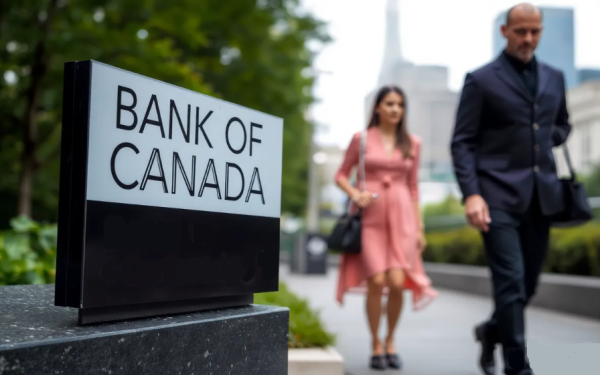
The Bank of Canada left its policy rate unchanged at 2.25% in its latest decision, extending a holding pattern against a backdrop of economic growth that has been essentially flat for the past 18 months. While the central bank struck a cautiously hopeful tone—pointing to easing inflation and an expected improvement ahead—its accompanying Monetary Policy Report made clear that the outlook remains clouded by towering uncertainties, most notably U.S. tariffs and the conflict in the Middle East. The message between the lines: any recovery is fragile, and the shocks are far from fully priced in.
The GDP numbers tell a sobering story. From the first quarter of 2025 to the first quarter of 2026, economic output was “roughly unchanged,” with real GDP growth hovering near zero—a stark miss from the 1.5% expansion the Bank had projected back in April. A modest rebound in exports and residential investment during the second quarter did lift growth slightly above 1% for the first half of 2026. But the prior quarter was weighed down by a cluster of temporary headwinds: an unexpected pullback in government spending, a decline in motor vehicle production, a sharp drop in oil and gas investment, and housing activity stifled by affordability strains, sluggish population growth, and elevated economic anxiety.
It’s precisely this macro deadlock—where the central bank appears unwilling to cut rates prematurely yet unable to engineer a meaningful growth pickup—that is shifting the spotlight toward blue-chip names with durable cash flows, reliable dividends, and business models built to weather prolonged uncertainty. For ordinary investors, these kinds of stocks offer something increasingly rare right now: visibility. Here are three Canadian blue chips that fit squarely into that logic.
With a market cap of $99 billion, Suncor stands as Canada’s largest integrated energy company, producing 860,000 barrels of oil equivalent per day across upstream, refining, and retail operations. A revitalized management team has engineered a sharp operational turnaround since 2022, and the company now sits on 25 years of proven reserves. The real story, however, is on the cost side. Suncor is targeting a breakeven cost of around US$38 per barrel by 2028, a path that is expected to unlock up to $2 billion in incremental free cash flow over that same period. The stock currently yields 2.9%. With debt declining, efficiency improving, and production volumes rising, a growing stream of buybacks and dividend increases looks less like a forecast and more like an execution roadmap.
At a $50 billion valuation, Dollarama operates Canada’s largest dollar-store network and is steadily expanding its footprint in Australia and Latin America. The model is straightforward and durable: sell low-priced, name-brand everyday goods through compact, efficiently staffed stores that require minimal capital and generate margins that outperform much of the retail sector. The dividend yield is a modest 0.24%, but that figure undersells the story. Over the past decade, the payout has grown more than 250%, and aggressive share buybacks have reduced the total share count by 28%. In an environment where households are squeezed, the trade-down effect tends to direct more traffic straight to Dollarama’s aisles. Meanwhile, international operations provide a long-duration growth engine that doesn’t depend on the Canadian economic cycle.
For investors who prioritize low volatility and predictable income, Fortis functions almost like a bond with equity upside. The $41 billion utility runs nine regulated transmission and distribution businesses across North America and has delivered 52 consecutive years of dividend increases—a track record the company intends to extend with a 4% to 6% compound annual dividend growth target. Underpinning that commitment is a low-risk project pipeline expected to drive 7% annual rate base growth. The stock yields 3.1%. When combined with modest capital appreciation potential, Fortis fits neatly into the corner of a portfolio designed to generate steady compounding rather than chase the next catalyst.
Faced with a central bank that is effectively boxed in—restrained from cutting by external risks, yet confronted with an economy that isn’t truly growing—ordinary investors may find better use of their attention by focusing on companies that generate real cash flows and return them to shareholders, cycle after cycle. Suncor’s cost-driven free cash flow generation, Dollarama’s non-discretionary consumer appeal, and Fortis’s virtually cycle-immune regulated earnings each offer a distinct avenue toward that goal. In a moment when macro visibility is in short supply, the clarity embedded in these balance sheets may be the closest thing to an edge.