
SLAM Exploration Ltd. (TSXV: SXL)
‘Exploring for critical elements and precious metals in New Brunswick, Canada.’
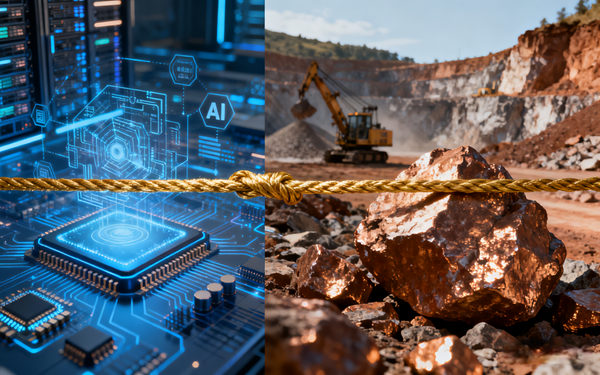
While markets cheer each leap in generative AI, a far less glamorous contest is intensifying beneath the surface—in mines, smelters, and refining plants. The physical anatomy of artificial intelligence, from copper cables that link server racks and high-purity silicon for chip substrates to the gallium and germanium enabling advanced circuitry and the rare-earth magnets driving cooling fans, rests entirely on critical minerals. The speed limit on AI expansion is shifting from code to ore.
The International Energy Agency (IEA) sketches a voracious appetite. By 2030, global data centers will consume more than 500,000 metric tons of copper and 75,000 tons of silicon each year, each accounting for roughly 2 percent of worldwide demand. For gallium, the figure is even starker: data centers alone could absorb more than one-tenth of total consumption. A single hyperscale campus already swallows almost as much copper as a mid-sized mine produces annually. With gigawatt-scale AI campuses now being planned—such as the 5-gigawatt project in Abu Dhabi—the mineral intensity curve is set to steepen dramatically.
The supply chain’s fragility lies in extreme concentration. China controls 80 to 90 percent of global refining capacity for silicon, gallium, and rare earths. Starting in 2023, Beijing imposed export restrictions on gallium and germanium. By late 2024, the curbs were extended to tungsten, tellurium, bismuth, indium, and molybdenum—all essential inputs for microprocessors, diodes, and server hardware. Prices for several of these metals have spiked sharply since the controls took effect, feeding directly into higher hardware manufacturing costs.
The mineral choke point is tightening just as the chip bottleneck persists. Training frontier models requires stacking thousands of specialized processors, virtually all manufactured by TSMC. Those chips cannot be built without gallium, germanium, and other rare elements. Washington has tightened advanced chip exports to China; Beijing has responded with calibrated mineral controls. The two chokepoints are now interlocked. Even the software-efficiency gains demonstrated by China’s DeepSeek, which lowered computing costs, do nothing to reduce absolute reliance on upstream raw materials.
Investors are enthusiastically pricing in a fierce capital-expenditure cycle, but they appear to be underestimating the hard physical constraints. As analyst Taggart warned, “The cash will be there to build out those data centers. What I think they are missing right now, though, is there are a lot of real-world physical constraints that may prevent that data center buildout from happening on the same pace that the Excel spreadsheet imagines.” He pointed specifically to the tightness in resources, permitted land, and copper—the indispensable inputs for construction. Should the data-center expansion curve bend downward under resource strain, the enormous market capitalization tethered to AI-linked assets could be pulled down with it.
Faced with mineral anxiety, the United States, the European Union, Japan, and South Korea have all rushed out critical-mineral strategies, from boosting recycling to forging alliances with resource-rich nations in Africa and Latin America. But in the near term, no policy paper can substitute for refining capacity that has been decades in the making. Without a stable, diversified mineral supply chain, artificial intelligence’s computing ambitions will inevitably hit the ceiling of the mine. The future of AI will be shaped as much by secured access to copper, gallium, rare earths, and silicon wafers as by the algorithms themselves.