
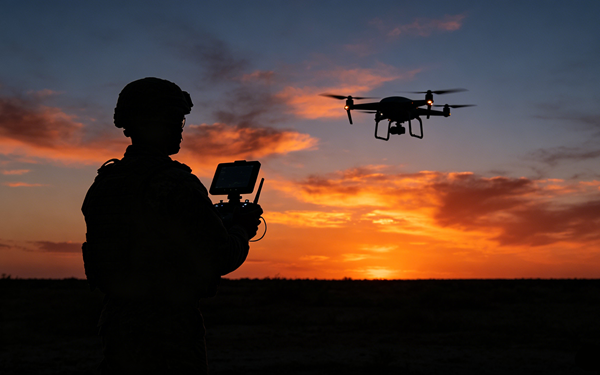
The military standoff between Iran and the United States entered a lower-intensity but still dangerous phase in late August. Direct airstrikes have largely paused in recent weeks, and military drone activity has dropped sharply, with the conflict shifting toward economic warfare in the Strait of Hormuz, naval pressure and intermittent attacks on shipping.
The lull has cooled a U.S. drone sector that soared through 2025 and the first half of 2026. The benchmark S&P Kensho Drones Index is still up 18.2% year to date, but it has barely moved over the past quarter, slipping 0.1%. Two representative drone ETFs have diverged: the pure-play DRNZ is down 1.5% in 2026, while the Defiance Drone and Modern Warfare ETF (JEDI) has gained 11.2% this year, strengthening notably over the past month.
Military and defense remain the cornerstone of demand for drone stocks even as civilian use cases expand in transportation, agriculture and manufacturing. Mike Shufeldt, general partner at Jetstream Venture Fund, says conflicts in the Middle East and Ukraine have permanently shifted modern warfare away from expensive, exquisite hardware toward low-cost, attrition-tolerant autonomous systems. The main bottleneck is no longer hardware manufacturing but achieving AI autonomy in GPS-denied and electronic warfare environments, along with the urgent need to de-risk component supply chains away from Chinese manufacturing. Tensions around Iran and the Red Sea are accelerating Pentagon procurement of scalable autonomous unmanned systems.
Investors may need to look beyond drone platforms themselves. Foad Farid, founder and CEO of defense tech company XCaliber Technologies, notes that every additional battlefield drone creates demand for detection, sensors, command and control, AI, communications, electronic warfare and counter-UAS technologies. The real challenge is not putting more autonomous systems into the air, but determining what is in the airspace, whether it poses a threat and how to respond within seconds. The winners will not be the companies building the most sophisticated individual platforms, but those building the infrastructure that allows thousands of autonomous systems and counter-systems to operate together. That transition is far larger than the drone market alone.
Against this backdrop, here are six U.S.-listed drone-related stocks worth watching.
AeroVironment (NASDAQ: AVAV) is a pure-play drone company supplying air and ground autonomous military vehicles to the U.S. government and more than 55 countries. In July 2026, the company announced a $117.3 million U.S. Army contract for its P550 electric vertical take-off and landing unmanned aerial system. Fiscal 2026 brought a record $1.2 billion funded backlog, with organic revenue up 26% to $1.98 billion. Adjusted EBITDA rose to $286.1 million from $146.4 million a year earlier. Management projects fiscal 2027 revenue of $2.125 billion to $2.225 billion and adjusted EBITDA of $305 million to $325 million.
Boeing (NYSE: BA) is best known for commercial aircraft, but the company also operates across unmanned domains: the Wave Glider and Echo Voyager at sea, the MQ-25 refueling drone and AI-enabled MQ-28 fighter in the air, and the X-37B orbital vehicle in space. After several turbulent years, Boeing reported second-quarter 2026 revenue up 8% year over year to $24.6 billion, with operating cash flow rising to $1.4 billion from $227 million in the same period last year. The quarter ended with a record backlog of $715 billion.
Northrop Grumman (NYSE: NOC) manufactures the MQ-4C Triton, RQ-4 Global Hawk, Bat series and MQ-8B Fire Scout, among other unmanned systems. The company has raised its dividend for 24 consecutive years, most recently in May 2026 with a 7% increase to $2.47 per share. It ended the second quarter of 2026 with a record backlog of $105 billion.
Kratos Defense & Security Solutions (NASDAQ: KTOS) provides weapons systems, satellite components and military drones to the U.S. and allies. Training targets include the BQM-167, BQM-177 and MQM-178 Firejet, while combat drones include the XQ-58 Valkyrie with a range exceeding 3,000 miles, the runway-independent UTAP-22 Mako and the sub-$500,000 Tactical Firejet. Second-quarter 2026 revenue climbed 30.5% year over year, and net income more than doubled to $4.4 million from $2.9 million. Full-year revenue is guided to $1.75 billion to $1.81 billion, growth of more than 29%.
Red Cat (NASDAQ: RCAT) develops autonomous air and sea systems. Its Arachnid drones provide intelligence, surveillance and reconnaissance in support of the Pentagon’s Replicator initiative. In August 2025, the company launched a maritime division, Blue Ops, centered on the Variant 7 unmanned surface vessel for strike, force protection and coastal security. Red Cat has pivoted fully to defense: 2025 revenue reached $40.7 million, up 161% year over year, and management expects $150 million to $180 million in 2026. Gross profit for the first two quarters of 2026 was $5.2 million, compared with a $0.5 million gross loss in the same period a year earlier.
Draganfly (NASDAQ: DPRO) was founded in 1998 and is one of the earliest drone manufacturers, as well as the first to commercialize quadrotor drones. The company serves public safety, agriculture, industrial inspection, mapping and defense. Defense-related revenue averaged about $7 million annually over the past three years, but management has signaled a major shift toward military contracts, saying defense could account for 90% of future sales. In February 2026, Draganfly announced an award from U.S. Air Force Special Operations Command, in collaboration with DelMar Aerospace Corporation, to provide Flex FPV drones and training. First-quarter 2026 revenue grew more than 49% year over year, and the diluted loss per share narrowed to $0.17 from $0.63 a year earlier.
The new paradigm of drone warfare is now clear: low-cost, expendable, AI-enabled and network-centric systems are replacing traditional high-value single platforms. For investors, short-term stock stagnation may be a matter of pacing. The larger opportunity lies in the infrastructure and ecosystem companies capable of enabling thousands of autonomous systems to operate together.