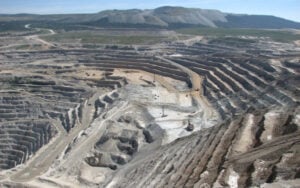
Koryx Copper has finished an infill and expansion drill program at its wholly owned Haib Copper Project in southern Namibia, and the company says the work is now feeding into an updated Mineral Resource Estimate and Pre-Feasibility Study targeted for publication before the end of 2026. The latest release covers assay results from 18 drill holes totaling 7,074 m, adding more data to a project that Koryx describes as a large disseminated porphyry copper-molybdenum-gold deposit intended for large-scale open-pit mining with conventional sulphide milling and flotation.
The headline intercept in the release came from hole HM199, which returned 438 m at 0.40% CuEq from surface, including 224 m at 0.51% CuEq from 96 m downhole. Another wide intercept came from HM193, which returned 681 m at 0.34% CuEq, including 169 m at 0.40% CuEq and 22 m at 0.71% CuEq. Those widths matter because they help define how much material may be mined and how continuous the mineralization could be in an open-pit scenario. In simple terms, broad mineralized intervals can be just as important as grade in large bulk-tonnage copper projects.
Other notable holes reinforce that theme. HM191 returned 429 m at 0.30% CuEq, HM192 returned 442 m at 0.28% CuEq, and HMRC015 returned 491 m at 0.22% CuEq. These numbers do not, by themselves, prove an economic mine, but they do suggest that mineralization remains extensive across the deposit. For investors, that is the key point to watch at a project like Haib: not just isolated high grades, but whether the mineralized shell stays wide enough and consistent enough to support a mine plan that can deliver scale.
Koryx also said some near-surface intersections are significantly higher grade than predicted by the current model, citing HM182, which returned 58 m at 0.42% Cu from surface. That is the kind of result that can matter in an open-pit design because near-surface material is usually cheaper to access than deeper ore. However, this is still the company’s interpretation of its own drill program, not an independent conclusion. Investors should treat it as encouraging but provisional until the updated model and study work are released.
The company’s technical team is now focused on geological modelling and estimation work for the updated resource and study. In the company’s words, the drilling set “demonstrates this well, particularly within Target Area 3 where the mine plan is scheduled to begin.” That statement matters because it ties the recent drilling directly to a part of the deposit that could be central to early mine planning. If the mineralization in Target Area 3 continues to match expectations, it may support the company’s next round of engineering work.
Not every hole pointed in a favorable direction. Koryx said hole HM200 in Target Area 4 did not encounter a predicted high-grade zone between 156 m and 300 m, and the company said the cause is not yet understood. That is a reminder that drill programs are as much about testing geological models as they are about confirming them. Misses happen, especially in systems as large and structurally complex as porphyry copper deposits. The important question is whether such misses are isolated or part of a broader pattern of model uncertainty.
For investors, HM200 is worth noting because it shows the limits of inference from earlier drilling. Even in a project with wide mineralized intervals, local grade distribution can shift from hole to hole. That can affect strip ratios, mine scheduling, and confidence in short-term production plans. Koryx’s own response is to continue with geological modelling and resource estimation, which is the appropriate next step if the company wants to tighten the mine model before the 2026 study work is released.
Haib is being advanced as a disseminated porphyry copper, molybdenum, and gold deposit, with plans for large-scale open-pit mining and conventional sulphide milling and flotation to produce copper and molybdenum concentrate. That processing route is important because it suggests a conventional development concept rather than a highly specialized or novel extraction flow sheet. Conventional processing can reduce technical uncertainty, but it also means the economics will depend heavily on grade, tonnage, strip ratio, recovery, and capital intensity.
That is why wide intercepts are meaningful only in context. A large open-pit project can tolerate lower grades if tonnage, metallurgy, and geometry are favorable. But it still needs enough metal per tonne to justify the mining and processing costs. The current drill results help refine that picture, yet they are not the same as a completed economic study. The upcoming Mineral Resource Estimate and Pre-Feasibility Study will be the real tests of whether the deposit can support the development case the company is building.
Koryx says the infill and expansion drill program is complete, and it is targeting publication of both the updated Mineral Resource Estimate and Pre-Feasibility Study before the end of 2026. That gives the market a clear next milestone, even if it is still a ways off. Until then, the stock will likely be judged on how well the technical team can convert these drill intersections into a more robust geological model and a more defensible development plan.
The company’s quoted commentary suggests management believes the current program has strengthened the case for Haib, especially near the proposed mine-start area. Still, the real question for investors is whether the new data improve confidence enough to support a larger, more detailed engineering effort. In a project like this, continuity and predictability can be more valuable than a few standout intervals. If the updated resource confirms that the wide mineralized zones are consistent, the project may become easier to evaluate. If not, the study work could expose more complexity than the headline holes imply.
This announcement is constructive, but it is still early-stage technical news. The strongest evidence here is that Koryx has completed a sizeable drill program and has delivered multiple broad intercepts from the Haib deposit. That supports the view that the project remains geologically active and worthy of continued follow-up. The weaker point is that the company has also disclosed at least one miss against expectation in HM200, which underlines that the model is still being refined and may require adjustment.
The safest way to frame the release is that it improves visibility, not certainty. Haib remains a large copper project with a conventional mining concept, and the latest holes help flesh out the resource base ahead of a future study update. But the real investment decision will depend on the forthcoming Mineral Resource Estimate and Pre-Feasibility Study, not on drill widths alone. For now, Koryx has done what an exploration developer should do at this stage: keep drilling, test the model, and move the project toward a more formal engineering assessment.