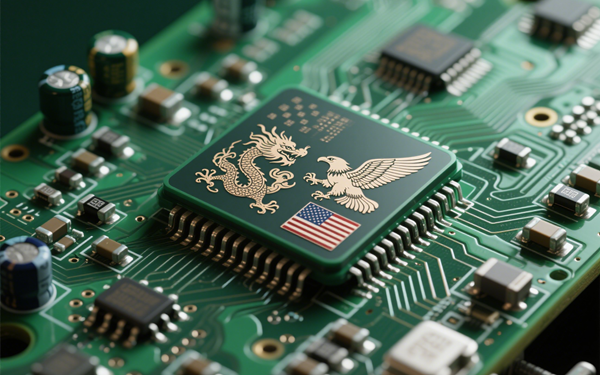
China’s Huawei on Thursday laid out a sharply accelerated launch schedule for its next-generation Ascend AI chips, the clearest public signal yet that the company is moving faster to narrow the performance gap with global market leader Nvidia (NVDA), as U.S. export controls continue to wall Nvidia off from the fast-growing Chinese AI market. Nvidia shares edged 2.54% higher in trading following the announcement, a muted reaction that reflects broad investor consensus the move poses no immediate financial threat.
For years, Nvidia has dominated the global high-end AI chip market, with its flagship GPUs in extremely strong demand from customers across nearly every major economy. China has long been the notable exception: strict U.S. rules governing exports of sensitive technology bar Nvidia from selling its most powerful AI accelerators to Chinese clients, creating an uneven playing field that has given Huawei, Nvidia’s largest homegrown Chinese rival, clear runway to build out its domestic chip business.
Nvidia previously designed the H20, a purpose-built lower-performance variant of its flagship Blackwell platform, to comply with earlier rounds of U.S. export rules specifically for sale in the Chinese market. Those regulatory carveouts were erased in June 2025, when tighter controls also banned H20 sales to Chinese buyers, costing Nvidia $2.5 billion in related revenue and forcing a $4.5 billion charge tied to stranded, unsellable H20 inventory. At the time of the H20 ban, Nvidia chief executive Jensen Huang warned that cutting China off from access to leading U.S. chips would only push Chinese firms to ramp up investment in domestic AI chip development — a warning that now lines up closely with Huawei’s newly disclosed product timeline.
Analysis from The Wall Street Journal notes Huawei’s currently shipping Ascend 950 chip line still trails Nvidia’s Blackwell platform in raw computing performance. Speaking at a public company event in Shanghai, Huawei rotating chairman David Wang announced a major compression of the company’s chip development schedule: The Ascend 960DT, originally slated for launch in the fourth quarter of 2027, will now debut nine months ahead of schedule in the first quarter of 2027. The companion Ascend 960PR chip, also initially expected in Q4 2027, will launch three months earlier in the third quarter of 2027. Wang also laid out plans for the next two Ascend generations — the 970 and 980 — scheduled to launch in 2028 and 2029 respectively, with computing power expected to double with each new generation.
For Nvidia investors, the near-term impact of Huawei’s faster roadmap is negligible. Because Nvidia is already barred from selling high-end AI chips into the Chinese market, there is no existing revenue at risk: even major performance gains for Huawei’s chips do not take away sales Nvidia is currently permitted to pursue. Huawei has also explicitly stated that all production for the upcoming Ascend 960 family will be allocated first to the domestic Chinese market. Speaking to reporters, Huawei rotating chairman Eric Xu noted the company does not have enough manufacturing capacity to even meet existing domestic demand, and has no plans to make a full-scale push into international markets for its chips. That means Huawei’s current product push is entirely focused on serving local Chinese customers, with no immediate move to compete directly with Nvidia in other global markets.
Longer term, the faster product cadence does represent a variable worth tracking: if Huawei can scale manufacturing significantly and improve chip performance faster than Nvidia’s own development pace, it could grow into a material, long-term competitor. But that scenario carries considerable uncertainty. Nvidia will continue rolling out new flagship AI chips through 2029, and holds a substantial head start as the established market leader. For now, investors appear to be discounting any near-term risk to Nvidia’s performance from Huawei’s roadmap acceleration.