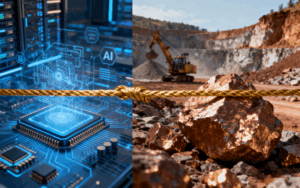

China is pouring concrete, steel and power into a fast-growing AI buildout in Inner Mongolia, where low land costs and cheaper electricity are being turned into a national advantage. The pace is so aggressive that a BBC News report quoted one unnamed construction worker in Ulanqab saying, “This is China speed.” Another worker described the cycle of expansion more bluntly: “There is one phase every year. This is the second phase. There will be many more phases afterwards.” The message from the ground is clear: Beijing is moving quickly because it wants computing capacity now, not later.
The surge is centered on Ulanqab, a city in Inner Mongolia that has become one of the clearest symbols of China’s effort to catch up in artificial intelligence infrastructure. Financial Times reporting cited by euro2day.gr says Ulanqab has 89 data-centre projects built or planned. That number sits inside a much larger national pattern. Bloomberg, citing BNEF data, says more than half of China’s data-centre pipeline is in the north and northwest, where the country can tap cheaper power and land. In other words, the AI boom is not just about chips or software. It is also about where China can physically house the machines.
China is building hundreds of data centres for Huawei, ByteDance and DeepSeek across sparsely populated provinces including Ulanqab, Ningxia, Gansu and Guizhou, according to BBC News. That spread matters because the buildout is not concentrated in one flashy tech hub. It is being pushed into regions that can handle vast electricity loads and large-scale construction. In Ulanqab, Xinhua says operational computing capacity reached 172,000 PFlops, with intelligent computing over 95%. China Daily says Inner Mongolia’s intelligent computing capacity reached 326,000 petaflops, and that over 85% of data-centre electricity there comes from green energy.
That combination of scale and energy sourcing is central to the story. Beijing is treating cheap land and lower power costs as strategic inputs for AI, not just operating savings. The same logic appears in the government’s broader push to spread computing infrastructure into the country’s north and northwest. For Beijing, the reward is not merely more server rooms. It is the ability to place enough computational muscle inside China to support training, inference and industrial AI deployment at scale.
The ambition is also tied to national industrial policy. BBC News reports that China’s stated goal is to embed AI across 90% of industries and society by 2030. That target helps explain why local governments and developers are moving so fast. The infrastructure is being built to support a future in which AI tools are embedded across manufacturing, logistics, finance, services and government. That is a much bigger thesis than one city or one campus. It is a nationwide attempt to make compute capacity part of the country’s core economic infrastructure.
Ulanqab’s rise is not accidental. The city is attractive because it offers the ingredients needed for huge facilities: space, lower costs and access to power. Those basics are what make a data-center cluster workable at the kind of scale AI requires. The FT summary says Beijing is rolling out computing infrastructure at breakneck speed in Inner Mongolia, converting low energy costs and cheap land into an AI-race advantage. That framing captures the logic well. If AI is an arms race, then the terrain itself becomes part of the strategy.
The region’s role is also reinforced by the kind of companies China is trying to serve. Huawei, ByteDance and DeepSeek are among the names linked to the country’s data-centre expansion in the BBC report. That points to a blend of state priorities and private-sector demand. It also suggests Beijing wants domestic champions to have access to enough domestic compute to build, test and deploy AI models without relying too heavily on overseas infrastructure. In a world of tighter technology constraints, location is no longer just a real-estate decision.
There is also a visibly political edge to the buildup. “Whoever wins AI, wins,” President Donald Trump told BBC News. The line is broad, but it captures the strategic mood around the world. China’s answer appears to be to make sure its industrial base can support AI at home, at scale, and with power and land advantages that are harder to replicate in denser, more expensive regions. That makes Ulanqab’s construction boom more than a regional development story. It is a piece of the global technology contest.
The numbers cited by Chinese state and state-linked outlets point to a system being assembled at speed. Xinhua’s report on Ulanqab’s 172,000 PFlops of operational computing capacity and China Daily’s figure of 326,000 petaflops for Inner Mongolia’s intelligent computing capacity show the sheer size of the effort. Even without getting lost in technical details, the direction is obvious: China wants more usable compute in more places, and it wants the power to be cleaner and cheaper where possible.
China Daily also says more than 85% of data-centre electricity in Inner Mongolia comes from green energy. That is important because the AI boom is often constrained not just by chips and land but by power availability and power politics. Building in regions with stronger access to green electricity can ease those bottlenecks and give developers a cleaner growth path. It also fits China’s broader industrial narrative of scaling advanced infrastructure while managing energy intensity.
The pace of the buildout suggests that the physical side of AI competition may become just as important as model quality. If the models need massive training runs and constant inference, then the country with the most efficient, available, and affordable computing backbone may have an edge. That is the bet behind the cranes in Inner Mongolia.
The next phase may be even larger. BBC News says China wants AI embedded across 90% of industries and society by 2030, and that goal will require far more than a handful of showcase campuses. It will need data centers, power lines, networking, cooling systems and a steady stream of skilled workers. The quoted remarks from Ulanqab suggest local construction is already moving in predictable stages, with each phase opening the door to the next.
China Daily adds another layer: Envision Group aims to build 5 GW of green AI computing centres across desert regions worldwide by 2030, with Ulanqab as the first step. That broadens the story beyond a single province and shows how the current buildout may be a template for future expansion. For now, the center of gravity is Inner Mongolia, where the country is trying to convert geography into leverage.
The market impact is less direct than in a chipmaker earnings report or a software stock surge, but the strategic impact is hard to miss. China is not waiting for AI infrastructure to mature on its own. It is building it, phase by phase, in the places best suited to handle the load. In Ulanqab, the race is already visible from the dirt road up.