Kropz is shifting its Elandsfontein operation in the Western Cape toward Nanophos production after an urgent restructuring, and the move points to a company trying to protect optionality while it waits for phosphate rock market conditions to improve. The trade press says management plans to lift Nanophos capacity to 180,000 tonnes per year, but that tonnage target is not confirmed in the company’s 7 September 2026 operational review, so investors should treat it as an external report rather than a settled company filing. What is clear is that Kropz is stepping away from near-term phosphate rock output and into a lower-risk operating model.
The immediate backdrop is weak economics and a sharp market reaction. After the restructuring announcement, Kropz’s shares fell by about 39% in London, according to Bloomberg and Moneyweb, which put the market value at about £9.1 million as of 8 September 2026. MarketScreener, citing Alliance News, reported a 33% fall on the same day to 0.60 pence. Those numbers are not identical, but they point in the same direction: investors were not reassured by the operational reset.
The company’s 7 September 2026 update described an urgent operational review and restructuring at Elandsfontein, with no further phosphate rock production currently planned. In plain terms, Kropz is keeping the asset alive, but not betting on a quick return to its original operating rhythm. That matters because mining projects do not have many good alternatives when the core product is under pressure. A producer can either keep pushing through weak market conditions, suspend activity, or reconfigure the operation around a different product mix. Kropz appears to be choosing the third path.
The company has said it will continue maintaining the majority of the unused plant in care and maintenance so that it can return to phosrock production if conditions improve. Mark Maynard, the chief operating officer, said: “Kropz will continue maintaining the majority of the unused plant in a care and maintenance state that will ensure a quick return to phosrock production when market conditions become more favourable.” That statement is important because it suggests the shutdown is not being framed as a permanent exit from phosphate rock. It is a holding pattern, but one with a commercial logic: preserve the asset base, reduce immediate operating complexity, and keep the door open.
The problem for investors is that care and maintenance still costs money, and there is no guarantee of a rapid rebound in the market that supports a restart. The company’s own update makes restart conditional on market normalisation and board approval. That is a sensible governance gate, but it also underlines how little control management has over the key variable: pricing and demand for the underlying product.
Nanophos is central to the new plan because it gives Kropz a product it can market as a slow-release organic fertiliser rather than a traditional phosphate rock output. The company describes it as a natural sedimentary soft rock phosphate, below 38 micron, rich in phosphate, calcium and silica. That composition matters because small particle size and mineral content can support use in certain agricultural applications, especially where a slower nutrient release profile is preferred.
For investors, the strategic appeal is straightforward. A processed fertiliser product can sometimes offer better market positioning than raw mineral output, particularly if the company can capture more value from the same ore body and plant. It can also reduce exposure to the exact pricing dynamics that affect unprocessed phosphate rock. That said, the move does not eliminate operating risk. The plant still needs to run reliably, the product still needs to find buyers, and the economics still need to work at scale.
Kropz’s own messaging is optimistic. The company said its entrance into the market “promises to herald a new era for South Africa’s agricultural community”. That is a promotional statement, and it should be read as such. There is no independent evidence in the pack that Nanophos will reshape the agricultural market, and no reason to treat the phrase as anything more than the company’s view of the opportunity. The more relevant question is whether the product can be produced consistently and sold profitably.
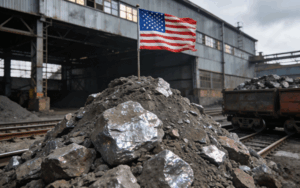
Elandsfontein has already been a substantial operating asset. In the first five months of the financial year ending 31 March 2027, the operation produced 150,246 tonnes of Phosrock and sold 149,907 tonnes. Those numbers show that the asset was active and moving material before the current reset. They also show how quickly a mine can swing from production to restructuring when market or operating conditions tighten. A mine with material throughput can still be economically fragile if margins are poor or if the market does not support continued output.
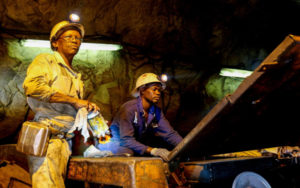
The next near-term pressure point is the contractor agreement. Bloomberg and Moneyweb report that the operation has about 540 workers including contractors, and Kropz will not renew its operating and maintenance agreement with contractors when it expires in November. That is a significant operational change because contractors often carry a portion of the plant running burden, especially in a transitional environment. Non-renewal should reduce cost, but it can also increase execution risk if the company is trying to preserve plant readiness while cutting back the people who keep the system functioning.
There is also a human cost, which management acknowledged directly. Louis Loubser, the chief executive, said: “The restructuring and operational downsizing process will be challenging and we understand the impact it will have on employees and their families and other stakeholders and are deeply saddened.” That is a standard corporate statement in one sense, but it also signals that the company knows the change will be disruptive. For investors, workforce reductions matter because they affect restart speed, institutional knowledge, and the broader social licence to operate.
Kropz is backed by billionaire Patrice Motsepe, whose African Rainbow Capital owns about 90% of the company. That is a meaningful support structure, especially for a small AIM-listed miner trying to reposition an asset. A controlling shareholder with deep pockets can reduce immediate financing pressure and may allow management to make decisions that would be difficult for a more loosely funded company.
But backing is not the same as a solved business model. A majority shareholder can support a turnaround, yet it does not remove geological, metallurgical, or market risk. If the underlying product does not generate margin, or if the cost of converting the operation to Nanophos is too high relative to the achievable selling price, the capital structure may still be stressed. Investors should also remember that a small market cap can move sharply on operational headlines, especially when the company is effectively asking the market to value a future product rather than an established cash flow stream.
The key question now is whether the Nanophos pivot can be turned into a repeatable operating business rather than a short-term bridge. The most useful indicators will be simple ones: whether Kropz confirms the 180,000-tonne-per-year target in formal disclosures, whether it provides any economics around the new product line, and whether the company can maintain plant integrity during the care-and-maintenance phase. Without that information, the market is being asked to price a strategy with limited disclosure.
Investors should also watch the November contractor expiry and the timing of staff cuts. Those events will show whether the company can preserve enough operational capability to restart phosrock if conditions improve, or whether the restructuring becomes a deeper reset than management currently suggests. The stated intention is to retain flexibility. The real test will be whether that flexibility remains practical once the cost cuts have been made.
For now, Kropz looks like a company trying to defend the value of Elandsfontein by changing the product mix rather than abandoning the asset. That is a legitimate response to a difficult market, but it is still only a strategy. The next evidence investors need is commercial, not rhetorical: confirmed capacity, credible margins, and proof that the plant can produce and sell Nanophos at scale.