What is a reserve currency, really, if not a confidence trick with paperwork? It is not merely a medium of exchange. It is a promise that the issuer will remain useful, liquid, and safe enough that others keep parking their surplus with it. That promise can look permanent for decades, then crack in a season. The latest strain on the petrodollar system is a reminder that global finance is less a fortress than a seawall: it stands until the tide tests the joints.
The core bargain is plain enough. The US protects Gulf monarchies such as Saudi Arabia, Kuwait, the United Arab Emirates, Bahrain, and Qatar. In return, those states price much of their oil in dollars and recycle large amounts of oil revenue into US financial assets, including Treasuries. The system has supported demand for the dollar and US government debt for more than 50 years, and it has done so quietly enough that many investors mistake habit for law. But history rarely rewards that kind of sleepwalking.
The language around this arrangement is revealing. One observer calls it an alliance, another a strategic partnership, and the harsher label is protection racket. That last phrase may sound cynical, but it captures the fragility at the center of the bargain. A racket works only while the protector can still protect. If the guarded party concludes that protection is no longer credible, the tribute stops making sense. In finance, as in biology, the host and parasite are locked together only until the host weakens or resists.
A 2006 warning still hangs over the debate because it identified the hinge point. On February 15, 2006, Ron Paul told the House that the chaos from the 35-year experiment with worldwide fiat money would require a return to money of real value. He said the signal would be when oil-producing countries demand gold, or its equivalent, for their oil rather than dollars or euros. That is not a casual remark to read after the fact. It is a testable proposition about incentives, and incentives are the only honest foundation in markets.
The reason oil matters is not sentimental. Oil sits at the center of the global economy, and every industrial economy needs it. If countries need dollars to participate in the oil trade, they need dollars for reasons that have nothing to do with buying American goods or services. That creates structural demand for the currency. It also creates demand for US assets because oil exporters earn dollars and need somewhere to put them. For decades, much of that cash flowed back into US banks and Treasury securities. The result supported the Treasury market, the dollar, borrowing costs, and deficits that few other countries could finance so easily.
But every protection system is only as durable as the shield. The recent Iran war threatens that premise because it raises a blunt question: if Gulf monarchies conclude the US cannot protect their oil infrastructure, shipping lanes, cities, and regimes from Iran, why keep up their side of the bargain? This is not just a geopolitical question. It is a game-theory problem. When the expected payoff of loyalty declines and the downside of dependence rises, rational players reprice the relationship. States, like investors, can tolerate a lot of noise. They cannot tolerate a broken balance sheet of security.
China changes the geometry of that choice. The Gulf Cooperation Council includes Saudi Arabia, Kuwait, Qatar, Bahrain, Oman, and the United Arab Emirates. Together, those countries are among the most important oil exporters on Earth. China is the other side of the trade: the world’s largest oil importer and the GCC’s largest trading partner. That makes for a natural commercial pull. China needs energy. The Gulf states need markets. For years, both sides have discussed ways to conduct more trade outside the dollar system. The obstacle was not economics alone; it was geopolitics.
The US security umbrella constrained how far the Gulf could drift. If moving toward China risked alienating the power that had been underwriting regime safety, the choice was obvious. The Iran war changes that calculus by calling the umbrella into question. If the protector can no longer guarantee protection, then dependence becomes liability. At that point, a Gulf state has every incentive to diversify its risk the way a prudent engineer adds a second support beam before the first one buckles.
China has also been building a route around the dollar problem. In 2018, the Shanghai International Energy Exchange launched a yuan-denominated crude oil futures contract. That gave oil producers another mechanism for pricing and trading crude outside the dollar. But the bigger issue for any exporter is what to do with the proceeds. Nobody wants to swap one form of dependence for another if the new currency just piles up as inert claims on a foreign system. So China has developed something more useful: a path from yuan into physical gold.
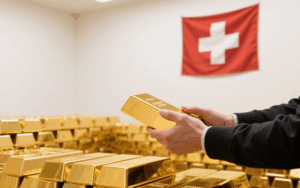
That matters because it alters the psychology of settlement. An oil producer can sell crude into the Chinese market, receive yuan, spend those yuan on Chinese goods, or use China’s financial and gold-market infrastructure to convert surplus yuan into physical bullion. The exporter does not have to sit on a pile of Chinese currency if it does not want to. It can move value into an asset with no issuer, no counterparty, and no foreign government between the owner and the wealth. That is not a minor convenience. It is the difference between a claim and a possession.
Gold’s appeal is ancient because its risks are simple. Nobody can print it. Nobody can default on it. Once an oil producer takes physical possession, no foreign government can freeze it with a keystroke. Washington demonstrated the counterparty risk of dollar assets when it froze Russia’s reserves after the invasion of Ukraine. That episode was a global seminar in political finance. It reminded every capital allocator, sovereign or private, that claims on a hostile system can be revoked when politics turns. Gold, for all its flaws, does not rely on foreign goodwill.
The deeper issue is not whether any one country can break the system tomorrow. It is whether trust can be slowly drained from the plumbing. Fragile systems often fail in layers. First the assumptions wobble, then the participants hedge, then they diversify, then they stop believing the old settlement layer is sacred. The petrodollar is vulnerable to that kind of erosion because it depends on confidence in both security and convertibility. If Gulf states start behaving as though those guarantees are conditional, the dollar loses not only demand but aura.
Investors too often imagine disorder arriving like a single loud crash. It usually arrives more like corrosion. The rivet loosens. The bridge still stands. Traffic keeps moving. Then one day the structure is carrying a load it can no longer bear. The prudent response is not drama but recognition. If the incentive structure around oil, security, and reserves shifts, the change will not need a formal announcement to matter. Money is a social technology, and social technologies decay first in expectation.
That is why this story matters beyond the Middle East. A loss of demand for dollars and US debt would not merely offend doctrine; it would alter purchasing power and the terms on which capital is priced. The global system has long assumed that oil wealth would cycle back into US markets because the protector would remain indispensable. If that assumption weakens, the financing of deficits, the depth of the Treasury market, and the dollar’s prestige all become less automatic.
The lesson is not that the dollar disappears on a date circled in red. It is that systems built on convenience can fail when convenience no longer compensates for risk. Gulf states do not need to announce a revolution for the petrodollar to fray. They only need to act like rational custodians of their own survival. In markets, as in nature, the species that survives is not always the strongest. It is the one that notices the terrain has changed.