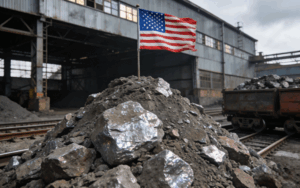
Valterra Platinum is moving closer to a decision that could reshape the world’s largest platinum mine. The company is assessing an underground expansion at Mogalakwena, its flagship asset in South Africa, because open-pit ore grades are declining and mining costs are rising. The project under review is Sandsloot, and the current plan is to begin trial mining later in 2026 before reaching a final investment decision in 2027. For investors, this is less about a near-term production spike than about whether a long-life asset can preserve economics as the easy ore gets harder to mine.
Mogalakwena sits halfway between Pretoria and the Zimbabwe border and remains the company’s most important mine. It also has more than eight decades of reserves remaining, which is a key reason the market is paying attention to the underground option. Valterra was spun off from Anglo American Plc in June 2025, when it became separate from Anglo American Platinum. That corporate change matters because the asset is now being managed as a standalone operating and capital allocation problem rather than as part of a larger diversified group.
The basic geology is straightforward enough for non-specialists. Open-pit mining is usually cheaper when ore bodies are near the surface and grades are robust. As grades decline, more rock has to be moved for the same amount of payable metal, which pushes costs higher. That is the setup at Mogalakwena. An underground move is being explored not because the surface mine has run out tomorrow, but because the company sees a better way to access ore that may support the mine over a much longer period.
Valterra’s prefeasibility work completed in the first half of 2025 is the key technical milestone so far. The company said the Sandsloot investment case was compelling, and it is targeting underground grades of 4 to 6 grams per tonne to blend with opencast ore. That blending concept is important. It suggests the underground material is not being viewed as a standalone replacement for the open pit, but as a way to improve the overall feed to the plant and support the life of the broader operation.
The company is also talking in terms of operating efficiency, not only ounces or tonnes. It targets a 10% to 50% increase in Mogalakwena metal-in-concentrate production and a 10% to 20% reduction in all-in sustaining costs. Those are wide ranges, which is a reminder that this is still a development concept rather than a final mine plan. For investors, the spread between the low and high end matters. It tells you the upside case is meaningful, but it also shows management is still dealing with uncertainty around mining method, grade continuity, and execution.
Valterra’s chief financial officer, Sayurie Naidoo, put the economic logic plainly: “We believe that going underground is the most cost-effective option for us.” That line is worth reading carefully. It does not mean underground mining is cheap. It means that relative to continuing to chase lower-grade material in the open pit, Sandsloot may offer a better long-term cost profile. In mining, that distinction is critical. A project can raise upfront capital and still improve the economics of a mature asset if it protects grade and lowers unit costs enough over time.
The capital plan is still measured, at least for now. Medium-term capital guidance is R1.5-billion to R2.5-billion per year. That is not a trivial amount, but it is also not the kind of capital burden that suggests the company is betting the balance sheet on a single idea. Still, investors should remember that underground projects often become more complex as they move from study to development. Cost guidance can change as access, infrastructure, hoisting, ventilation, and sequencing details become better defined.
The company plans to begin trial mining in the fourth quarter of 2026. A final investment decision is expected in 2027, and Mining Weekly reported that feasibility study completion and the investment decision are targeted for the first half of 2027. Those timing references are broadly consistent, but they also show that the precise decision date is not fixed. In practical terms, the market still has several quarters before it gets a clearer view of whether Sandsloot advances from a promising technical option to a sanctioned mine plan.
That matters because the next phase will likely determine whether the project is truly scalable. Trial mining is important, but it is only a test. It can confirm the ground conditions, ore characteristics, and operating assumptions that underpin the underground concept. It does not yet prove long-term commercial performance. For investors, the main questions between now and 2027 are whether the technical results match the prefeasibility assumptions and whether the economics remain strong enough after more detailed engineering.
The broader platinum price backdrop is not especially supportive. As of October 15, 2026, spot platinum was about $1,614 an ounce, down more than 6% year to date, according to FXMAG citing Trading Economics. That does not break the Mogalakwena story, but it does make capital discipline more important. A stronger metal price can hide a lot of operational friction. A weaker one forces mining companies to justify every ton moved and every rand spent.
At the same time, Valterra is not talking as if the supply case for its portfolio is in doubt. CEO Craig Miller said, “We have many, many decades of PGMs available just within our portfolio, so the supply is not a concern.” He also said, “We still feel that PGMs will have a role to play in future mobility.” Those comments are a reminder that the company sees this asset base through a long-cycle lens. That is sensible for platinum group metals, where mine life and replacement options matter as much as next quarter’s pricing.
The investment case here is less about a sudden rerating and more about the durability of a world-class ore body. Mogalakwena is already a flagship mine, and more than eight decades of reserves remaining gives management room to plan beyond short-cycle market noise. But the reason Sandsloot is being studied is also the reason investors should stay cautious: declining open-pit grades are a structural issue, not a temporary one. Underground mining may solve part of that problem, but it introduces new technical and capital risks of its own.
The most important near-term indicators are practical ones. Does trial mining start in the fourth quarter of 2026 as planned? Do the underground grades and blend assumptions hold up? Does the project still support the target of higher metal-in-concentrate production and lower all-in sustaining costs once the work becomes real rather than conceptual? And does the company keep medium-term capital within the range it has outlined? Those are the questions that will determine whether Mogalakwena’s next phase is a value-preserving transition or just a more expensive way to chase the same metal.