Chasing MP Materials: USA Rare Earth’s Rare-Earth Ambitions and Risks
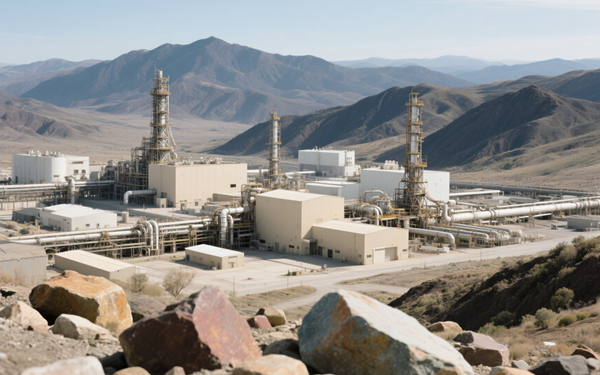
The U.S. is moving to break China’s hold on rare earth mining and processing and build a fully domestic, controlled mine-to-magnet supply chain. Two government-backed publicly traded firms stand at the center of the effort: MP Materials (MP), the established leader in North America’s rare earth sector, and USA Rare Earth (USAR), which is constructing its entire supply chain from scratch. For investors gauging USA Rare Earth’s growth potential and market cap ceiling, MP Materials serves as the core benchmark.
MP Materials, which operates California’s Mountain Pass mine — the largest rare earth operation in North America — holds a market capitalization of roughly $6.7 billion. USA Rare Earth’s market value sits at about half that size, with public estimates ranging from $2.78 billion to $3.3 billion. To match MP Materials’ market cap by 2030, USA Rare Earth’s share price would need to more than double from current levels, meaning a $5,000 initial investment would grow to more than $10,150.
Unlike MP Materials with its mature producing mine, USA Rare Earth is building its footprint starting with upstream resource assets. Its acquisition of the Serra Verde project gives it control of the only large-scale rare earth mine outside China that contains all four critical magnet minerals. Paired with its Round Top Project in Texas, the company has a clear path to becoming a leading domestic supplier of heavy rare earth elements — a capability MP Materials does not currently possess.
On the downstream processing and manufacturing front, USA Rare Earth acquired Less Common Metals to secure technical expertise in refining rare earths into high-grade metals and alloys. It is also expanding permanent magnet production capacity in Oklahoma and building a new facility in South Carolina, steadily connecting every link from ore extraction to finished magnet products.
Shifting geopolitical dynamics form the core driver of long-term demand for domestic rare earth supply. China currently dominates global rare earth extraction and processing, leaving the U.S. and its allies exposed to material supply contraction as geopolitical competition intensifies. Beijing imposed a rare earth export ban in October 2025, which was temporarily lifted following negotiations. Even so, some Chinese firms have recently canceled export orders to the U.S., and exports to Japan remain under heavy restriction. China has also barred exports of related technologies and products to the two U.S. rare earth companies.
Beyond its growth upside, USA Rare Earth carries clear operational risks. Aside from the recently acquired Serra Verde asset in Brazil, the company remains largely in a pre-revenue stage. Integrating its multiple acquisitions and scaling up processing and manufacturing capacity all carry notable execution uncertainty. The stock has dropped roughly 15% year to date in 2026, and is down about 74% from its all-time high in October 2025, with far sharper price volatility than mature peers in the sector.
Market analysis notes the stock offers a reasonable risk-reward balance at current price levels, and can serve as a defensive holding in scenarios of worsening U.S.-China relations. The company targets annual EBITDA of roughly $1.8 billion by 2030, against its current market cap of around $4 billion. As the strategic value of critical minerals continues to rise globally, the stock is suited for investors with strong risk tolerance.
China News
Contrarian Investing
Mining
Rare Earth