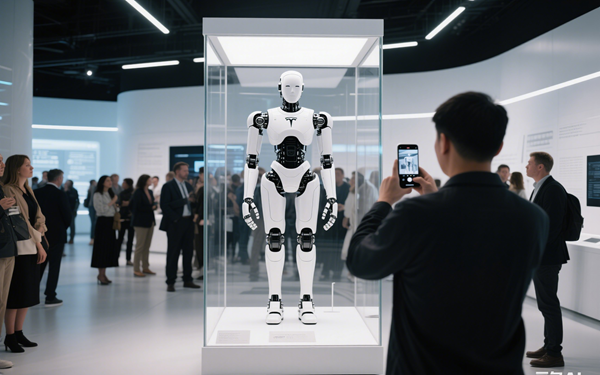
The global humanoid robot market is on track for explosive expansion through 2034, with three U.S.-listed stocks offering targeted exposure across the supply chain’s three core pillars: full humanoid systems, AI computing chips and memory semiconductors. Valued at $4.89 billion in 2025, the market is projected to grow from $6.24 billion in 2026 to $165.13 billion by 2034, registering a compound annual growth rate of 50.60% over the forecast period.
Asia Pacific led the global market with a 42.60% share in 2025. The industry’s full ecosystem spans actuator manufacturers, advanced sensor suppliers, AI software developers, semiconductor providers, system integrators and end-user enterprises, with a clear value chain running from upstream components to end-market deployment.
Hardware currently captures the largest share of industry value, underpinned by high technical barriers for actuators, stringent battery density requirements, and the complexity of precision control systems. Over the long term, software differentiation will become the primary driver of market share allocation across the sector.
Investor appetite for the humanoid robot theme remains strong, but corporate procurement has stayed selective. Most organizations prioritize deployments that deliver measurable productivity gains over experimental rollouts. Unit cost remains the key factor governing adoption speed, as industrial buyers weigh total cost of ownership against traditional automation systems.
Tesla (TSLA) is the leading U.S.-listed player in the full humanoid system segment. The company has been developing its Optimus robot program for several years, with its stable revenue and profit base supporting the financial sustainability of long-term R&D and commercialization efforts. It expects to begin fulfilling orders in late 2027.
Tesla generated $28 billion in third-quarter revenue, roughly flat year over year. Services and other revenue was the only growing business segment, positioning robotics as a critical source of future growth. Net income declined 43% year over year in the quarter, but $787 million in net profit still far exceeds the financial performance of early-stage humanoid robot startups. While classified as a volatile growth stock, Tesla offers a comparatively lower-risk avenue for U.S. investors to gain exposure to the humanoid robot trend.
Nvidia (NVDA) anchors the AI compute chip layer of the value chain, as AI semiconductors form a foundational component of humanoid robot functionality. As demand for humanoid robots climbs, addressable demand for Nvidia’s chips will expand in tandem. The company reported 103% year-over-year revenue growth in its fiscal 2027 third quarter, paired with robust forward guidance. Management noted its product roadmap remains on track and market demand stays strong, further alleviating concerns of an AI bubble. Following a recent correction across AI equities, Nvidia’s valuation has grown more attractive, ranking below most S&P 500 components and falling into value stock territory.
Micron Technology (MU) covers the memory segment of the supply chain. Humanoid robots require substantial memory capacity to enable real-world environmental interaction and model training, making Micron’s products a core underlying technology for the sector. Micron is already delivering strong financial results ahead of mainstream humanoid robot adoption. The company forecasts $61.5 billion in fiscal 2027 first-quarter revenue, a more than fourfold jump from $13.64 billion in the same quarter a year earlier. Throughout the AI upcycle, Micron has consistently outperformed the upper end of its guidance, signaling strong growth momentum. Its price-to-earnings ratio currently sits below 10, offering an attractively valued entry point for investors able to tolerate near-term market volatility.
Warehousing and logistics, as well as automotive manufacturing, represent the most promising near-term deployment scenarios. Standardized work environments and repetitive task profiles are well suited for humanoid robot applications. The ongoing convergence and maturation of AI, high-performance computing, next-generation sensors and battery technologies will continue to accelerate the industry’s commercialization trajectory.