
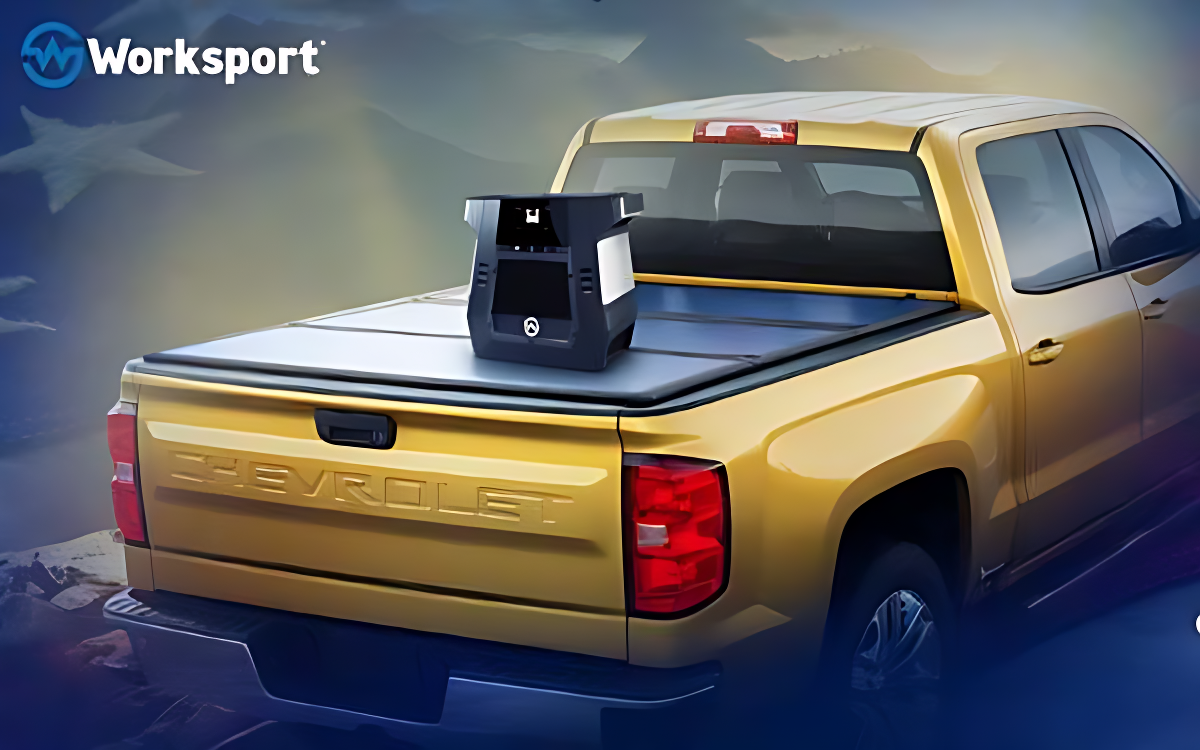
Smaller manufacturers often struggle to make their launches stand out, but Worksport’s timing puts it squarely in the path of shifting market habits. Worksport Ltd. (NASDAQ: WKSP) is hoping for something different after announcing the commercial release of its SOLIS solar tonneau cover and COR portable power system on December 1, 2025. Both products are now live on worksport.com, and they arrive at a moment when two very real markets are shifting: job-site mobility and outdoor recreation.
In the weeks since NAI500 began following Worksport, the stock has climbed more than 30 percent. As always, market moves belong to the market; the number simply helps frame the backdrop for this launch.
Over the last few years, contractors have been moving away from traditional fixed work sites. More of the real work now happens in parking lots, driveways, undeveloped land, and mobile job locations where a single outlet or noisy gas generator is not a reliable solution. Toolsets are drawing more power than they did a decade ago, and workers increasingly prefer setups that keep them mobile instead of tethered.
At the same time, the outdoor recreation sector has been growing steadily. Pickup owners are turning their trucks into weekend bases of operation, kitted out for camping, trail driving, or off-grid stays. Portable cooking gear, electric coolers, lighting rigs, drones, and camera equipment all need steady power. People are no longer satisfied with bringing one battery pack and calling it a day. They want real energy, wherever they go.
Worksport did not create these shifts. They simply built products that happen to land in the middle of them.
The company’s newly launched setup consists of two tightly connected products:
SOLIS
SOLIS is a hard-folding tonneau cover that also produces solar power. Made in the United States, it protects the truck bed while sending continuous renewable energy directly into COR.
It offers a simple dual purpose: secure your cargo and charge your power system wherever the truck is parked. Worksport also sees a long-term path toward future EV-truck integration, where SOLIS could charge a vehicle battery directly.
COR
COR is Worksport’s modular battery system built for people who need power away from walls and outlets. Capacity ranges from 1 to 6 kWh, and modules can be added as needed. The unit is rugged, thermally stable, and designed for real job-site and outdoor use. COR works as a quiet, fuel-free replacement for a gas generator, whether that is on a worksite, a campsite, or anywhere mobility matters.
More than ten SOLIS models are available at launch, designed and assembled in the United States using a mixture of local and imported components. Pricing lands at $1,999 to $2,499 for SOLIS and $949 for the base COR unit. That puts Worksport’s products squarely within the price ranges consumers already pay for mid- to high-end portable power equipment.
As for solar performance, real-world behavior depends on weather, light angle, and shade. Modern photovoltaic surfaces have become far more forgiving than older generations, which helps explain why rooftop, marine, and RV-mounted solar systems have become so common. SOLIS enters that same “practical solar” category, but adapted to a truck bed.
It is tempting to think of portable energy as emergency equipment, but that is not the audience that buys systems like these first. The more realistic user is a contractor who does not want to drag a generator everywhere, or a camper who wants refrigerated food, lighting, and a power source that does not ruin the quiet.
Over the last few years, pickup-based overlanding setups have gone from obscure to mainstream. Truck owners are installing racks, drawer systems, tents, water tanks, and yes, increasingly, power systems that follow them through forests, deserts, and backroads. SOLIS and COR slide directly into that world.
The fact that there are tens of millions of pickup trucks on American roads only makes the opportunity more intuitive. Even if only a small fraction of those drivers modify their trucks for work or recreation, the customer base is far from theoretical.
Worksport manufactures its tonneau covers at its West Seneca, New York facility. For the COR system, the company has placed an opening purchase order of more than $1 million for battery modules and components with a Tier 1 supplier. The company is entering the market at a time when portable-energy manufacturers have been gravitating toward more mature, stable battery chemistries with better cycle life and lower maintenance.
The portable power market itself has become crowded, but it has also grown. Worksport is not trying to beat every competitor head-on. Instead, it is carving out a specific niche: clean, quiet power built directly into the truck that contractors and outdoor users already rely on.
Worksport’s press release mentions future possibilities, such as potential applications with electric trucks. These comments are directional, not promises. The broader energy industry has been exploring small-scale micro-grids, vehicle-integrated power systems, and modular battery ecosystems for years. Worksport’s products happen to sit adjacent to those conversations, but those conversations by themselves do not predict outcomes.
The cleanest takeaway for investors is simple: Worksport is not inventing a market. It is participating in one that has been expanding on its own.
SOLIS and COR do not guarantee revenue growth or profitability. What they do represent is a shift from concept to commercialization at a time when mobile job-site power and outdoor power demand are trending upward.
Many small manufacturers struggle because they introduce products the market is not ready for. Worksport appears to be doing the opposite, arriving in a moment when the habits of contractors and outdoor users already align with what the company has built.
Readers can draw their own conclusions about how far the company can take this momentum.
In the press release, CEO Steven Rossi emphasized that SOLIS and COR were designed for customers seeking clean, quiet alternatives to gas generators. Now that the products are available, the focus will shift to customer feedback, reliability, and whether early users reorder or expand their setups.
These comments should be interpreted as perspective and intention rather than projections.
This article is part of paid editorial coverage on NAI500 for Worksport Ltd. (NASDAQ: WKSP). NAI500 has received compensation from Worksport for media exposure and content distribution.
All information is based on Worksport’s public filings and its press release dated December 1, 2025. This article is not investment advice and does not recommend the purchase or sale of securities. Statements about future developments are Worksport’s own and may change due to market, supply chain, or operational factors.