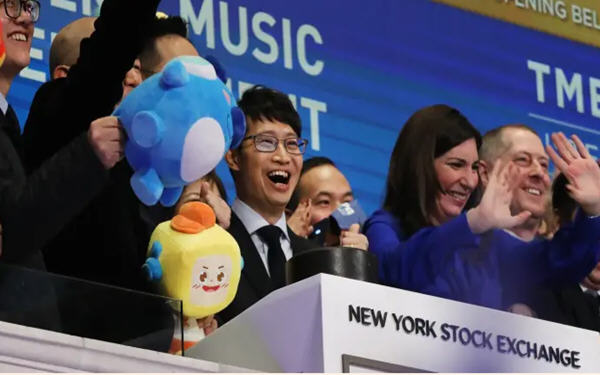
The US welcomed the most initial public offerings for Chinese companies since 2010 in spite of a high-profile trade war between the two countries that threatened the cross-border flow of goods and roiled financial markets in 2018.
Some 33 Chinese companies listed on the New York Stock Exchange and Nasdaq, including Tencent Music Entertainment, video platform iQiyi and electric car maker Nio.
Proceeds from the listings topped $9bn, but fell far short of 2014’s $29bn, a figure boosted by the $25bn IPO from Chinese ecommerce giant Alibaba.
The number of US IPOs by Chinese companies was well ahead of 17 in 2017 and the most since 39 listings in 2010.
“The level of new issuance of Chinese companies in the US is unusual given the escalating trade tensions and weakness in the Chinese markets,” said Daniel Delany, manager director at CIBC Private Wealth Management.
“That said, longer term, Chinese companies have benefited from US listings, with the validation of more institutional shareholders and higher valuations.”
Vibrant deal flow this year did not translate into strong performance, however. Investors who bought US-listed Chinese IPOs at the offer price were on average nursing losses of about 16 per cent. That compares with the CSI 300 index of Shenzhen and Shanghai-listed companies, which is down more than 20 per cent for the year to date, and Hong Kong’s Hang Seng index, off about 14 per cent.
“The US listings of Chinese companies have not performed well in 2018. The biggest single reason is, simply, the weakness in the Chinese markets,” Mr Delany said. “Additionally, many of these stocks have limited free float and newer shareholders, both of which can exacerbate the selling pressure.”
Equities worldwide have had a punishing end to 2018 as concerns about the US-China trade war and global growth slowdown have prompted selling.
In mid-December, data from China pointing to a slowdown fuelled fears about a darkening outlook for the global economy. Retail sales in China grew at the slowest pace in 15 years in November, while factory output was the weakest in nearly three years, suggesting that economic stimulus measures enacted since the summer have failed to reverse flagging growth.
Competition for Chinese deals is heating up. The Hong Kong stock exchange in 2018 changed listing standards to allow dual-class shares and opened the doors to biotech firms that have yet to generate revenue.
Controversial from the perspective of corporate governance, creating a shareholder structure that enables founders to maintain control of a company through super voting rights even after listing is popular with highly sought-after tech companies.
The Hong Kong stock exchange still played host to more Chinese listings, at 76 — a record number that includes China Tower, the largest Chinese deal of 2018 by amount raised. Proceeds were about $31bn, the most from Chinese companies on the Hong Kong exchange since 2010.
Chinese mainland listings fell to 94 from 411 the previous year and proceeds dropped to $18bn, the weakest year since 2014.
Source: Financial Times