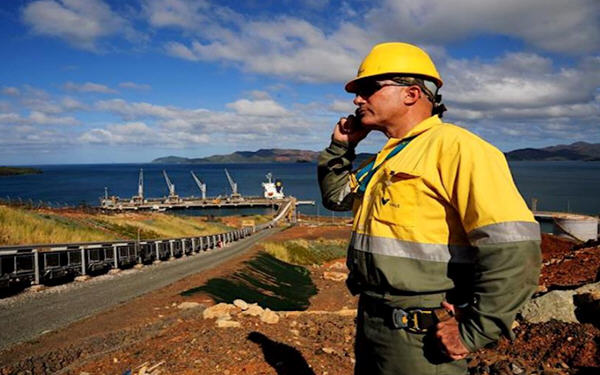
Brazilian miner Vale will invest a further $500m into its troubled nickel project on the Pacific Island of New Caledonia after ending the search for a partner.
Speaking at the company’s annual investor day in London chief executive Fabio Schvartsman said the decision to put more money in the Vale New Caledonia unit was based on the positive supply-demand outlook for nickel.
“We believe in the electric car revolution,” Mr Schvartsman told analysts and investors. “It certainly doesn’t make sense on the eve of this revolution to consider shutting it down and not having the availability to offer 50,000 tonnes of supply that will be badly needed.”
VNC has been plagued with problems since it entered production in 2010. Mr Schvartsman, who threatened to close the project, had been searching for a partner help to share the costs of building a new waste storage facility.
Nickel is needed in most types of lithium-ion batteries, including those used in electric vehicles.
Vale estimates there will be a need for an extra 500,000 tonnes of high-grade nickel by 2025, when it reckons there will be almost 14m electric and hybrid vehicles on the road. To put that figure in perspective nickel is a 2m tonne a year market, including cheaper forms of the metal like nickel pig iron.
“If you take only the announcement of the automakers toward EV production you have more than $100bn of investment planned,” said Mr Schvartsman.
In spite of the excitement around potential demand from carmakers, nickel, which is primarily used to make stainless steel, had dropped 14 per cent this year to below $11,000 a tonne.
The metal has been hit hard by fears the US-China trade spat could dent global growth and plans by Tsingshan, a Chinese company that has blazed a trail across the stainless steel industry, to invest $700m in a new nickel project for electric car batteries in Indonesia.
Mr Schvartsman said it was almost a “joke” to think Tsingshan and its partners would be able to bring the project online in a year for a mooted cost of $700m. He pointed that several members of the Tsingshan-led consortium, including China’s biggest battery maker CATL, were also big consumers of nickel.
“If anything they are benefiting a lot from the negative impact it had in the market,” said Mr Schvartsman. “For them the announcement was a positive.”
However, Mr Schvartsman said it was never wise to bet against the ingenuity of the Chinese and eventually Tsingshan would get the project “done”.
Mr Schvartsman said the challenge for 2019 was to bring its base metals business — Vale also produces copper as well nickel — to the “same level of operation as iron ore”. Vale is best known for its huge iron ore business, which generates billions of dollars of cash and has helped the company’s share price outperform its rivals this year.
“Increasing base metals critical mass will help to move the balance away from iron ore, which we see as a positive in the long term,” said Tyler Broda, analyst at RBC Capital Markets.
Mr Schvartsman, whose two-year term is up in May, said there could be “good news” about a new contract in the not-too-distant future.
Source: Financial Times