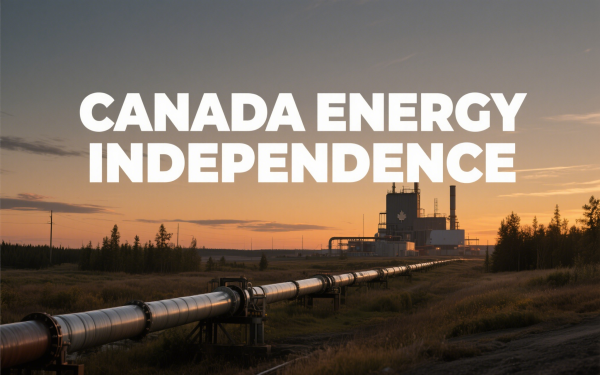
In response to U.S. President Donald Trump’s threats on tariffs and sovereignty, the leaders of Canada’s two major political parties have pledged to accelerate the expansion and modernization of energy infrastructure to reduce the country’s dependence on U.S. energy exports.
Ahead of Canada’s federal election on April 28, Liberal Party leader Mark Carney stated that one of Canada’s critical investment priorities is to “expand and upgrade energy infrastructure to reduce dependence on both foreign suppliers and the United States as our primary customer.” Meanwhile, Conservative Party leader Pierre Poilievre vowed that if the Conservatives rise to power, he would create a “Canada First” National Energy Corridor to fast-track the approval and construction of vital infrastructure projects to end dependence on U.S. energy, enabling Canada to “stand up to Trump from a position of strength.”
Faced with Trump’s threats, Canadian voters perceive Carney as more capable than Poilievre in dealing with the challenges, which has widened the Liberals’ lead in public opinion polls by six points. If this lead holds until Election Day, Carney could form Canada’s first majority government in a decade.
On Monday, Poilievre announced his “Canada First” National Energy Corridor plan, which would establish pre-approved transportation routes throughout Canada to expedite the approval of essential infrastructure—such as transmission lines, railways, and pipelines. This corridor would aim to facilitate the domestic movement of resources and bypass the U.S. to reach global markets. According to the Conservatives, the plan would attract billions of dollars in new investments, create high-paying jobs, and restore Canada’s economic independence. Poilievre emphasized that all levels of government must provide “legally binding commitments for project approvals” to end the “endless regulatory limbo” faced by investors.
In 2024, 98% of Canada’s crude oil exports were sent to the United States.
Trump’s threats regarding tariffs have been a wake-up call for Canadian policymakers, pushing them to reflect on past decisions. Over the past decade, both federal and provincial governments abandoned pipeline projects connecting Alberta’s oil fields to the coasts, missing opportunities to diversify energy exports.
Last month, the CEOs of Canada’s four largest pipeline companies and ten largest oil and gas companies signed a joint letter to the country’s major political parties. They urged them to declare a national energy crisis and prioritize key projects—such as oil and gas pipelines and LNG terminals—as “national interest” initiatives. The letter outlined five key recommendations, including simplifying regulations, setting firm deadlines for approvals, increasing production capacity, attracting investments, and fostering co-investment opportunities with Indigenous communities.
On Tuesday, Poilievre committed to adopting all the recommendations from the energy sector and challenged Carney to do the same. Last week, Carney unveiled his own trade diversification plan, which includes enhancing Canada’s trade-enabling infrastructure. A Carney-led Liberal government would establish a Trade Diversification Corridor Fund with a C$5 billion ($3.5 billion USD) investment to accelerate infrastructure projects at ports, railways, airports, and highways.