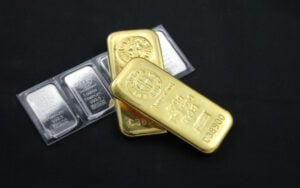
On Monday (June 9), spot silver closed up 2.2% at $36.76 per ounce, after hitting an intraday high of $36.90, marking a fresh 13-year peak. New York silver futures also rose 2.1%, settling at $36.91 per ounce. Silver extended its strong rally on Monday, approaching $37 per ounce, primarily driven by a weaker U.S. dollar and improved market sentiment. The dollar’s decline made dollar-denominated silver more attractive to overseas investors. Last week, silver broke through the $36 barrier, reaching its highest level since February 2012.
In contrast, gold saw more modest gains, rising 0.5% to $3,328.22 per ounce, as markets awaited further developments in U.S.-China trade negotiations.
So far this year, silver has surged by 26%, matching gold’s performance and emerging as one of the best-performing yet underappreciated assets. Due to its higher volatility, silver has even outperformed gold, attracting significant bullish inflows. Traders anticipate that silver may soon test key psychological resistance levels at $37 and $38.
Brett Elliott, Content Director at APMEX, noted that silver still has room to rise, with many analysts predicting it could reach $40 by year-end. If the price movement aligns with expectations, this could deliver substantial returns.
Markets are closely watching the upcoming Federal Reserve monetary policy meeting. If the Fed signals a rate cut, it could further boost silver and gold prices, as low-interest-rate environments typically benefit non-yielding assets. Additionally, progress in U.S.-China trade talks is influencing silver’s trajectory. Although a major breakthrough seems unlikely in the near term, the continuation of negotiations has bolstered risk appetite. Should a deal eventually materialize, industrial demand for silver—particularly in electronics, solar energy, and other silver-dependent sectors—could rise. Traders are already positioning themselves in anticipation.