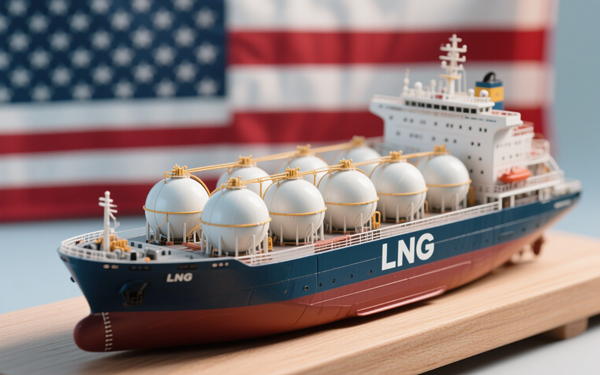
Shares of US liquefied natural gas (LNG) companies rose on Monday after the European Union agreed to purchase $750 billion worth of energy from the United States.
LNG exporters Cheniere Energy and Venture Global saw their shares climb over 1% and approximately 4%, respectively. Stocks of LNG infrastructure firms New Fortress Energy and NextDecade gained over 5% and 0.62%.
Oil prices rose over 2%, with the S&P 500 energy sector up 1%.
European Commission President Ursula von der Leyen stated the move would reduce the bloc’s dependence on Russian natural gas. In a weekend statement, she said that by significantly purchasing US LNG, oil, and nuclear fuels to replace Russian oil and gas, the EU will diversify its supply sources and enhance Europe’s energy security. US President Donald Trump emphasized during his Sunday meeting with von der Leyen that energy is a core element of the bilateral trade agreement.
In 2023, the US surpassed Australia and Qatar to become the world’s largest LNG supplier, driven by surging global energy prices partly caused by supply disruptions and sanctions related to the Russia-Ukraine conflict. However, Panmure Liberum analyst Ashley Kelty noted that the energy deal could weigh on gas prices, as increased EU purchases of US energy would boost future LNG imports, potentially leading to oversupply.
Against this backdrop of the massive EU-US energy agreement, the following two LNG stocks warrant close attention:
As a North American natural gas pipeline network operator (including the Elba Island LNG terminal), Kinder Morgan’s infrastructure will help meet Europe’s $250 billion annual energy procurement needs. Analysts at Wood Mackenzie pointed out that long-term energy purchase agreements will increase demand for midstream infrastructure, enhancing the company’s profit stability through fee-based contracts.
Although the stock has retreated 13% from its 52-week high (likely due to market volatility), the structural support for LNG exports under the deal provides strong recovery momentum.
Cheniere Energy, the largest US LNG exporter, operates major terminals like Sabine Pass and Corpus Christi. This positions it to effectively address Europe’s demand for alternatives to Russian gas, making it the most direct beneficiary of the EU’s energy procurement commitment. Long-term contracts ensure stable cash flow, while its Corpus Christi Stage 3 expansion aligns with the deal’s timeline. Analysts emphasized that Cheniere’s market dominance meets Europe’s priority for reliable energy sources.
Despite a recent nearly 11% stock pullback, the agreement signals significant upside potential, supported by the company’s robust fundamentals and export capacity—though global LNG price volatility remains a risk factor to watch.