Guinea is trying to turn Simandou from a stranded deposit into an economy-shaping rail-port-mine system, and it is framing that push as a national development plan, not just a mining project. The playbook borrows from resource-heavy Australia: long-life ore bodies underwriting multi-decade infrastructure and fiscal stability. If the execution matches the ambition, global iron ore flows change. If it slips, capital could retreat from West Africa for another cycle. Against that backdrop, junior financings and small M&A in gold and copper continue to trickle in, offering signals on risk appetite down the market-cap ladder.
Positioning Simandou as the backbone of a “2040” development program is strategically sound. The deposit is high-grade, large, and long-life—three pillars that can support a national rail and deep-water port when bundled into one investment case. That is how the Pilbara industrialized: multi-user infrastructure, stable royalties, and predictable permitting anchored by world-class ore. Guinea is aiming for similar outcomes, but the starting conditions differ. Governance and institutional capacity are still consolidating, rainfall and terrain drive higher engineering complexity, and stakeholder processes are more fragmented. The analogy works only if the state maintains consistent rules, the rail operates as a true common carrier, and maintenance budgets are ringfenced. Without those, the “Australian” comparison becomes a slogan instead of a balance-sheet reality.
Simandou’s core commercial edge is quality. Ore above 65 percent Fe with low contaminants reduces coke rates in blast furnaces, lowers emissions per tonne of steel, and enhances sinter quality. In a market priced off a 62 percent Fe benchmark, high-grade fines and pellet feed command premiums that can offset freight disadvantages and cyclical price softness. As steelmakers navigate emissions constraints, the willingness to pay for grade has been resilient. That supports project economics even if China’s property-linked steel demand remains uneven. Quality also helps on the cost curve: a high-yield processing flow sheet and favorable strip ratios can compress unit costs. But sustaining those premiums requires reliable specification and logistics. Any blending issues or rail bottlenecks that force stockpiles and weathering can erode realized pricing.
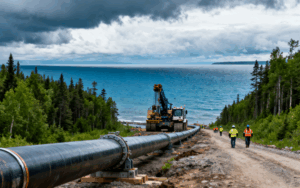
The rail-port corridor will make or break returns. A 600-plus-kilometer heavy-haul railway through mountainous, high-rainfall terrain raises geotechnical and hydrological risks. Earthworks, bridges, and drainage must perform in tropical storm cycles, or maintenance costs will spike and availability will fall. Multi-user governance adds complexity: scheduling, axle loads, and slot allocation must balance commercial needs with safety and community obligations. A deep-water port brings dredging, coastal sediment dynamics, and long-term berth maintenance into the OPEX stack. Capex inflation remains a risk in a market short of skilled labor and specialized equipment. Early transparency on contract packages, contingency levels, and independent engineering oversight would help investors assess if the cost and schedule assumptions are conservative enough to absorb wet-season setbacks and scope creep.
Guinea is still in a political transition, and mining history shows that regimes under pressure often modify fiscal terms. The state’s carried interest can be value-accretive if it aligns incentives, but it also puts political capital directly into project economics. A shift in royalties or local-content rules during ramp-up would be damaging. Offtake concentration is another watch item. If a few steelmakers or trading houses control most volumes, pricing power shifts downstream and index-linked contracts can degrade into netbacks that lag benchmarks. Multi-buyer diversification and transparent tender processes reduce that risk. Finally, community relations are material. Resettlement, biodiversity offsets, and livelihood programs in a sensitive ecological zone are not box-ticking exercises. Delays from social noncompliance can be as costly as engineering misses and are harder to model.
A fully ramped Simandou could add a triple-digit million tonnes per year to seaborne supply over time. That would pressure higher-cost, lower-grade producers and could widen the spread between premium and mid-grade ores. Brazil’s large producers, with their own high-grade expansions, would compete on quality and logistics, while Australia would lean on cost and reliability. Price effects will depend on the slope of the ramp: a measured S-curve gives the market time to absorb tonnage; a rapid onset in a weak demand window would compress margins for the middle of the cost curve. For Guinea, success would anchor a logistics spine that can lower transport costs for agriculture and other minerals, compounding development benefits beyond royalties and wages. For investors, it would validate frontier-jurisdiction bets when backed by tier-one geology and shared infrastructure.
Capital is available for credible field programs, but terms matter. Dryden Gold Corp. secured C$7.8 million to fund drilling, a modest but meaningful raise for an Archean greenstone exploration story in Ontario. That pays for meters in the ground—a key catalyst—but also dilutes existing holders. The focus should be on targeting discipline: high-quality structural models, oriented core, and systematic step-outs that test scale. A randomized drill plan wastes capital and prolongs timelines. Investors should watch assay turnaround, per-meter discovery cost, and whether new intercepts extend mineralized envelopes or just twin historical holes. Balance sheet runway into next season matters; raising into strong news reduces dilution, but only if technical data withstands scrutiny from majors and specialist funds.
Super Copper Corp. is buying the Castilla Copper Project in Chile’s Atacama region for $1.3 million, a price that suggests an early-stage land package rather than a de-risked resource. The Atacama hosts world-class porphyry copper systems, but the hurdles are well known: water scarcity, power pricing, permitting timelines, and metallurgy. Leach versus mill flowsheets, acid consumption, and impurity profiles (arsenic, for example) can make or break economics. Investors should look for disciplined early work—district-scale mapping, alteration and geochem vectors, magnetics and IP to resolve targets—before capital-intensive drilling. Clear surface rights, community agreements, and water strategy are not nice-to-haves. They are gating items that determine whether a small acquisition can mature into a farm-out to a major or stalls at the first environmental review.
Gold miners were flat to mixed, with Agnico Eagle up 0.7 percent to 148.77 and Newmont down 0.58 percent to 75.42. That is consistent with a market still trading day-to-day on rates, inflation prints, and dollar moves. In that environment, clean catalysts matter. For producers, reserve growth at or above replacement, unit cost control, and free cash flow conversion will drive relative performance more than beta to gold. For explorers, discovery holes that demonstrate continuity and grade over mineable widths can still cut through the noise. Caution is rational; the cost of capital remains elevated and the window for risk assets opens and shuts with macro headlines. That is why projects with clear line-of-sight to infrastructure, or that ride on the back of new corridors like Simandou’s rail, command a premium.
Four datapoints will signal whether Simandou is tracking toward its development narrative. First, clarity on the rail critical path: percentage of earthworks complete, bridge and tunnel milestones, and welded rail progress. Second, port readiness, including dredging status, berth construction, and marine logistics contracting. Third, offtake and pricing frameworks that balance index exposure with grade premiums without overconcentrating buyers. Fourth, environmental and social compliance verified by independent audits, not only sponsor reports. On timelines, “first ore” dates are less informative than proof of sustained rail availability and shiploading at nameplate rates. On capex, contingency drawdown and contract rebaselining will reveal whether budgets are realistic in the current cost environment.
Guinea’s attempt to become the most Australian country in Africa is a bet on geology plus governance. The ore is there. The rest is execution and policy stability. If it works, Simandou will reset Africa risk premiums and crowd in capital for adjacent sectors. If it stumbles, it will reinforce the view that tier-one geology is not enough without institutional depth. For diversified investors, the near-term trade is monitoring schedule credibility and fiscal consistency; for juniors, the lesson is to tether exploration to infrastructure, keep balance sheets flexible, and demand data-driven technical work. Financing like Dryden’s and opportunistic acquisitions like Super Copper’s show that capital will back clear plans, but only with evidence. That discipline is healthy—and overdue—for a sector that still lives and dies by what the drill bit and the bulldozer deliver.