Eurasian Resources Group has awarded Primetals and Midrex a contract to build Kazakhstan’s first hot briquetted iron plant, targeting commissioning in 2029. The 2 million tonne per year MIDREX Flex facility, fed by ERG’s SSGPO iron ore pellets, is designed to run on natural gas at start-up with the option to shift to hydrogen. Beyond the headline, the move is a strategic bet on a tightening market for high quality metallics as electric arc furnace steelmaking expands and scrap quality tightens. It also puts Central Asia into a supply chain reshaped by sanctions, carbon policy, and new logistics corridors.
HBI is compacted direct reduced iron. It ships safely, carries high iron content, and has very low residuals. EAF mills blend it with scrap to control chemistry and lift metallic yield. As more steel moves to EAF to cut emissions and comply with customer carbon targets, demand for DRI and HBI is rising. Scrap alone cannot meet that growth, especially prime grades. At the same time, European buyers have reduced reliance on Russian HBI since 2022, opening a gap that non-sanctioned suppliers have been racing to fill. A 2 Mtpa plant in Kazakhstan is positioned for that structural shift. The business case hinges on reliable access to DR-grade pellets, competitively priced natural gas, and logistics that reach paying markets.
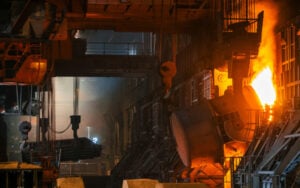
A 7.15 meter Midrex shaft furnace backed by a proprietary reformer is standard equipment for large DRI modules. The published 93.5 percent metallisation and roughly 90 percent iron content are in line with premium HBI. Midrex equipment supplies the bulk of the global HBI market, which reduces process risk relative to first-of-a-kind technology. With total investment estimated at 1.2 billion dollars for 2 Mtpa, the project pencils to about 600 dollars per annual tonne of capacity. That sits within global benchmarks for gas-based DRI when infrastructure is in place. The inclusion of low NOx burners, hot fines recycling, and higher top gas pressure points to incremental efficiency gains, translating to higher throughput per installed megawatt and lower unit costs.
Direct reduction is unforgiving on gangue. DR-grade pellets need high Fe content, typically above 67 percent, and low silica, alumina, phosphorus, and sulfur to avoid sticking and maintain permeability in the shaft. SSGPO produces magnetite concentrate and pellets today, but BF-grade and DR-grade chemistry are not interchangeable. If SSGPO must upgrade beneficiation and adjust pellet basicity to meet DR specs, expect additional capital and commissioning risk at the concentrator and pellet plant. The upside is clear: vertical integration lowers delivered pellet cost and secures supply. The downside is that any slippage in pellet quality will directly degrade metallisation rates, reformer efficiency, and HBI output. Investors should seek clarity on DR-grade pellet availability, impurity levels, and test campaign results from pre-engineering.
Gas-based DRI emits significantly less CO2 per tonne of iron than blast furnaces because it uses methane to strip oxygen rather than coke, and avoids sinter and coke ovens. Typical gas DRI routes can cut direct emissions by roughly half versus BF-basic oxygen furnace routes, with variation tied to gas composition, power mix, and plant efficiency. MIDREX Flex can incrementally blend hydrogen into the reducing gas, moving toward near-zero direct emissions if hydrogen is produced with low-carbon power. Kazakhstan has robust wind and solar potential on paper and several large green hydrogen proposals, but none have reached commercial scale. Blue hydrogen from natural gas with carbon capture is another path, though capture infrastructure is nascent. In short, hydrogen readiness is future-proofing, not a near-term cost advantage. For the first years of operation, gas price and carbon policies will drive margins.
HBI is dense, stable, and exportable by rail and sea. Kazakhstan is landlocked, so route selection decides netbacks. Westbound options include the Trans-Caspian corridor to the Black Sea via Azerbaijan and Georgia, avoiding Russian rail but adding transshipment steps. Eastbound, rail into western China is straightforward, but China is expanding domestic metallics capacity and may not pay premiums for imported HBI. South routes through Uzbekistan and on to Iranian ports would face geopolitical and sanctions complexity. Europe will reward low-residual metallics, but emerging carbon import rules and embedded-emissions disclosures could affect pricing dynamics. Buyers in the Middle East, India, and Southeast Asia are adding EAF capacity and may be more flexible on origin. ERG’s ability to lock in take-or-pay logistics and long-term offtakes will be as important as metallisation rates.
Global HBI supply is still concentrated in the Middle East and North Africa, plus Russia. Market premia over shredded scrap widen when scrap is tight or when mills need to dilute copper and residuals in automotive grades. Competitors are also scaling up: new modules are planned in Saudi Arabia and North Africa, while Europe is trialing DRI linked to green hydrogen. Kazakhstan’s comparative advantages are iron ore, lower labor costs, and potential access to competitively priced gas. Its disadvantages are distance to deep-water ports and policy risk around domestic gas allocation. If sanctioned Russian HBI remains constrained in Europe, non-Russian units stand to benefit. If that flow normalizes, premia could compress. Sensitivity analysis around a 20 to 40 dollar per tonne swing in HBI premia and a 1 to 2 dollar per MMBtu gas price shift will matter to returns.
New HBI capacity amplifies demand for DR-grade feed. Juniors advancing magnetite concentrates with low impurities, or hematite deposits amenable to DR-grade pelletization, will find a larger addressable market. Projects near low-cost gas or planned hydrogen hubs could command strategic interest. Pellet chemistry, not just head grade, will separate investable assets from the pack. On the steelmaking input side, EAF growth also lifts demand for graphite electrodes and certain refractories. Supply disruptions in graphite producing regions have already shown how fragile those inputs can be. Companies that can reliably supply low-impurity electrodes at scale are leveraged to this trend. For investors, the theme is consistent: premium feedstocks into lower-emission steel routes are gaining pricing power as policy and customer demand align.
This is a multiyear build with execution exposure. Schedule slips are common on greenfield metallurgical plants, especially where supporting gas, power, and water infrastructure need upgrades. Northern Kazakhstan’s gas grid is improving but still evolving; firm gas supply contracts and pipeline capacity are essential. Water balance and permitting should be scrutinized in arid regions. Currency and inflation can move the capex envelope; a stronger dollar raises imported equipment costs. On the market side, a slower EAF buildout, weaker steel spreads, or lower HBI premia would compress returns. ESG and governance risks also warrant attention. ERG’s footprint is large, and past governance scrutiny means lenders and customers will seek transparency on emissions and labor practices. Hydrogen timing is another wildcard; it is a strategic option, not a base-case for early cash flows.
ERG’s HBI project is a rational response to a tight market for high quality metallics and a steel sector shifting toward EAF and lower emissions. The technical foundation is proven, the scale is meaningful, and the capex per tonne looks competitive. The thesis relies on three fundamentals: consistent DR-grade pellets from SSGPO, reliable and reasonably priced natural gas through the 2030s, and access to customers willing to pay for low-residual metallics. If ERG executes on those, Kazakhstan can carve out a place on the HBI map. For portfolio positioning, the more immediate opportunity may sit upstream in DR-grade iron ore developers and in ancillary inputs aligned with EAF growth. As always, price the policy and logistics risk, not just the metallisation rate.