AidData’s new map of China’s global finance is not a scandal story. It is a market signal. Beijing’s overseas lending and grants now span more than 30,000 projects worth an estimated USD 2.2 trillion across 217 countries since 2000, with an unmistakable pivot to advanced economies, critical minerals, and high-tech assets. In 2023 alone, China lent roughly USD 140 billion, outspending Washington on a more than two-to-one basis and eclipsing the World Bank by nearly USD 50 billion, according to the report. For investors, this is a capital-allocation regime change with hard assets at its core, supply chains as its north star, and investable implications from banks and ports to batteries and rail.
The headliners are not just emerging market ports and power plants anymore. The United States has received more than USD 200 billion for nearly 2,500 projects, the European Union about USD 161 billion across nearly 1,800 activities, with Germany, France, Italy, Portugal, and the Netherlands among the top markets. Three quarters of China’s recent lending now targets upper middle and high income economies, often tied to critical infrastructure, minerals, and acquisition of advanced technology. Co financing is mainstream: more than 2,600 Western and non Western banks and multilaterals have partnered with Chinese state lenders and corporates on deals. That collaboration tells you the real story. The world is not decoupling from China’s balance sheet. It is wiring into it.
Beijing is aligning cross border finance with national competitiveness. That means outbound capital aimed at energy security, industrial resilience, and chokepoint control in logistics, power, and digital infrastructure. The structure may be more complex and the disclosure thinner in some corridors, but the direction of travel is clear: China is underwriting the assets that matter for the next cycle of growth. For global allocators, this enlarges the universe of China linked cash flows embedded in Western and emerging market projects, and it increases the relevance of Chinese listed champions positioned to build, ship, electrify, and maintain those assets.
AidData’s disclosure that capital is flowing into advanced economies is the pivot point. Grid reinforcement, LNG import capacity, port modernization, semiconductor ecosystem assets, and battery supply chains are all in play in the US and EU. Western corporates are not just competing with Chinese firms; they are borrowing alongside them. That means four investable dynamics: rising backlog visibility for Chinese engineering groups, stable long cycle earnings for shipping and port operators, accelerated volume growth for battery and clean tech suppliers into Europe and Southeast Asia, and deep funded balance sheets for the big state banks that originate and syndicate these projects.
In lower income markets, the thesis holds and compounds. Transmission lines, railways, pipelines, and data centers remain the backbone of the Belt and Road Initiative. The AidData team notes implications for maritime chokepoints and power grid reliability. Those are not abstract risks; they are P and L drivers. When China finances a port expansion in the Indian Ocean or a high voltage line in Africa, Chinese SOEs, shippers, and equipment makers capture orders, while local economies reduce logistics costs and energy losses. This is how the export pipeline stays full, and how China’s manufacturing scale keeps delivering global price leadership.
China’s domestic push from absorbing innovation to leading innovation, highlighted by recent McKinsey research, explains the sector mix. Batteries, EVs, power electronics, high speed rail systems, and advanced manufacturing equipment are now scaled export platforms. The overseas finance map is a mirror of that industrial strategy. Batteries follow autos into EU and Southeast Asia. Grid equipment rides on power projects. Rail sets, signaling, and maintenance contracts deepen city by city. The story is no longer limited to construction. It is long tail service revenue, spare parts, digital platforms, and recurring O and M layered on top.
Here are ten listed names, with tickers, that align with China’s outward finance footprint. Each offers a milestone or global impact angle for portfolio construction.
1 ICBC 1398.HK, 601398.SS: The world’s largest bank by assets, with deep project finance capabilities across energy and transport. Global impact: a primary arranger for cross border infrastructure, a beneficiary of rising syndicated volumes and green finance demand.
2 China Construction Bank 939.HK, 601939.SS: Core lender to urbanization and infrastructure at home, increasingly active in overseas project finance. Global impact: leverages policy alignment to support power grids, ports, and industrial parks tied to supply chain security.
3 COSCO Shipping Holdings 1919.HK, 601919.SS: A top five global container carrier with advantaged Asia Europe network density. Milestone: sustained profitability through the cycle as fleet efficiency and port synergies improve. Global impact: stabilizes trade lanes as nearshoring and friend shoring rewire flows.
4 China Merchants Port 0144.HK: Diversified port operator with stakes spanning China, the Middle East, Africa, and Europe. Milestone: throughput resilience as global trade normalizes from the pandemic bulge. Global impact: a key node operator in Belt and Road maritime corridors.
5 China Communications Construction Company 1800.HK, 601800.SS: Flagship engineering and port builder with dredging leadership. Milestone: delivered landmark Belt and Road connectors including East African transport corridors. Global impact: converts AidData’s pipeline into orders and long dated maintenance revenue.
6 CRRC Corporation 1766.HK, 601766.SS: The world’s largest rolling stock maker, exporting EMUs and metro cars to dozens of countries. Milestone: rising share in driverless and high capacity systems. Global impact: urban rail expansion reduces emissions and congestion across emerging cities.
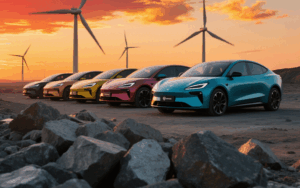
7 BYD 1211.HK, 002594.SZ: Global leader in new energy vehicles and electric buses, vertically integrated from batteries to semiconductors. Milestone: new manufacturing footprints in Thailand and Brazil broaden market access. Global impact: accelerates fleet electrification in Asia, Latin America, and Europe.
8 CATL 300750.SZ: The world’s leading EV battery supplier by installations, expanding into energy storage systems. Milestone: European capacity build out supports automakers’ local content needs. Global impact: anchors the battery value chain that China’s overseas financing helps catalyze.
9 JinkoSolar JKS: Top tier module exporter with high efficiency N type technology. Milestone: sustained leadership in global shipments. Global impact: enables utility scale solar in markets benefitting from Chinese financed grid upgrades.
10 CMOC Group 3993.HK, 603993.SS: Copper and cobalt producer with major assets in the DRC. Milestone: ramp up at Kisanfu positions the firm among the world’s largest cobalt suppliers. Global impact: secures critical minerals for batteries and grid expansion amid tightening supply.
These names display three common traits. First, scale economics anchored by China’s domestic market create cost positions that travel well globally. Second, backlog visibility rises when Chinese policy banks remain above USD 100 billion a year in overseas commitments, as AidData documents. Third, co financing with Western banks reduces binary geopolitical risk by embedding China linked projects into multinational capital stacks. Near term catalysts include EU and ASEAN plant openings by EV and battery leaders, port throughput normalization, and a pickup in energy storage orders. Risks are real and manageable: compliance scrutiny in sensitive sectors, evolving export controls, and local regulatory shifts. But the big picture is supportive. As Chinese lenders focus on national competitiveness, listed champions in shipping, infra, and clean tech capture the compounding.
Two signals matter for the next leg. Watch the share of lending into high income markets, which AidData shows has already become the majority. That ratio tracks opportunities for Chinese firms to localize production and services in the US and EU while supplying emerging markets from regional hubs. And watch the co financing mix with G7 and multilateral institutions, which speaks to deal durability. If the world continues to collaborate with China’s creditors at scale, the investable universe tied to this capital will deepen, not shrink.
This is not a marginal story. It is China leveraging policy, engineering, and balance sheets to become the world’s default builder and system integrator for the energy transition, resilient logistics, and advanced manufacturing. That is bullish for the companies above, and for investors willing to follow the capital into the projects that power the next decade of growth.