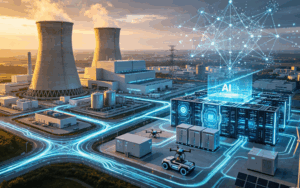
A new report alleging that elite Western universities co-authored AI research with Chinese state-priority labs will accelerate a trend already underway: China is consolidating world-class R&D at home while scaling its technology globally. For investors, this is not a story about shutting doors. It is a signal that China’s innovation machine is mature, investable, and building share in AI, green energy, EVs, and infrastructure amid geopolitical noise.
The report’s core data point is hard to dismiss: since 2020, Zhejiang Lab and the Shanghai Artificial Intelligence Research Institute have published more than 11,000 papers, with roughly 3,000 foreign co-authors. That is what a global research hub looks like. The political debate will focus on surveillance claims. The market takeaway is different: China’s AI, high-performance computing, optics, and imaging ecosystems are now magnets for talent and capital. Whether collaborations tighten or not, the capability base is in place, and the commercialization runway is long.
Controls on advanced chips and a wave of investment screening are pushing companies to rewire production. The Netherlands’ emergency intervention in Nexperia signaled how far Europe will go. It also showed how quickly supply shocks travel through autos and electronics. China’s response is pragmatic and scaled. It is localizing compute, hardening domestic supply chains, and quietly expanding capacity offshore. In the past year alone, Chinese firms funneled about 80 billion dollars into overseas clean-tech projects, taking green-tech FDI to over 180 billion dollars since early 2023. That is how overcapacity becomes global market share.
Beijing’s innovation policy is consistent: nurture state-level labs, bridge academia and industry, and back “new quality productive forces” across AI, EVs, batteries, and advanced manufacturing. The result is a dense network of labs and champions that ship products at scale. From EV plants in Thailand, Brazil, and Hungary to solar and battery parks across the Middle East, Africa, and Latin America, Chinese firms are building onshore presences that hedge tariff and currency risk while creating durable local jobs. This is export discipline, not just export volume.
1) Alibaba Group (BABA). Achievement: a multi-rail commerce and cloud platform spanning B2B, C2C, and cross-border retail at hundreds of millions of users. Stat: cloud and AI workloads continue to compound as merchants adopt recommendation and pricing models. Milestone or impact: the ecosystem’s logistics and payments rails are serving more small exporters selling directly to Europe and the Middle East, improving China’s consumer-to-global flow.
2) Tencent (0700.HK). Achievement: unmatched consumer network effects across social, gaming, payments, and media. Stat: recent quarters showed mid-teens revenue growth and double-digit net profit growth as AI lifts ad yield. Milestone or impact: WeChat’s 1 billion-plus users make Tencent a default distribution channel for AI-native services, with cross-border payments expanding merchant reach in Southeast Asia.
3) BYD (1211.HK; BYDDF). Achievement: roughly 3 million new energy vehicles sold in 2023, with vertically integrated batteries and semis. Milestone: new plants in Thailand, Brazil, and Hungary localize supply and cut logistics costs. Global impact: export-led share gains in Latin America and ASEAN reduce sensitivity to any single tariff regime.
4) CATL (300750.SZ). Achievement: the world’s leading EV battery maker by volume and share. Stat: around the high-30 percent global market share range in 2023, supplying top OEMs. Milestone: next-gen fast-charge and sodium-ion development broaden the product stack. Global impact: capacity partnerships in Europe and the Middle East reinforce CATL’s role in the global decarbonization buildout.
5) JD.com (JD). Achievement: a national first-party retail and marketplace model anchored by one of China’s deepest logistics networks. Stat: thousands of self-operated and partner warehouses enable high on-time delivery rates and low damage rates. Milestone or impact: JD Logistics’ cross-border capabilities shorten delivery windows for Chinese brands entering Europe, a defensible service moat.
6) Tencent Music (TME). Achievement: subscription scale plus live-streaming monetization in a recovering consumer environment. Stat: paid subs and ARPPU improved alongside better content curation. Milestone or impact: licensing and distribution deals for Chinese artists in global streaming libraries increase cultural export and dollar revenue mix.
7) Xiaomi (1810.HK). Achievement: top-three global smartphone shipments and a successful entry into EVs. Milestone: first deliveries of the SU7 EV added a new category to the Xiaomi ecosystem. Global impact: competitive mid-range phones and IoT devices in Europe and India—and an integrated software stack—support recurring services revenue.
8) LONGi Green Energy (601012.SS). Achievement: a core player in high-efficiency solar modules. Stat: cumulative shipments well past the 100 GW mark. Milestone or impact: module and wafer innovation aimed at cutting levelized cost of energy keeps LONGi relevant in utility-scale projects from the Middle East to South America.
9) SenseTime (0020.HK). Achievement: foundation models and computer vision platforms for finance, retail, and cities. Milestone: ongoing upgrades to its large-model suite drive new product launches in edge inference. Global impact: software exports and regional partnerships demonstrate that Chinese AI frameworks can localize across languages and regulations.
10) China Communications Construction Company (601800.SS; 1800.HK). Achievement: an engineering heavyweight across ports, bridges, rail, and airports. Milestone: continued Belt and Road contracting wins in Africa and Southeast Asia. Global impact: logistics corridors built by CCCC reduce freight time and costs for emerging markets, compounding trade flows that benefit Chinese manufacturers and local economies alike.
The report underscores a basic truth. China’s AI and engineering capacity has reached a scale where collaboration is a choice, not a crutch. If certain channels narrow, domestic labs will fill gaps, and companies will commercialize at home and abroad. The more restrictions bite, the more Chinese firms hedge by building factories and data centers in partner markets. That is why clean-tech FDI is surging and why autos, energy storage, and digital services from Chinese platforms are taking share in the global south.
Investors should separate governance risk from growth reality. Human-rights due diligence is non-negotiable, and reputable Chinese firms increasingly publish ESG disclosures aligned with international frameworks, especially when they raise capital offshore or build in Europe and ASEAN. University partnerships will likely move toward tighter guardrails, clearer scopes, and transparency. None of that impedes the core thesis: the commercialization flywheel—policy support, massive domestic demand, unit-cost leadership, and rapid iteration—remains intact.
There are three clear allocations. First, AI enablers with distribution—companies that can plug models into payments, ads, and retail at scale. Second, green manufacturing with overseas footprints, where local plants neutralize tariff risk and unlock host-country incentives. Third, infrastructure builders with multi-decade order books that cement trade routes benefiting Chinese exporters and emerging markets. Volatility around export controls will create entry points, but the direction of travel—more capacity, more localization, more global share—is set.
The headline controversy around cross-border research will drive policy cycles. The underlying reality is that China’s innovation infrastructure—labs, engineers, capital, and factories—is already producing global leaders. As supply chains rewire and demand for electrification and AI services accelerates, Chinese companies with scale and governance discipline are positioned to compound. The right response to a research rift is not retreat. It is to own the platforms and producers turning disruption into durable global growth.