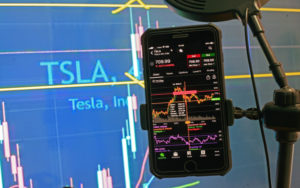

Elon Musk says money will “disappear” as AI and robotics make work optional, a sweeping claim that lands just as Tesla concentrates its future on robotaxis and humanoid robots. “In a future where anyone can have anything, you no longer need money as a database for labor allocation,” he said on the People by WTF podcast. The vision is provocative. The investment takeaway is simpler: Tesla is wagering that software, autonomy and robots will matter far more than vehicles, and that investors will fund that bet now for cash flows that show up much later.
Musk’s end-of-money thesis arrives months after Tesla shareholders approved a massive, decade-long compensation framework designed to keep him locked into an AI-first roadmap. The company’s board set targets that would push Tesla toward the world’s most valuable tier if achieved, with milestones including a $2 trillion valuation and 20 million vehicles over time, while elevating AI-led businesses like a robotaxi network and the Optimus humanoid robot from slideware to revenue. More than 75% of shareholders backed that direction at the annual meeting, despite ongoing debate about autonomy timelines and execution risk. Musk’s argument is that wages are a proxy for scarcity, and in a world where robots can build homes, harvest food, and teach your kids at near-zero marginal cost, scarcity—and the wages that price it—evaporate. Investors are deciding whether the stock already prices that future.
Tesla has reframed itself around the thesis that autonomy and robotics will be its highest-margin growth engines, outpacing hardware. The company is investing in proprietary models, large-scale training infrastructure and a fleet-learning advantage that it argues is hard to replicate. Robotaxis, if cleared and scaled, could convert Tesla from a cyclical automaker into a software-take-rate platform, with economics that look more like a network than a manufacturer. Optimus, the humanoid robot, is pitched as labor-as-a-service for factories and logistics before moving into broader markets. This is the bridge between Musk’s post-money rhetoric and the product pipeline: if the cost of physical work trends toward zero, pricing power shifts to compute, power and data. That is a radical margin mix shift, and it is why Musk keeps pushing the narrative that work becomes optional in 10 to 20 years.
Musk’s logic is straightforward: if AI and robots can do most work, wages become an outdated way to allocate goods and services. He cited Iain M. Banks’s Culture novels as a blueprint—abundance makes cash redundant. In markets, the friction is less philosophical and more practical. Even in an abundant world, scarce assets exist: prime real estate, high-quality energy, compute capacity, regulatory approvals, and human attention. Money persists as a rationing mechanism when scarcity persists. If Tesla’s robots and autonomy systems drive costs down, value may consolidate in the chokepoints—chips, power and platforms. That suggests winners would be the companies controlling foundation models, silicon, and distribution. Musk’s case for Tesla is that it will straddle all three with a live fleet to collect data, its own training stack, and a consumer base ready to convert. If he’s wrong, the margin pool accrues elsewhere.
The biggest debate is not whether AI will reshape labor markets—it already is—but when and who monetizes it. Musk has repeatedly shortened the runway, saying work could be optional within 10 to 15 years. Investors have heard timelines before on Full Self-Driving. Regulatory clearance, safety thresholds and public acceptance remain gating factors for robotaxis. Inside Tesla, the pivot has brought turnover alongside ambition, including departures tied to battery leadership and the Optimus program, even as the company leans harder into AI. Building millions of humanoid robots is a supply chain, manufacturing and field-support problem on top of a software problem. Scaling a global ride-hailing network requires not just code, but insurers, regulators and cities on board. That gap between demo and deployment is where Musk’s post-money thesis either builds credibility—or becomes another deferred milestone.
Markets have a long memory for technology promises. In 1930, John Maynard Keynes predicted 15-hour workweeks by 2030. Productivity surged. Leisure did not. Economists like Ioana Marinescu argue that automation has repeatedly hit diminishing returns and re-sorted labor, rather than erased it entirely. The counterpoint today is speed: Bill Gates and OpenAI’s Sam Altman are among those publicly worried about how quickly frontier models are improving. If acceleration holds, displacement could be faster and broader than prior waves. But even fast curves meet bottlenecks—data quality, compute costs, safety, liability. For Tesla, that means investors will want evidence of safer-than-human autonomy at scale, unit economics for robotaxis that clear regulatory and insurance hurdles, and robots doing useful work outside carefully staged demos. Until then, lofty narratives about money’s obsolescence remain a risk factor, not a forecast.
Vinod Khosla, a longtime tech investor, has pushed the debate toward concrete policy choices. If AI outperforms humans at most jobs, he argues, governments must manage wealth distribution to avoid economic dystopia. He favors a universal basic income that preserves demand as paid labor shrinks. Without intervention, the risk is a thinner wage ladder, rapidly rising asset concentration and social instability. That framing matters for Tesla’s narrative. If money “disappears,” the process will run through tax codes, transfer systems and safety nets long before it runs through sci-fi utopias. For investors, the policy arc matters as much as the product roadmap: UBI pilots, labor market reforms, and AI safety rules could decide the slope of adoption and the shape of margins across autonomy, logistics and consumer robotics.
If wages are on the way out, the market has an odd way of showing it. Compensation for top AI talent has spiked, with technical staff at leading labs and startups landing packages that approach the upper six figures to low seven figures. That is the opposite of wage irrelevance; it is scarcity priced in plain sight—of compute, data and people who can bend them to outcomes. Anthropic’s Avital Balwit has warned that many jobs, including her own, could go obsolete in just a few years, and even floated the notion that a million two-legged robots could be working within a decade. The message for investors: in the short run, salaries are a leading indicator of where value accrues. If Tesla can hire and retain the people who ship safe autonomy and useful humanoids, the equity case strengthens. If talent gaps widen or timelines slip, the stock will have to re-rate to the slower lane.
Musk’s claim that money will disappear is a headline. Tesla’s checkpoints are more prosaic. Look for a dated launch plan for commercial robotaxis in multiple cities with regulator sign-off, credible safety stats versus human drivers, and a path to insurance and liability coverage. Watch Optimus move from factory pilot to measurable hours displacing human labor, with unit costs disclosed and service contracts signed. Track disclosure on AI capex, training infrastructure and power procurement, because compute and energy are the tollbooths of this cycle. Shareholder support for Musk’s compensation package bought time; execution will decide whether optionality becomes cash flow. Until then, the market will treat post-money futurism as marketing. Tesla’s stock will trade on visible autonomy progress, robot labor doing real work, and whether the company can turn sci-fi into gross margin.