

District Metals Corp. (TSXV:V.DMX. Nasdaq: DMXSE SDB)
Advancing the Largest Undeveloped Uranium Deposit in the World
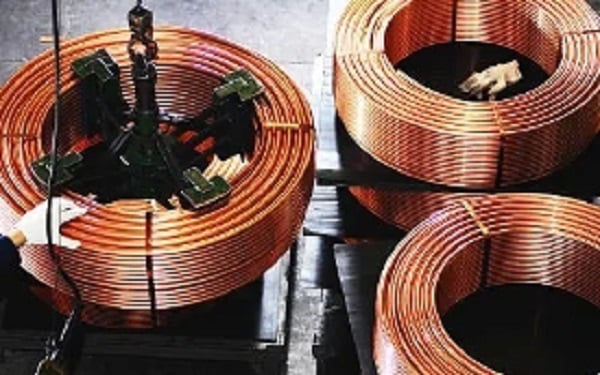
In the final week of 2025, the copper market experienced dramatic divergence on Monday: the London Metal Exchange (LME) copper price surged by as much as 6.6% intraday, approaching the $13,000 per tonne mark, marking its largest single-day gain since 2022.
Meanwhile, New York COMEX copper futures unexpectedly plummeted by 6%, completely erasing the previous day’s gains. By the close, LME three-month copper settled approximately 1.6% higher, while the COMEX front-month March contract retreated to $5.56 per pound (equivalent to about $12,260 per tonne). Despite this, copper still posted a staggering annual gain of approximately 35% for the year, its largest since 2009, cementing its status as one of the commodity market’s brightest stars in 2025.
Today’s market divergence profoundly reveals the contradictory dynamics within the current copper market. The surge in London reflects concerns over long-term structural shortages, while the plunge in New York can be partly attributed to technical adjustments and short-term profit-taking—the impact of the Chicago Mercantile Exchange’s (CME) earlier increase in margin requirements continues to linger. This volatility precisely underscores that copper prices are at a juncture where “short-term speculative sentiment” and “long-term fundamentals” are fiercely contending.
Looking back at 2025, the surge in copper prices was driven by a triple engine:
Historic Supply Disruptions: Major operational crises struck multiple critical mines worldwide. Freeport-McMoRan’s Grasberg copper mine in Indonesia (the world’s second-largest) declared force majeure following a fatal accident, with full production not expected until 2027; Ivanhoe’s Kamoa-Kakula mine in the Democratic Republic of Congo (poised to become the world’s third-largest) was hit by flooding; and Codelco’s El Teniente mine in Chile experienced a rock blast. Institutional calculations indicate that actual supply disruptions in 2025 far exceeded expectations, with several top producers failing to meet output targets.
“Trump Tariff” Induced Stockpiling Rush: Speculation about potential US import tariffs on copper prompted US buyers to engage in large-scale, anticipatory stockpiling, disrupting global trade flows. JPMorgan Chase noted that this “front-loading of shipments” behavior consistently supported prices throughout 2025, even as demand in China showed signs of softening.
Strengthened Green Transition Demand Narrative: The combined forces of artificial intelligence data centers, widespread electric vehicle adoption, and global grid upgrades have forged a long-term optimistic outlook for copper demand. A Goldman Sachs report points out that power grids and electricity infrastructure will contribute to 60% of copper demand growth through 2030, while BloombergNEF forecasts that data centers alone could drive annual copper demand to a significant 572,000 tonnes by 2028.
Looking ahead to 2026, can copper replicate silver’s epic near-150% surge in 2025? Analysis suggests that copper is more likely to experience a “structural bull market” characterized by heightened volatility but an overall upward trend, rather than a purely speculation-driven explosion. Key supports include:
Supply Constraints Difficult to Alleviate Rapidly: The mine development cycle from investment to production often exceeds a decade. The currently weak project pipeline suggests limited new supply in 2026-2027. BloombergNEF predicts that copper demand linked to the energy transition could triple by 2045, with the market potentially entering a deficit as early as 2026. Without substantial investment in new mines and recycling, the shortage could reach as high as 19 million tonnes by 2050.
More Solid Demand Foundation: Compared to silver, copper has a higher proportion of industrial demand (over 60%). Its demand is deeply intertwined with global GDP growth and the electrification process, giving it a broader and more rigid foundation. The green infrastructure competition among major global economies provides copper with a demand growth story poised to last for decades.
Enhanced Financial Attributes and Strategic Status: Against a backdrop of geopolitical turmoil and de-globalization, copper’s strategic value as a critical mineral is becoming increasingly prominent, attracting more institutional investors and sovereign wealth funds to include it in long-term asset allocations.
However, the path ahead for copper prices is not without obstacles. Once the threat of US tariffs diminishes or trade flows normalize, the currently hoarded “invisible inventories” could flood the market, triggering price corrections. Simultaneously, if major global economies fall into a deep recession, a short-term contraction in industrial demand would test price resilience. On the policy front, the specifics of US trade policy implementation remain the biggest variable affecting short-term market sentiment.
In summary, the drivers for the copper market in 2026 share similarities with those for the silver market in 2025 but also have fundamental differences. Both benefit from the green transition, supply tightness, and enhanced financial attributes. However, copper’s bull run is more driven by long-term structural gaps and broad-based industrial demand, potentially giving it a more solid foundation than silver. Its volatility might be lower than silver’s in 2025, but its sustainability could be stronger.
For investors, copper’s journey in 2026 may not be as “thrilling” as silver’s was in 2025. Yet, its strategic status as “the new oil” and its indispensable role in the global energy transition herald the dawn of a new cycle—one that may last longer and trend upward through volatility. The market’s test will lie in identifying the true trajectory of value amidst short-term policy disturbances and long-term certainties.