

SLAM Exploration Ltd. (TSXV: SXL)
‘Exploring for critical elements and precious metals in New Brunswick, Canada.’
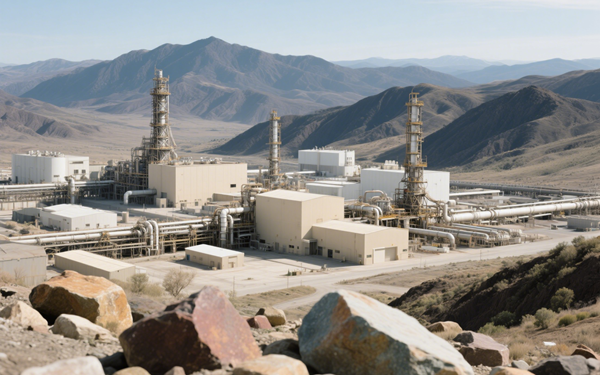
The U.S. House of Representatives has approved the bipartisan DOMINANCE Act on Monday, advancing Washington’s push to strengthen national energy security, cut reliance on external critical mineral supplies and build more resilient supply networks together with allied nations.
Short for the Developing Overseas Mineral Investments and New Allied Networks for Critical Energies Act, the legislation was co-sponsored by California Representatives Ami Bera and Young Kim. Critical minerals serve as fundamental materials for America’s defense industrial base, advanced manufacturing and emerging technologies. The concentrated global rare earth processing capacity has long exposed the U.S. and its allies to notable strategic risks, which has driven Congress to roll out the new legislative initiative.
The DOMINANCE Act lays out a full set of measures to fix supply chain vulnerabilities. It calls for deeper collaboration with allies and partner economies, scaled-up investments in strategic minerals and energy sectors, and enhanced energy diplomacy. The bill also prioritizes workforce development and professional training to support the construction of diversified, secure and robust critical mineral supply chains.
“This is not a partisan issue — securing steady access to critical minerals is a national priority for all Americans,” Bera stated in a press release. He noted that roughly 90% of the world’s rare earth processing capacity is currently concentrated in one region, and export controls and economic leverage have created tangible strategic challenges for the United States.
While expanding domestic mining, processing, refining and recycling capabilities remains a long-term solution, industry insiders acknowledge that the U.S. cannot build fully self-reliant supply chains alone. The new law aims to address this gap by ramping up cooperation with trusted partners, mobilizing strategic capital and aligning diplomatic and economic tools to reduce exposure to fragile supply chains.
To ensure effective implementation, the bill mandates the establishment of an Office of Energy Security Pacts within the U.S. State Department. The new body will coordinate efforts across multiple federal agencies, including the Department of Energy, the U.S. International Development Finance Corporation, the Export-Import Bank and the Department of Commerce. It also encourages the development of alternative mineral sources via long-term supply and offtake agreements, and backs vocational training programs for mining workforces in partner countries.
The legislation has garnered broad support from a wide coalition spanning national security, manufacturing, technology, energy and policy communities. Endorsing groups include the National Association of Manufacturers, the Information Technology Industry Council and the Bipartisan Policy Center Action, among others. The National Association of Manufacturers hailed the bill as a vital step toward more resilient supply chains, pointing out that U.S. manufacturers are increasingly dependent on stable critical mineral supplies amid growing risks posed by the existing global supply landscape.
Under U.S. legislative rules, the DOMINANCE Act will now move to the Senate for deliberation. It can only be sent to the President for signature and formal enactment after winning Senate approval.
This latest legislation is part of a broader U.S. strategy targeting critical minerals. Previous moves include executive orders designed to accelerate domestic mineral output through emergency measures, as well as direct government investments in companies along the critical minerals value chain. The House passage of the DOMINANCE Act marks another major step in America’s drive to shore up its critical minerals sector and diversify global supply chains.