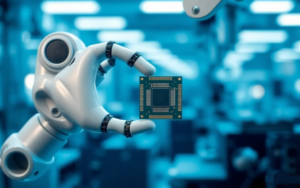
Today’s tape did not wait for nuance. Morgan Stanley spotlighted memory as the new AI bottleneck, and the market sprinted straight into anything tied to high-bandwidth memory, server builds, or AI plumbing. The most active names were the obvious ones: chips, servers, switches, and a speculative AI tag-along. The common thread was simple: if HBM supply is tight, pricing power sits with the winners and everyone else pays up.
The driver: scale and scarcity. Nvidia continues to dictate the AI compute stack while relying on high-bandwidth memory from SK Hynix, Micron, and Samsung for H100 and B100 class accelerators. Shares gained 3.17 percent to 188.94 on 119.887 million shares, landing squarely in the most-active cohort. The company’s march past the 4 trillion and 5 trillion market cap marks in 2025 was not just about chips; it was about controlling the AI bill of materials. Trading profile: deep liquidity, relentless institutional demand, and intraday dip-buying any time the HBM constraint narrative tightens. Key takeaway for investors: the AI leader’s throughput is gated by HBM availability, not desire. Watch supply updates from HBM suppliers and datacenter capex commentary for read-through on shipment cadence and margins. Tight memory keeps Nvidia’s pricing power intact; any credible signal of HBM easing can compress that premium fast.
The driver: share gain hope and more memory. AMD ripped 11.4 percent as investors leaned into MI300 momentum and the idea that multiple suppliers will get a bigger slice of the AI accelerator pie if memory availability scales. The setup looks familiar: AMD’s success is less about absolute performance bragging rights and more about being next in line when HBM3E allocations expand. Trading profile: a double-digit pop with heavy notional turnover, call buyers crowding the near-dated windows as shorts back off in front of new order chatter. Key takeaway for investors: execution equals access. AMD’s upside is tethered to HBM allocations and module yields; when HBM supply tightens, patience is required. If capacity ramps as hinted by vendors, AMD has room to surprise on shipments, but investors should expect volatility as procurement windows open and shut.
The driver: AI server backlog meets raised targets. Dell jumped 9.1 percent after boosting its annual revenue growth target to 7 to 9 percent from 3 to 4 percent, a classic tell that AI server demand is real and building. But getting those racks out the door requires HBM-loaded accelerators and validated networking. Trading profile: big-cap tech with momentum, outsized volume for a hardware OEM, and sensitivity to hyperscaler order timing. Key takeaway for investors: backlog is not revenue until the parts land. Dell’s AI revenue conversion hinges on HBM and GPU deliveries from partners, plus tight integration across networking and cooling. As memory capacity scales, Dell’s invoices print; if HBM stays constrained, expect timing slippage but a stickier order book. The read-through is clean: track HBM supply commentary from SK Hynix, Micron, and Samsung; that is as much a Dell leading indicator as any channel check.
The driver: bandwidth or bust. Arista rose 8.3 percent on steady demand for 400G and 800G switches feeding GPU clusters. It is the less glamorous half of the AI buildout, but you do not get model training without low-latency fabric. As Morgan Stanley framed the memory bottleneck, networking sits right beside it: even if you secure GPUs and HBM, a starved fabric leaves compute idle. Trading profile: high-quality momentum, up on strong volume with buy-side rotation into must-own AI infrastructure. Key takeaway for investors: as hyperscalers normalize cluster design around higher-radix 800G and push toward 1.6T, Arista remains a core vendor leverage point. Watch cloud capex guides, backlogs, and lead-time commentary. If the memory bottleneck eases and GPU shipments accelerate, Arista’s revenue pull-through tends to lag by a quarter but lasts longer as fabrics scale to soak up the new compute footprint.
The driver: sympathy flows and headline gravity. BigBear.ai edged up 1.28 percent on 49.527 million shares, an eye-catching volume print for a small-cap where news attention often outweighs fundamentals. In a session where memory and infrastructure set the tone, anything with an AI label caught bids as traders hunted beta and liquidity. Trading profile: high volatility, heavy churn, and sharp reversals when the AI complex fades intraday. Key takeaway for investors: this is a trading vehicle, not a core proxy on the memory bottleneck. If you are holding BBAI for a networked HBM thesis, you are doing it for the momentum, not the operating leverage. Treat updates on backlog quality, contract wins, and cash burn as the only real anchors; otherwise, size positions like options, not investments.
Memory is the new oil in AI land, and today’s flows acted like everyone just found out the rig count is capped. Nvidia and AMD move when HBM constraints tighten because scarcity props up pricing and pushes customers to prepay for allocation. Down the stack, Dell and Arista monetize the buildout once GPUs and memory actually arrive, creating a staggered revenue wave that can outlast the initial chip surge. For spec names, the trade is exposure to the narrative, not the bottleneck itself.