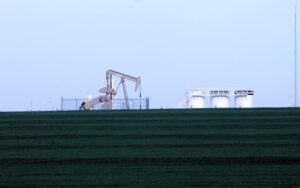
Oil fell hard into Asia hours as a ceasefire between Israel and Iran took the immediate risk of supply disruption off the table. The move came alongside a fresh round of Saudi price cuts to Asia and renewed uncertainty over US-China trade policy, reinforcing a demand-focused market rather than a geopolitics-driven one. Energy shares underperformed, while airlines and transport names rallied on cheaper fuel expectations.
Across Asia’s local-language market coverage, the tone was uniform: the geopolitical premium is bleeding out. Japanese morning briefs captured it succinctly: 中東の緊張緩和で原油先物が続落 (crude futures extend declines as Middle East tensions ease). Chinese financial dailies used the same frame: 地缘风险溢价回吐,油价短线承压 (geopolitical risk premium unwinds; oil under short-term pressure). In Seoul, market commentary read: 중동 긴장 완화에 국제유가 하락세 (international crude downtrend on easing Middle East tensions). Brent traded in the high 60s at the Asia open after sliding more than 3 percent, with some desks flagging further downside if peace prospects hold elsewhere. That matches the broader theme seen over recent weeks as Eastern Europe risk premia also compressed and traders shifted focus to fundamentals.
Stocks followed the script. Energy lagged across the region, with integrated oils and E&P names down as crude retreated and time spreads softened. Japan’s TOPIX Oil and Coal Products subgroup and Korea’s refiners traded lower, while the MSCI Asia Pacific Energy complex underperformed the broader market. By contrast, airlines and logistics outperformed in Tokyo, Seoul, and Mumbai as jet and diesel forward cracks eased. Japan’s full-service carriers and low-cost operators saw bids on expectations of lower fuel surcharges, while Korean Air and Asiana also drew interest. In China and Hong Kong, petrochemical plays were mixed: naphtha-linked names benefited from cheaper feedstock, but margin concerns lingered given weak downstream demand. Sentiment in broader indices held steady to mildly risk-on as lower oil was read as disinflationary for importers.
Riyadh quietly delivered the more important message for Asia. Saudi Aramco cut its Arab Light official selling price to Asia to the lowest in roughly 11 months, a clear signal to refiners that volumes matter and that Riyadh is willing to defend market share. Local buyers read it as tactical and cautious: 价格让步显示对需求端的谨慎 (price concessions signal caution about demand). For China’s teapot refiners in Shandong, cheaper OSPs improve economics but do not erase constraints from import quotas and tepid product demand. State refiners can lift runs into the spring if margins hold, but they are watching domestic inventories and export quotas closely. In India, lower OSPs intersect with continued inflows of discounted Russian grades, giving refiners a wider slate to optimize. For North Asia, especially Japan and Korea, the OSP signal tends to flow through to near-term term-lifting choices and opportunistic spot buying when cracks support it. This is the piece of the oil move that equity traders in Asia actually price: better refining margins now, not theoretical supply fears later.
The ceasefire headline removed a tail risk. That alone justified some of the price reaction, particularly after weeks of elevated freight and insurance premia. But local desks are not ignoring the structural picture. Even as Middle East risk fades, residual constraints in the Red Sea logistics chain and bunker costs are normalizing gradually rather than instantly. Meanwhile, the broader geopolitical premium has been fading as peace prospects in Eastern Europe improve. External desks flagged Brent in the low- to mid-60s on days when trade-policy uncertainty between Washington and Beijing chilled risk appetite. That interplay matters for Asia: US-China policy is now a bigger swing factor for demand expectations than Middle East supply interruptions, at least in the near term. In short, oil is trading like a macro asset again, with positioning and growth expectations in the driver’s seat.
The immediate read-through in Asia is in product cracks and time spreads, not just flat price. Singapore jet and diesel cracks have eased, supporting airlines while pressuring refiners with distillate-heavy yields. Gasoline cracks remain choppy, reflecting uneven mobility data across the region. Time spreads in Brent and Dubai benchmarks have softened, hinting at looser prompt balances. Japanese commentary summed it up: 需給の緩みが見える (a loosening in supply-demand is visible). Chinese traders point to coastal storage levels and the pace of product exports as the next tell: if export quotas rise into spring, that will cap domestic inventory builds but pressure regional product prices. Korean desks are also watching condensate and naphtha dynamics, where a cheaper crude slate can support margins for ethylene producers, though downstream demand in plastics remains fragile.
Company moves are mapping neatly to the new curve. Japanese refiners underperformed as investors questioned the durability of margins after the OSP cut; dividend stability remains the support. Korean refiners and petrochemical names traded defensively, with only selective bids for companies with strong export exposure and feedstock flexibility. Airlines rallied broadly, with Japan’s flag carriers, Korean majors, and select Southeast Asian LCCs catching flows on cheaper fuel. In India, index heavyweights with refining and marketing exposure saw mixed action as investors weighed inventory losses on cheaper crude against healthier marketing margins if pump prices stay steady. China’s state-owned oil majors held up better than pure upstream names given their integrated model and the potential for refining and chemicals tailwinds. Across the region, service and drilling contractors weakened as capex-sensitive sentiment followed the spot curve lower.
Policy remains a swing variable for earnings. In China, refiners are focused on the next tranche of product export quotas and any hints of domestic price band adjustments; 稳供稳价 (stabilize supply and prices) remains the official refrain, which tempers volatility in downstream margins. India’s oil marketing companies continue to straddle policy and profitability, with the possibility of retail price adjustments and tax tweaks influencing marketing margins more than crude swings alone. Japan’s measures to buffer retail fuel costs, including subsidies that have been flexed in recent years, help smooth pass-through to consumers but compress upside for marketers when crude rallies; in a falling market, those buffers unwind more slowly, improving near-term cash flow. None of these levers change the direction of oil today, but they shape the equity winners and losers across Asia over the next quarter.
US-China trade uncertainty is creeping back into Asian commodity conversations. Local analysts tied part of oil’s slide to softer global growth expectations if tariffs or tech restrictions expand. That helps explain why cyclicals outside energy also traded cautiously despite cheaper oil. Within China, the demand story is uneven: industrial fuel demand is stabilizing but not accelerating, while mobility-related consumption has improved from last year’s trough yet lacks the surge that would tighten regional balances. Chinese-language commentary framed it bluntly: 内需恢复不及预期,成品油出口或成边际变量 (domestic demand recovery is below expectations; refined product exports may be the marginal variable). If product exports accelerate into Q2, Asia’s refining margins will lean on OSP discounts and efficient slates rather than strong end demand.
English-language coverage correctly links oil’s drop to easing Middle East tensions, but misses what Asia is actually trading: Saudi OSP cuts, crack spreads in Singapore, export quota mechanics in China, and airlines’ leverage to jet fuel. The risk premium was the catalyst; the earnings drivers are local. For portfolio positioning, that means underweighting Asia upstream beta, being selective in integrated oils with resilient dividend policies, and overweighting airlines and logistics with disciplined capacity plans. Watch Brent-Dubai time spreads and Arab Light OSP differentials more than headlines. If spreads continue to soften and OSPs stay generous, Asia’s refiners and petrochemicals can grind higher even if Brent drifts. The bigger risk to that trade is not a Middle East flare-up, but a trade-policy shock that hits demand and collapses cracks further.