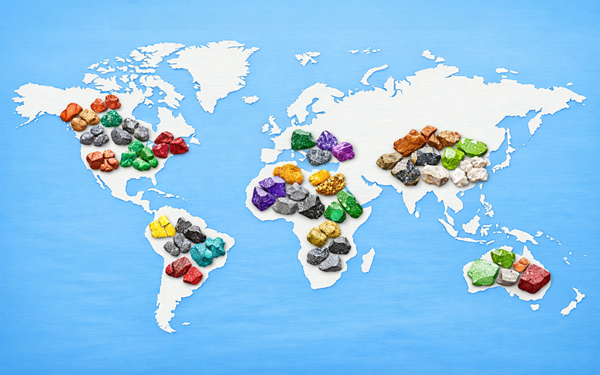
“The international market for critical minerals is not functioning.” U.S. Vice President JD Vance stated bluntly at a ministerial meeting in Washington, DC, convened by Secretary of State Marco Rubio and attended by officials from over 50 nations. The meeting culminated in a strategic announcement: the United States, in coordination with allies including the European Union, Japan, and Mexico, would move to establish a “preferential trade zone” for critical minerals. The goal is to build a “de-risked” strategic supply chain through coordinated minimum pricing and trade policies, a move widely perceived as a key step toward creating a “mineral NATO” in the resource domain.
The logic behind this push is clear. China currently controls approximately 70% of global rare earth mining and 90% of processing capacity. This dominance creates strategic vulnerabilities in high-tech and defense industries essential for everything from electric vehicles and missiles to smartphones. The Trump administration is now seeking to extend the trade war into the realm of resources through a new multilateral framework.
District Metals Corp. (TSXV:V.DMX. Nasdaq: DMXSE SDB) is a polymetallic exploration and development company focused on the Viken and Tomtebo Properties in Sweden. The Viken Property covers 100% of the Viken Energy Metals Deposit, which contains the largest undeveloped mineral resource estimate of uranium in the world along with significant mineral resource estimates of vanadium, molybdenum, nickel, copper, zinc, and other important and critical raw materials.
The American strategy advances on two systematic tracks. On the front of rules and mechanisms, the U.S., EU, and Japan announced plans to sign a memorandum of understanding within 30 days to develop a “Critical Minerals Supply Chain Resilience Action Plan,” aiming ultimately for a binding multilateral agreement. A core proposed tool is a “border-adjusted price floor,” using tariffs to maintain a minimum price, ostensibly to counter what U.S. officials describe as a pattern of cheap exports followed by monopolistic price hikes. Simultaneously, the U.S. and Mexico unveiled a 60-day bilateral action plan to identify specific mining and processing projects, extending cooperation to third countries. Notably, Canada, a member of the US-Mexico-Canada Agreement (USMCA), was absent from this core coalition, highlighting the pragmatic nature of Washington’s strategy.
On the front of physical reserves and capital mobilization, action is equally swift. President Trump recently launched “Project Vault,” a plan to build a strategic stockpile of critical minerals valued at nearly $12 billion, financed through loans from the U.S. Export-Import Bank and private capital. The Senate is moving to support the agenda with legislation that would grant the bank an additional $70 billion in lending authority. These moves indicate an effort to build defenses by simultaneously reshaping market rules and bolstering physical inventories.
Implementing this strategy requires a global reconfiguration of resources, and America’s chessboard is already in motion. In resource-rich Africa, cobalt, copper, and zinc concentrates from the Democratic Republic of Congo are a key focus. Mining giants like Ivanhoe Mines and Glencore are in talks with U.S.-backed consortia to channel output into the American stockpile system. In traditional ally Australia, nearly 80 critical mineral projects are seeking international financing, with the U.S. Export-Import Bank having issued a letter of interest for a key scandium project. Across the Americas, Canada has reached a co-investment agreement with the U.S. Department of Defense, while Argentina has signed a bilateral critical minerals pact.
However, this seemingly ambitious alliance is far from monolithic. Denmark, which oversees resource-rich Greenland, did not attend the meeting, a reflection of longstanding wariness over U.S. interest in acquiring the Arctic island. Furthermore, the Trump administration’s frequent use of “tariff weapons” and sharp rhetoric against allies continues to erode the trust necessary for sustained international cooperation.
The most formidable challenge may be rooted in economic fundamentals. “It’s standard behavior. If I can cheat and get away with it, I will,” noted an expert from the Colorado School of Mines, pinpointing the core dilemma: how to effectively prevent member countries from clandestinely purchasing cheaper Chinese products. While the U.S. Department of Defense might enforce sourcing rules for defense contractors, its control over the vast civilian manufacturing supply chains, such as for electric vehicles, is significantly weaker. Beijing has responded unequivocally. A Chinese foreign ministry spokesperson stated, “We oppose any country undermining the international economic and trade order through rules set by small cliques.” China’s dominance in global critical mineral processing, built over decades and backed by integrated supply chains and economies of scale, presents a cost advantage difficult to supplant in the short term.
Analysts suggest this U.S. initiative marks a new phase in global resource competition, elevating it from corporate supply chain management to a contest of rule-setting and strategic stockpiling among state alliances. Its success will depend not only on political will and capital investment but also on the ability to overcome internal friction, establish sustainable market incentives, and ultimately withstand the long-term tests posed by market forces and geopolitical complexity. Resources, the ancient chessboard of great-power rivalry, are being infused with new variables from the contest for technological supremacy. Whether America’s “mineral NATO” can function effectively will profoundly shape the global industrial landscape and balance of power for the next decade.