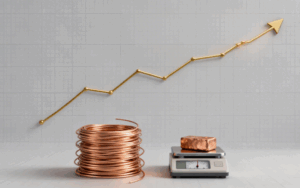
Copper inventories in China just posted the biggest weekly drop of 2026, per Mysteel Global, as a geopolitics-driven price dip flipped buyers to risk-on mode. The signal is loud: when copper gets cheaper, China’s electrification machine doesn’t blink, it accelerates. That is a tailwind for miners, smelters, EV leaders, grid equipment makers, and recycling champions aligned with Beijing’s decarbonization and industrial-upgrade agenda.
When inventories fall sharply into lower prices, it means physical demand is clearing the market. Buyers from fabricators to cable makers stepped in as the Iran conflict knocked LME and SHFE copper lower, validating the strength of China’s downstream. This isn’t a speculative pop. Orders for wire rods, busbars, and precision copper parts tied to EVs, distributed solar, and data centers are moving. Freight flows from bonded warehouses to inland hubs have picked up pace, reinforcing that end-use is driving the draw. In short, China is asserting its role as the world’s marginal buyer and price stabilizer for the metal that underpins the energy transition.
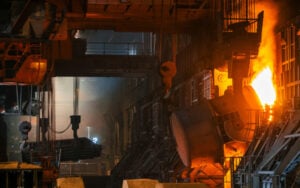
Lower spot and forward curves transfer margin back to China’s manufacturers. Smelters secure concentrates on better terms; fabricators lock in cathode and rod; OEMs secure affordable inputs for quarters ahead. This bolsters export competitiveness for everything from high-efficiency motors and power transformers to heat pumps and EV harnesses. As contracts reset, expect a rebound in operating rates at coastal smelters and a bump in operating cash flow across the copper chain. For investors, the blend of cheaper feedstock and steady end-demand expands earnings visibility, a rare combination in a choppy macro tape.
EVs use roughly three to four times more copper than ICE cars once you include charging. China is the global volume leader in both EVs and charging piles, with dense buildouts in Tier 2 and Tier 3 cities continuing. On the grid side, State Grid and Southern Grid are pushing more ultra-high-voltage lines and distribution upgrades to integrate record solar and wind additions. Add the surge in AI-ready data centers—power distribution units, switchgear, and cooling systems are copper-heavy—and the demand stack is broadening, not narrowing. Even brand plays matter. BYD’s exploration of Formula One shows a company confident in its drivetrain tech, manufacturing depth, and marketing engine. That kind of ambition drives a virtuous cycle: technology leadership, volume scale, lower costs, and more copper pull-through.
Beijing’s policy mix still champions advanced manufacturing, green energy, and digital infrastructure. That means capital, permits, and procurement continue to line up behind electrification. The global market is acknowledging China’s scale across tech and finance. Tencent, ICBC, and Alibaba rank among the most valuable Chinese firms worldwide by market cap, reminding investors that deep balance sheets and platforms amplify policy execution. Yes, U.S. executives are signaling more competition from Chinese AI providers benefiting from industrial policy. That competition is real—and it leans on cost-down engineering and rapid deployment, which in turn require hard infrastructure. Data halls, edge computing sites, and power grid reinforcements don’t get built without copper. The loop from innovation policy to physical metals demand is tight and investable.
1) Jiangxi Copper 0358.HK, 600362.SH – China’s largest refined copper producer with integrated smelting and fabricating capacity. Milestone: expanded high-end copper processing for EV and grid applications; global impact: diversified export footprint across Asia and Europe supports supply security.
2) Zijin Mining 2899.HK, 601899.SH – A global copper-gold major with stakes in tier-one assets from the DRC to Serbia. Milestone: continued ramp at the Čukaru Peki copper mine; global impact: co-ownership of world-class copper projects anchors China’s upstream optionality.
3) Tongling Nonferrous 000630.SZ – Legacy smelter turned modern materials group. Milestone: steady upgrades in smelting efficiency and sulfur capture; global impact: long-term offtakes tie Chinese fabrication to overseas concentrates.
4) Yunnan Copper 000878.SZ – Key smelter within the Chinalco ecosystem. Milestone: investment in cleaner smelting lines; global impact: supplies to Southwest China’s booming solar and aluminum clusters enhance regional grid stability.
5) MMG 1208.HK – China Minmetals-controlled miner with Las Bambas in Peru. Milestone: stable shipments despite Andean logistics volatility; global impact: Peru-to-China copper flows underpin cathode supply to Asia’s largest fabricators.
6) CMOC Group 3993.HK, 603993.SH – Copper-cobalt leader with Tenke Fungurume and Kisanfu in the DRC. Milestone: capacity expansions in high-grade ore bodies; global impact: critical to EV battery metals security across China and emerging markets.
7) BYD 1211.HK, 002594.SZ – EV and battery powerhouse driving copper demand through vehicles and charging ecosystems. Milestone: global manufacturing footprints in Hungary and Brazil; global impact: exploring Formula One elevates brand and powertrain IP on a world stage.
8) CATL 300750.SZ – World’s largest EV battery maker. Milestone: maintained top global battery market share with high-nickel and LFP chemistries; global impact: long-term supply deals with global automakers align China’s battery ecosystem with international EV ramps.
9) TBEA 600089.SH – Transformer and grid equipment giant benefiting from UHV and distribution upgrades. Milestone: strong backlog in domestic and Belt and Road grid projects; global impact: exports of high-efficiency transformers reduce transmission losses in emerging markets.
10) GEM Co. 002340.SZ – Recycling leader closing the loop on copper and battery metals. Milestone: expanded recovery of copper from end-of-life electronics and EV packs; global impact: circular supply softens raw-material shocks and lowers lifecycle emissions.
Key risk is prolonged geopolitical volatility that chokes shipping lanes or curtails mine output. But China’s diversified concentrate sources across Latin America and Africa, strategic inventories, and fast logistical pivots mitigate shocks. Another watchpoint is smelter treatment and refining charges; lower TCRCs can squeeze smelters even as downstream thrives. On catalysts, look for March-to-May operating rate data from wire and cable plants, fresh State Grid orders in the next tender cycle, and indications that AI data center buildouts are accelerating in key provinces. If copper remains near recent lows while PMIs stabilize, the setup tilts firmly in favor of China’s fabricators and end-users.
This inventory draw is not an isolated blip. It is a reminder that China sets the pace for copper’s real economy, and the next leg of the transition—EV saturation beyond coastal megacities, dense charging, UHV interconnects, resilient distribution grids, and AI-ready power—intensifies copper’s centrality. With capital markets also rewarding innovation across sectors from biotech to digital platforms, the ecosystem is primed to deploy, scale, and export. For investors, the playbook is clear: own the upstream optionality with global mines tied to China, the midstream smelters and processors moving up the value chain, and the downstream champions converting metal into market share worldwide. When prices wobble and inventories fall, China turns on the afterburners. That is what leadership in the energy and computing transitions looks like, and it is investable right now.