
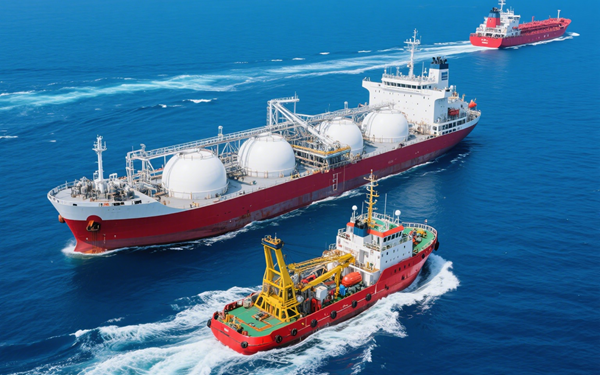
Against a backdrop of geopolitical upheaval reshaping global energy markets, a strategic window is opening for Canada. Escalating tensions in the Middle East have disrupted liquefied natural gas (LNG) supply chains, offering Canadian natural gas—long overlooked—a long-awaited chance to take center stage. At the heart of this shift is Calgary-based ARC Resources Ltd. (TSX:ARX), which is quickly emerging as a key name to watch.
Recent developments in Iran have taken a significant toll on global LNG supply. Qatar’s Ras Laffan Industrial City, a key production hub, sustained damage from recent strikes. The country’s state-owned energy giant, QatarEnergy, has confirmed that repairs to the facility will take three to five years, cutting off roughly 20% of the world’s LNG supply and resulting in an estimated US$20 billion in annual lost revenue.
“There’s going to have to be a replacement for LNG,” said Brooke Thackray, research analyst at Global X. “ARC Resources will be able to help fill that later on.” Thackray noted that while market attention has long focused on heavy oil, ARC’s substantial natural gas exposure positions it to capitalize on current dynamics.
The question now is whether Canada can move fast enough to seize the moment. Francois Poirier, CEO of pipeline operator TC Energy Corp., framed the country’s position in stark terms: “If we were playing a hockey game right now, the score would be eight to one.” Fifteen years ago, neither the U.S. nor Canada had LNG export capacity. Today, the U.S. has eight operational facilities—Canada has one.
Poirier warned that global customers won’t wait for regulatory timelines. Despite holding one of the world’s largest natural gas reserves, Canada has struggled with lengthy infrastructure approval processes. To compete, Poirier suggested aiming high: “Let’s be the largest exporter of LNG to Asia.” With Canada’s West Coast offering an eight-day shipping advantage over the U.S. Gulf Coast, he argued that a target of 12 billion cubic feet per day in exports is within reach.
Among Canadian energy producers, ARC Resources stands out as particularly well-positioned. As the country’s largest pure-play Montney producer, with over one million net acres across Alberta and northeastern British Columbia, the company also operates a low-cost infrastructure network that Thackray says gives it a competitive edge.
“What we’re seeing is the emphasis is all about heavy oil, but Arc Resources has a lot of natural gas…so it can take advantage of what’s taking place here,” Thackray said.
The company is already executing on that strategy. Starting next year, ARC plans to direct 25% of its natural gas production to international markets, a move that will help it move away from discounted domestic AECO pricing and capture premium, globally linked prices.
In Q4 2025, ARC reported record production of 408,000 barrels of oil equivalent (boe) per day, while full-year free cash flow nearly doubled to $1.3 billion. The company returned 75% of that to shareholders through buybacks and dividends. Management expects free cash flow of roughly $1.2 billion in 2026, supported by a disciplined capital program of $1.8 billion to $1.9 billion.
CEO Terry Anderson highlighted the company’s operational flexibility during the Q4 earnings call, noting that ARC curtailed nearly 400 million cubic feet per day of natural gas during periods of low prices in 2025—a move that deferred approximately $50 million in capital expenditures while preserving resources for more favorable pricing.
ARC’s capital discipline has supported a consistent track record of shareholder returns. In 2025, the company repurchased nearly 20 million shares for $514 million and paid $452 million in dividends, marking the fifth consecutive year of dividend growth with an 11% increase.
CFO Crystal Bibby outlined the company’s approach for the coming year: “We plan to continue to return essentially all free funds flow to shareholders in 2026…through a combination of a growing base dividend and share buybacks.”
Looking ahead, the company is set to reach a key inflection point in 2027, when it begins shipping natural gas to international markets through Gulf Coast LNG facilities. The move is expected to provide structural margin improvements that analysts say are not yet reflected in the current valuation.
With more than 30 years of Montney inventory, net debt of $2.9 billion—less than one times free cash flow—and a conservative financial framework, ARC has built a stable foundation for long-term growth.
Consensus estimates project free cash flow rising from $1.1 billion in 2026 to $1.51 billion in 2028, with the annual dividend expected to increase from $0.84 to $0.92 per share. At a forward yield of approximately 3.7%, the stock trades at a 33% discount to consensus estimates. Including dividends, cumulative total returns could approach 36%.
As global LNG supply maps are redrawn by conflict and shifting demand, Canada’s window of opportunity has opened. For ARC Resources, the question now is whether it can evolve from a regional producer into a key player on the global LNG stage—and capture the valuation that comes with it.