
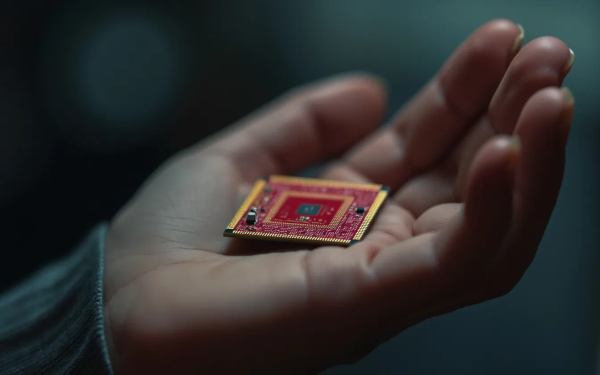
While much of the market’s attention remains fixed on Nvidia and its dominance in AI chip design, a deeper industry reality often goes overlooked. No matter how advanced an AI chip’s architecture may be, it still has to be physically manufactured. And in that domain, a company that designs no chips at all holds the critical bottleneck for the global AI industry: Taiwan Semiconductor Manufacturing Co. (TSMC, TSM).
As of the third quarter of 2025, TSMC controlled 72% of the global pure-play semiconductor foundry market. Its closest competitor, Samsung Electronics, held just 7%. This is not simply a lead — it is total dominance.
Even more striking is TSMC’s grip on advanced process technologies, which determine the ceiling for AI computing power. The company produces 90% of the world’s most advanced semiconductors. That means whether it is Nvidia’s flagship AI accelerators, AMD’s server processors, or Apple’s next-generation mobile chips, the physical path to production almost inevitably runs through TSMC’s fabs.
TSMC has long remained a “hidden champion” because of its pure-play business model. It does not design chips and does not compete with its customers. Instead, it provides the manufacturing foundation that the world’s leading chip designers cannot bypass. That unique positioning has given it a client list that includes Nvidia, Apple, AMD, Broadcom, Qualcomm, Intel and virtually every other major name in the industry.
But this near-monopoly was not an accident — it was built on an extraordinary capital barrier.
The core equipment required to manufacture advanced semiconductors — extreme ultraviolet (EUV) lithography machines — costs nearly $500 million per unit. Building a leading-edge fab requires a staggering level of investment. TSMC’s facility in Arizona initially carried a price tag of $12 billion. That figure has since swelled to $165 billion as the company expanded the project from one fab to three.
By comparison, Intel, aiming to claw back market share, has committed $100 billion to a manufacturing hub in Ohio. But the project has faced repeated delays, with the first plant now not expected to be completed until 2030. By that time, TSMC’s Arizona expansion is slated to be fully operational, with its second fab scheduled for 2028 and its third by the end of the decade. For any would-be competitor, the combination of time and capital required to catch up is simply prohibitive.
With its grip on the manufacturing backbone of AI and high-end computing, TSMC’s financial performance reflects the value of its market position.
In 2025, the company reported revenue of $122.4 billion, up 35.9% from the previous year, while diluted earnings per share (EPS) grew 46.4%. Even for a capital-intensive semiconductor manufacturer, TSMC delivered a net profit margin of 45% — a level rarely seen outside of businesses with monopoly-like pricing power.
Looking ahead, growth shows no sign of slowing. The company expects revenue to increase another 30% in 2026 and forecasts a compound annual growth rate (CAGR) of 25% from 2025 through 2029. The insatiable demand for AI computing power continues to translate into a steady stream of orders filling TSMC’s fabs.
Nvidia defines the architecture of AI, but TSMC defines its physical limits. In an industrial revolution where computing power is the currency, the company that never designs chips and consistently stays out of the spotlight holds the only supply choke point that matters. As the world’s biggest tech players race toward the AI frontier, TSMC is the vessel carrying them all — and it is collecting the rewards of a shipowner in a sea of high demand.