What breaks first when the price of energy jumps: supply, demand, or the stories we tell about both? The International Energy Agency says global oil demand will fall this year for the first time since 2020, not because the world suddenly forgot how to grow, but because price is doing what war and policy often cannot. The Iran conflict has exposed a brittle system built on single-point dependencies, thin buffers, and investor habits trained by a decade of cheap volatility.
The IEA’s call is blunt: the war-driven price shock has erased this year’s oil demand growth. Brent above 100 dollars did the heavy lifting. The agency has also described today’s disruption as the biggest on record for global oil supply. That is not just a data point. It is a reminder that efficiency and optimization, prized in boardrooms, can be liabilities under stress. Oil supply chains that once looked like robust networks now resemble tightrope acts. Most energy models assume incremental change and smooth substitution. Reality often arrives as a step function. High prices do not linearly reduce consumption; they change behavior in lurches, shut marginal activities, and expose balance sheets built on stable input costs.
Roughly a fifth of global oil shipments typically pass through the Strait of Hormuz. Choke it, and the market’s vaunted flexibility becomes a line of tankers with nowhere to go. A system that routes 20 percent of throughput through a narrow channel is not diversified; it is a bridge hung on a single cable. Every modern commodity slide deck mentions supply diversification, yet the map has not meaningfully changed. Game theory helps here: a small set of actors can impose large costs by threatening a shared bottleneck. The expected value of disruption has long been underpriced because the probability looked small. But fat tails matter in energy. Tail risks do not require frequent occurrence to dominate outcomes. They need only be credible and hard to hedge.
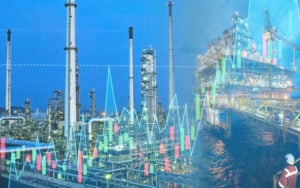
The market response has been textbook and revealing. Options volumes in crude spiked. Implied volatility jumped to the highest levels since 2023. In theory, more options mean more ways to insure. In practice, when dealers hedge and risk managers update their models, liquidity can thin as fast as it appears. Value at Risk targets tighten as volatility rises, forcing position cuts that chase the market. Hedging becomes procyclical. The result is a pressure vessel dynamic: the very tools designed to absorb shocks can amplify them when too many rely on the same triggers. Investors trained to buy the dip discover they have been harvesting pennies in front of a blowout preventer. Liquidity is plentiful until it is only available at prices that no longer resemble yesterday’s valuation math.
The OECD has cut its global growth outlook. The IMF warns of a stagflationary hit: higher inflation with slower output, especially for oil importers. The arithmetic is bleak. Energy price pass-through lifts headline inflation. Central banks face a credibility test: ease too early, and inflation expectations risk drifting up; tighten into a supply shock, and the real economy takes another leg down. Fiscal cushions help households but complicate the signal. Subsidies suppress price feedback, delaying the demand adjustment that actually clears markets. Price caps can cap supply, not just costs. When policy tries to freeze a moving target, Goodhart’s law often wins. The metric becomes the goal, behavior adapts, and the system grows more fragile as actors bet on official backstops.
Strategic petroleum reserves are bridges, not destinations. Drawdowns can ease prompt tightness, but they are finite and face logistics constraints. Crudes are not interchangeable widgets. Refinery configurations, crude grades, and shipping lanes all matter. Releasing light sweet barrels into a system short of heavier grades solves headlines, not distillation yields. Inventory is a form of time arbitrage. It can smooth, not erase, a structural gap if a major export artery stays impaired. Governments know this, which is why temporary measures multiply during crises. Yet temporary often becomes policy habit. That trade burns resilience. It converts slack and optionality into commitments that are hard to reverse when conditions normalize.
This moment rhymes with 1973 in one way that matters: long stretches of cheap, ample oil encourage structures that cannot handle the opposite. After the first oil shock, energy intensity eventually fell, but only after a hard adjustment across industries and consumer behavior. Today’s economy is more services-heavy and marginally less energy intensive. Yet the system’s interdependencies are tighter. Just-in-time logistics, concentrated refining hubs, and a financial layer that prices the world in one benchmark deepen the coupling. Minsky taught that stability begets instability as agents lever to the prevailing calm. In energy, the leverage is behavioral and infrastructural as much as financial. Decades of smooth flows created the assumption that a vital strait would not close, that spare capacity would appear, and that technology would bail out timing.
Another comfortable narrative says a price spike accelerates the transition. It can, but timelines bite. Electric vehicle interest may rise, and renewables deployment can gain policy momentum. Yet both depend on supply chains powered by hydrocarbons, metals constrained by permitting and geopolitics, and grids that cannot be rebuilt overnight. Transition is not a switch; it is a portfolio problem with path dependency. Under stress, capex discipline in oil and gas looks like underinvestment. Meanwhile, transition projects face the same interest rate and materials cost headwinds. Price signals work, but with lag and friction. Betting on a smooth handoff from crude to electrons while critical routes are contested is theory fighting the map.
Antifragility in energy is not clever forecasting. It is redundancy, optionality, and small, frequent stress that reveals weak points before they fail big. That means alternative routes and more storage where it is economic, yes, but also contractual flexibility, modular infrastructure, and demand-side responsiveness that can throttle without breaking. It means paying for slack that looks inefficient on a slide but buys survival when a chokepoint closes. It means recognizing that the cheapest barrel in calm can be the most expensive exposure in a shock. The inversion is simple: optimize for robustness, not for the last cent of margin. Portfolios and policies that accept minor underperformance in stable periods tend to keep compounding when others are resetting to zero.
The market narrative will move on from this war headline. Prices will settle, or not. What should not settle is the lesson. Systems fail where they are tightest, not where they are most visible. The IEA’s demand downgrade is a symptom. The cause is a design problem: a world comfortable with thin buffers facing a commodity that punishes comfort. Investors, executives, and policymakers can either treat this as another weather event or as a prompt to rewrite the architecture. The next shock will not wait for their preferred timeline.